IEEE Announces 2023 Winners of Medals, Awards

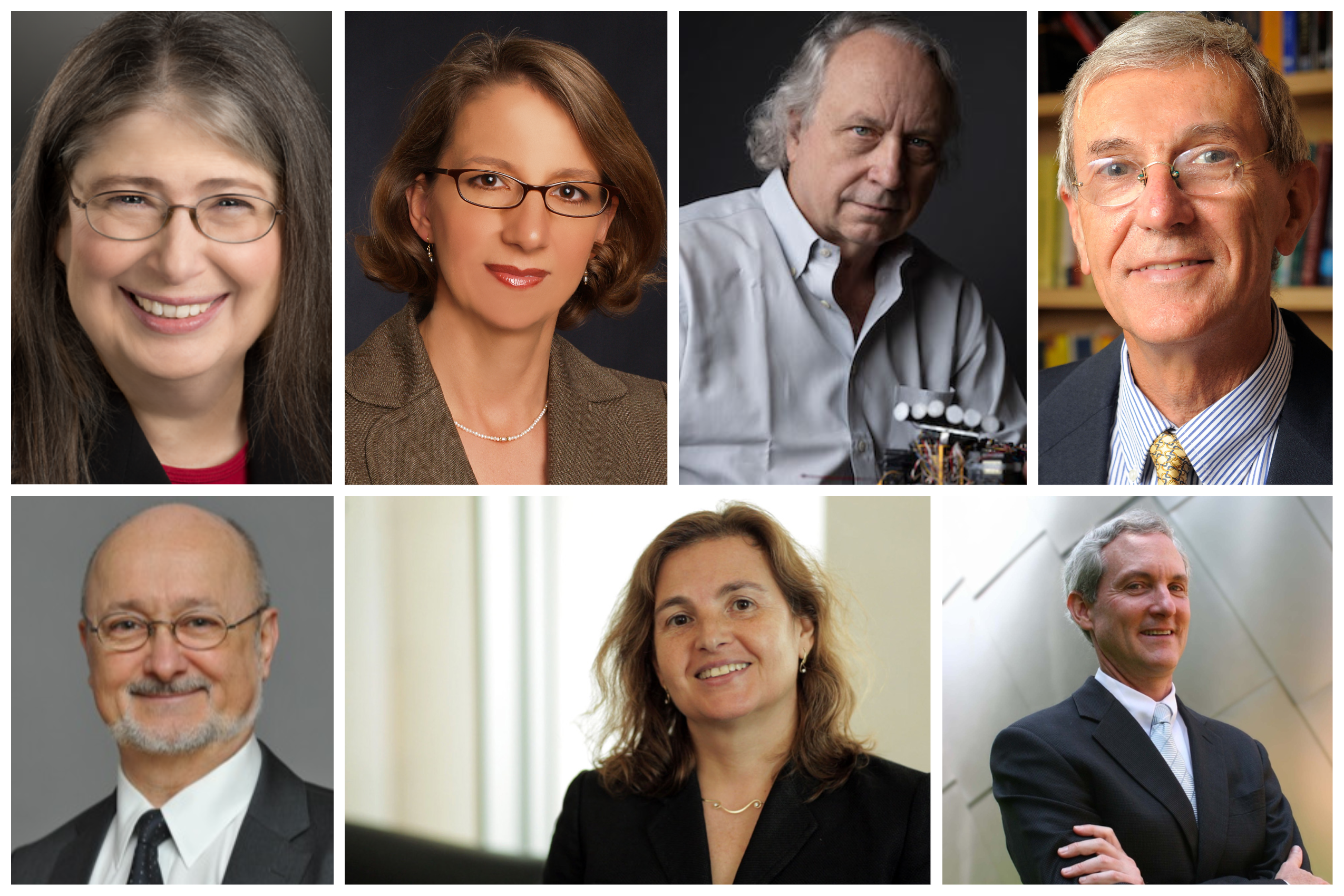
The IEEE recently announced the annual winners of their 2023 medals and technical awards, and MIT faculty and alumni appeared throughout the ranks of honors.

Medals

Faculty

Rodney Brooks, Panasonic Professor of Robotics (Emeritus) of the Department of Electrical Engineering and Computer Science (EECS), was awarded the IEEE Founders Medal “for leadership in research and commercialization of autonomous robotics, including mobile, humanoid, service, and manufacturing robots.” An entrepreneur, Brooks is the CTO and co-founder of Robust AI. Prior to his time at Robust AI, he was Founder, Chairman and CTO of Rethink Robotics, and prior to that, was a Founder, former Board Member and former CTO of iRobot Corp. Dr. Brooks is the former Director of the MIT Artificial Intelligence Laboratory and then the MIT Computer Science & Artificial Intelligence Laboratory (CSAIL). He received degrees in pure mathematics from the Flinders University of South Australia and a Ph.D. in Computer Science from Stanford University in 1981. He held research positions at Carnegie Mellon University and MIT, and a faculty position at Stanford before joining the faculty of MIT in 1984.

Frank Thomson “Tom” Leighton PhD ’81, Professor of Applied Mathematics and a member of CSAIL at MIT, received the 2023 IEEE John von Neumann medal “for fundamental contributions to algorithm design and their application to content delivery networks.” In 1998, Leighton co-founded Akamai Technologies, where he is currently the CEO and a member of the Board of Directors. Leighton is considered an authority on algorithms for network applications, and has published over 100 papers on algorithms, cryptography, parallel architectures, distributed computing, combinatorial optimization, and graph theory. He also holds numerous patents involving content delivery, Internet protocols, algorithms for networks, cryptography, and digital rights management. He shares the Graduate School Council’s 2016 Irwin Sizer Award with Professor Michael Sipser for their development of the 18C major, mathematics with computer science. Leighton received his BSE in electrical engineering and computer science from Princeton in 1978, and his PhD in applied mathematics from MIT in 1981, under the direction of Gary Miller. He joined the MIT Mathematics faculty in 1982, and became professor in 1989.

Alumni

José Manuel Fonseca Moura EE ’73, SM ’73, SCD ’75 (EECS), was awarded the IEEE Jack S. Kilby Signal Processing Medal “for contributions to theory and practice of statistical, graph, and distributed signal processing.” José M. F. Moura is the Philip L. and Marsha Dowd University Professor at Carnegie Mellon University. He is a member of the US National Academy of Engineers, Fellow of the US National Academy of Inventors, a member of the Portugal Academy of Science, an IEEE Fellow, and Fellow of the American Association for the Advancement of Science (AAAS). A detector Moura patented (with coinventor Alek Kavcic) is used in more than 3 billion disk drives (in over 60% of all computers sold worldwide in the last 16 years). The detector was the subject of the then-largest settlement in IT ($750 Million, between CMU and a chip manufacturer). Before coming to MIT, Moura studied Electrical Engineering at the Technical University of Lisbon.

Rebecca Rae Richards-Kortum SM ’87, PhD ’90 (Physics and HST) was awarded the IEEE Medal for Innovations in Healthcare Technology, “for contributions to optical solutions for cancer detection and leadership in establishing the field of global health engineering.” Richards-Kortum is the Malcolm Gillis University Professor, a professor of bioengineering and electrical and computer engineering, and director of the Rice 360: Institute for Global Health Technology at Rice University. Her research and teaching focus is on the development of low-cost, high-performance technologies to provide access to life-saving health technologies that address diseases and conditions that cause high morbidity and mortality, such as cervical and oral cancer, premature birth, sickle cell disease and malaria. She received her bachelor’s in physics and mathematics from the University of Nebraska in 1985, and from MIT, her SM in physics in 1987, and her PhD in medical physics in 1990 from the Harvard-MIT Health Sciences and Technology (HST) program.

Awards

Faculty

Daniela Rus, Director of CSAIL; MIT Schwarzman College of Computing Deputy Dean of Research; and Andrew (1956) and Erna Viterbi Professor within the Department of EECS, was awarded the IEEE Robotics and Automation Award “for pioneering contributions to the design, realization, and theoretical foundations of innovative distributed, networked autonomous systems.” Rus’s research in robotics, artificial intelligence, and data science focuses primarily on developing the science and engineering of autonomy, with the long-term objective of enabling a future where machines are integrated into daily life to support both cognitive and physical tasks. Rus is a Class of 2002 MacArthur Fellow, a fellow of ACM, AAAI and IEEE, and a member of the National Academy of Engineers, and the American Academy of Arts and Sciences. She earned her PhD in Computer Science from Cornell University. Prior to joining MIT, Rus was a professor in the Computer Science Department at Dartmouth College.

Alumni

Radia Perlman ’73, SM ’76, PhD ’88 (Mathematics, EECS), received the IEEE Eric E. Sumner Award “for contributions to Internet routing and bridging protocols.” Currently a Dell EMC Fellow, she is best known for her invention of the algorithm behind STP, the Spanning Tree Protocol, which solved a challenging information routing problem and earned her the moniker “Mother of the Internet.” She is a member of the Internet Hall of Fame, and is widely considered to be one of the pioneers behind the networking revolution. She graduated from MIT with a SB degree in 1973 and an SM in 1976, both in mathematics. She later earned her PhD in computer science from MIT in 1988, advised by CSAIL’s David D. Clark, with her doctoral thesis on routing in environments where malicious network failures are present — which serves as the basis for much of the work that now exists in this area. She also worked at Digital, Novell, Sun Microsystems, and Bolt, Berenek, and Newman (BBN), and has over 100 patents.

Alexander Waibel ’79 (EECS) was awarded the IEEE James L. Flanagan Speech and Audio Processing Award, “for pioneering contributions to spoken language translation and supporting technologies.” Waibel is a Professor of Computer Science at Carnegie Mellon University, and at the Karlsruhe Institute of Technology (Germany) and director of the International Center for Advanced Communication Technologies (interACT). He is known for his work on AI, Machine Learning, Multimodal Interfaces and Speech Translation Systems. Waibel founded more than 10 companies that transferred academic results to practical deployment; including Jibbigo, the first commercial speech translator on a phone (acquired by Facebook 2013); and KITES, the first simultaneous lecture translation service (acquired by Zoom 2021).  Other deployments include dialog translators for humanitarian missions, and interpretation support at the European Parliament. Waibel is a member of the National Academy of Sciences of Germany and a Life Fellow of the IEEE. He received his BS, MS and PhD degrees from MIT and CMU, respectively.

A faster way to preserve privacy online

Searching the internet can reveal information a user would rather keep private. For instance, when someone looks up medical symptoms online, they could reveal their health conditions to Google, an online medical database like WebMD, and perhaps hundreds of these companies’ advertisers and business partners.

For decades, researchers have been crafting techniques that enable users to search for and retrieve information from a database privately, but these methods remain too slow to be effectively used in practice.

MIT researchers have now developed a scheme for private information retrieval that is about 30 times faster than other comparable methods. Their technique enables a user to search an online database without revealing their query to the server. Moreover, it is driven by a simple algorithm that would be easier to implement than the more complicated approaches from previous work.

Their technique could enable private communication by preventing a messaging app from knowing what users are saying or who they are talking to. It could also be used to fetch relevant online ads without advertising servers learning a users’ interests.

“This work is really about giving users back some control over their own data. In the long run, we’d like browsing the web to be as private as browsing a library. This work doesn’t achieve that yet, but it starts building the tools to let us do this sort of thing quickly and efficiently in practice,” says Alexandra Henzinger, a computer science graduate student and lead author of a paper introducing the technique.

Co-authors include Matthew Hong, an MIT computer science graduate student; Henry Corrigan-Gibbs, the Douglas Ross Career Development Professor of Software Technology in the MIT Department of Electrical Engineering and Computer Science (EECS) and a member of the Computer Science and Artificial Intelligence Laboratory (CSAIL); Sarah Meiklejohn, a professor in cryptography and security at University College London and a staff research scientist at Google; and senior author Vinod Vaikuntanathan, an EECS professor and principal investigator in CSAIL. The research will be presented at the 2023 USENIX Security Symposium. 

Preserving privacy

The first schemes for private information retrieval were developed in the 1990s, partly by researchers at MIT. These techniques enable a user to communicate with a remote server that holds a database, and read records from that database without the server knowing what the user is reading.

To preserve privacy, these techniques force the server to touch every single item in the database, so it can’t tell which entry a user is searching for. If one area is left untouched, the server would learn that the client is not interested in that item. But touching every item when there may be millions of database entries slows down the query process.

To speed things up, the MIT researchers developed a protocol, known as Simple PIR, in which the server performs much of the underlying cryptographic work in advance, before a client even sends a query. This preprocessing step produces a data structure that holds compressed information about the database contents, and which the client downloads before sending a query.

In a sense, this data structure is like a hint for the client about what is in the database.

“Once the client has this hint, it can make an unbounded number of queries, and these queries are going to be much smaller in both the size of the messages you are sending and the work that you need the server to do. This is what makes Simple PIR so much faster,” Henzinger explains.

But the hint can be relatively large in size. For example, to query a 1-gigabyte database, the client would need to download a 124-megabyte hint. This drives up communication costs, which could make the technique difficult to implement on real-world devices.

To reduce the size of the hint, the researchers developed a second technique, known as Double PIR, that basically involves running the Simple PIR scheme twice. This produces a much more compact hint that is fixed in size for any database.

Using Double PIR, the hint for a 1 gigabyte database would only be 16 megabytes.

“Our Double PIR scheme runs a little bit slower, but it will have much lower communication costs. For some applications, this is going to be a desirable tradeoff,” Henzinger says.

Hitting the speed limit

They tested the Simple PIR and Double PIR schemes by applying them to a task in which a client seeks to audit a specific piece of information about a website to ensure that website is safe to visit. To preserve privacy, the client cannot reveal the website it is auditing.

The researchers’ fastest technique was able to successfully preserve privacy while running at about 10 gigabytes per second. Previous schemes could only achieve a throughput of about 300 megabytes per second.

They show that their method approaches the theoretical speed limit for private information retrieval — it is nearly the fastest possible scheme one can build in which the server touches every record in the database, adds Corrigan-Gibbs.

In addition, their method only requires a single server, making it much simpler than many top-performing techniques that require two separate servers with identical databases. Their method outperformed these more complex protocols.

“I’ve been thinking about these schemes for some time, and I never thought this could be possible at this speed. The folklore was that any single-server scheme is going to be really slow. This work turns that whole notion on its head,” Corrigan-Gibbs says.

While the researchers have shown that they can make PIR schemes much faster, there is still work to do before they would be able to deploy their techniques in real-world scenarios, says Henzinger. They would like to cut the communication costs of their schemes while still enabling them to achieve high speeds. In addition, they want to adapt their techniques to handle more complex queries, such as general SQL queries, and more demanding applications, such as a general Wikipedia search. And in the long run, they hope to develop better techniques that can preserve privacy without requiring a server to touch every database item. 

“I’ve heard people emphatically claiming that PIR will never be practical. But I would never bet against technology. That is an optimistic lesson to learn from this work. There are always ways to innovate,” Vaikuntanathan says.

“This work makes a major improvement to the practical cost of private information retrieval. While it was known that low-bandwidth PIR schemes imply public-key cryptography, which is typically orders of magnitude slower than private-key cryptography, this work develops an ingenious method to bridge the gap. This is done by making a clever use of special properties of a public-key encryption scheme due to Regev to push the vast majority of the computational work to a precomputation step, in which the server computes a short ‘hint’ about the database,” says Yuval Ishai, a professor of computer science at Technion (the Israel Institute of Technology), who was not involved in the study. “What makes their approach particularly appealing is that the same hint can be used an unlimited number of times, by any number of clients. This renders the (moderate) cost of computing the hint insignificant in a typical scenario where the same database is accessed many times.”

This work is funded, in part, by the National Science Foundation, Google, Facebook, MIT’s Fintech@CSAIL Initiative, an NSF Graduate Research Fellowship, an EECS Great Educators Fellowship, the National Institutes of Health, the Defense Advanced Research Projects Agency, the MIT-IBM Watson AI Lab, Analog Devices, Microsoft, and a Thornton Family Faculty Research Innovation Fellowship.

New device can control light at unprecedented speeds

In a scene from “Star Wars: Episode IV — A New Hope,” R2D2 projects a three-dimensional hologram of Princess Leia making a desperate plea for help. That scene, filmed more than 45 years ago, involved a bit of movie magic — even today, we don’t have the technology to create such realistic and dynamic holograms.

Generating a freestanding 3D hologram would require extremely precise and fast control of light beyond the capabilities of existing technologies, which are based on liquid crystals or micromirrors.

An international group of researchers, led by a team at MIT, spent more than four years tackling this problem of high-speed optical beam forming. They have now demonstrated a programmable, wireless device that can control light, such as by focusing a beam in a specific direction or manipulating the light’s intensity, and do it orders of magnitude more quickly than commercial devices.

They also pioneered a fabrication process that ensures the device quality remains near-perfect when it is manufactured at scale. This would make their device more feasible to implement in real-world settings.

Known as a spatial light modulator, the device could be used to create super-fast lidar (light detection and ranging) sensors for self-driving cars, which could image a scene about a million times faster than existing mechanical systems. It could also accelerate brain scanners, which use light to “see” through tissue. By being able to image tissue faster, the scanners could generate higher-resolution images that aren’t affected by noise from dynamic fluctuations in living tissue, like flowing blood.

“We are focusing on controlling light, which has been a recurring research theme since antiquity. Our development is another major step toward the ultimate goal of complete optical control — in both space and time — for the myriad applications that use light,” says lead author Christopher Panuski PhD ’22, who recently graduated with his PhD in electrical engineering and computer science.

The paper is a collaboration between researchers at MIT; Flexcompute, Inc.; the University of Strathclyde; the State University of New York Polytechnic Institute; Applied Nanotools, Inc.; the Rochester Institute of Technology; and the U.S. Air Force Research Laboratory. The senior author is Dirk Englund, an associate professor of electrical engineering and computer science at MIT and a researcher in the Research Laboratory of Electronics (RLE) and Microsystems Technology Laboratories (MTL). The research is published today in Nature Photonics.

Manipulating light

A spatial light modulator (SLM) is a device that manipulates light by controlling its emission properties. Similar to an overhead projector or computer screen, an SLM transforms a passing beam of light, focusing it in one direction or refracting it to many locations for image formation.

Inside the SLM, a two-dimensional array of optical modulators controls the light. But light wavelengths are only a few hundred nanometers, so to precisely control light at high speeds the device needs an extremely dense array of nanoscale controllers. The researchers used an array of photonic crystal microcavities to achieve this goal. These photonic crystal resonators allow light to be controllably stored, manipulated, and emitted at the wavelength-scale.

When light enters a cavity, it is held for about a nanosecond, bouncing around more than 100,000 times before leaking out into space. While a nanosecond is only one billionth of a second, this is enough time for the device to precisely manipulate the light. By varying the reflectivity of a cavity, the researchers can control how light escapes. Simultaneously controlling the array modulates an entire light field, so the researchers can quickly and precisely steer a beam of light.

“One novel aspect of our device is its engineered radiation pattern. We want the reflected light from each cavity to be a focused beam because that improves the beam-steering performance of the final device. Our process essentially makes an ideal optical antenna,” Panuski says.

To achieve this goal, the researchers developed a new algorithm to design photonic crystal devices that form light into a narrow beam as it escapes each cavity, he explains.

Using light to control light

The team used a micro-LED display to control the SLM. The LED pixels line up with the photonic crystals on the silicon chip, so turning on one LED tunes a single microcavity. When a laser hits that activated microcavity, the cavity responds differently to the laser based on the light from the LED.

“This application of high-speed LED-on-CMOS displays as micro-scale optical pump sources is a perfect example of the benefits of integrated photonic technologies and open collaboration. We have been thrilled to work with the team at MIT on this ambitious project,” says Michael Strain, professor at the Institute of Photonics of the University of Strathclyde.  

The use of LEDs to control the device means the array is not only programmable and reconfigurable, but also completely wireless, Panuski says.

“It is an all-optical control process. Without metal wires, we can place devices closer together without worrying about absorption losses,” he adds.

Figuring out how to fabricate such a complex device in a scalable fashion was a years-long process. The researchers wanted to use the same techniques that create integrated circuits for computers, so the device could be mass produced. But microscopic deviations occur in any fabrication process, and with micron-sized cavities on the chip, those tiny deviations could lead to huge fluctuations in performance.

The researchers partnered with the Air Force Research Laboratory to develop a highly precise mass-manufacturing process that stamps billions of cavities onto a 12-inch silicon wafer. Then they incorporated a postprocessing step to ensure the microcavities all operate at the same wavelength.

“Getting a device architecture that would actually be manufacturable was one of the huge challenges at the outset. I think it only became possible because Chris worked closely for years with Mike Fanto and a wonderful team of engineers and scientists at AFRL, AIM Photonics, and with our other collaborators, and because Chris invented a new technique for machine vision-based holographic trimming,” says Englund.

For this “trimming” process, the researchers shine a laser onto the microcavities. The laser heats the silicon to more than 1,000 degrees Celsius, creating silicon dioxide, or glass. The researchers created a system that blasts all the cavities with the same laser at once, adding a layer of glass that perfectly aligns the resonances — that is, the natural frequencies at which the cavities vibrate.

“After modifying some properties of the fabrication process, we showed that we were able to make world-class devices in a foundry process that had very good uniformity. That is one of the big aspects of this work — figuring out how to make these manufacturable,” Panuski says.

The device demonstrated near-perfect control — in both space and time — of an optical field with a joint “spatiotemporal bandwidth” 10 times greater than that of existing SLMs. Being able to precisely control a huge bandwidth of light could enable devices that can carry massive amounts of information extremely quickly, such as high-performance communications systems.

Now that they have perfected the fabrication process, the researchers are working to make larger devices for quantum control or ultrafast sensing and imaging.

This research was funded, in part, by the Hertz Foundation, the NDSEG Fellowship Program, the Schmidt Postdoctoral Award, the Israeli Vatat Scholarship, the U.S. Army Research Office, the U.S. Air Force Research Laboratory, the UK’s Engineering and Physical Sciences Research Council, and the Royal Academy of Engineering.

The task of magnetic classification suddenly looks easier

Knowing the magnetic structure of crystalline materials is critical to many applications, including data storage, high-resolution imaging, spintronics, superconductivity, and quantum computing. Information of this sort, however, is difficult to come by. Although magnetic structures can be obtained from neutron diffraction and scattering studies, the number of machines that can support these analyses — and the time available at these facilities — is severely limited.

As a result, the magnetic structures of only about 1,500 materials worked out experimentally have been tabulated to date. Researchers have also predicted magnetic structures by numerical means, but lengthy calculations are required, even on large, state-of-the-art supercomputers. These calculations, moreover, become increasingly expensive, with power demands growing exponentially, as the size of the crystal structures under consideration goes up.

Now, researchers at MIT, Harvard University, and Clemson University — led by Mingda Li, MIT assistant professor of nuclear science and engineering, and Tess Smidt, MIT assistant professor of electrical engineering and computer science — have found a way to streamline this process by employing the tools of machine learning. “This might be a quicker and cheaper approach,” Smidt says.

The team’s results were recently published in the journal iScience. One unusual feature of this paper, apart from its novel findings, is that its first authors are three MIT undergraduates — Helena Merker, Harry Heiberger, and Linh Nguyen — plus one PhD student, Tongtong Liu.

Merker, Heiberger, and Nguyen joined the project as first-years in fall 2020, and they were given a sizable challenge: to design a neural network that can predict the magnetic structure of crystalline materials. They did not start from scratch, however, making use of “equivariant Euclidean neural networks” that were co-invented by Smidt in 2018. The advantage of this kind of network, Smidt explains, “is that we won’t get a different prediction for the magnetic order if a crystal is rotated or translated, which we know should not affect the magnetic properties.” That feature is especially helpful for examining 3D materials.

The elements of structure

The MIT group drew upon a database of nearly 150,000 substances compiled by the Materials Project at the Lawrence Berkeley National Laboratory, which provided information concerning the arrangement of atoms in the crystal lattice. The team used this input to assess two key properties of a given material: magnetic order and magnetic propagation.

Figuring out the magnetic order involves classifying materials into three categories: ferromagnetic, antiferromagnetic, and nonmagnetic. The atoms in a ferromagnetic material act like little magnets with their own north and south poles. Each atom has a magnetic moment, which points from its south to north pole. In a ferromagnetic material, Liu explains, “all the atoms are lined up in the same direction — the direction of the combined magnetic field produced by all of them.” In an antiferromagnetic material, the magnetic moments of the atoms point in a direction opposite to that of their neighbors — canceling each other out in an orderly pattern that yields zero magnetization overall. In a nonmagnetic material, all the atoms could be nonmagnetic, having no magnetic moments whatsoever. Or the material could contain magnetic atoms, but their magnetic moments would point in random directions so that the net result, again, is zero magnetism.

The concept of magnetic propagation relates to the periodicity of a material’s magnetic structure. If you think of a crystal as a 3D arrangement of bricks, a unit cell is the smallest possible building block — the smallest number, and configuration, of atoms that can make up an individual “brick.” If the magnetic moments of every unit cell are aligned, the MIT researchers accorded the material a propagation value of zero. However, if the magnetic moment changes direction, and hence “propagates,” in moving from one cell to the next, the material is given a non-zero propagation value.

A network solution

So much for the goals. How can machine learning tools help achieve them? The students’ first step was to take a portion of the Materials Project database to train the neural network to find correlations between a material’s crystalline structure and its magnetic structure. The students also learned — through educated guesses and trial-and-error — that they achieved the best results when they included not just information about the atoms’ lattice positions, but also the atomic weight, atomic radius, electronegativity (which reflects an atom’s tendency to attract an electron), and dipole polarizability (which indicates how far the electron is from the atom’s nucleus). During the training process, a large number of so-called “weights” are repeatedly fine-tuned.

“A weight is like the coefficient m in the equation y = mx + b,” Heiberger explains. “Of course, the actual equation, or algorithm, we use is a lot messier, with not just one coefficient but perhaps a hundred; x, in this case, is the input data, and you choose m so that y is predicted most accurately. And sometimes you have to change the equation itself to get a better fit.”

Next comes the testing phase. “The weights are kept as-is,” Heiberger says, “and you compare the predictions you get to previously established values [also found in the Materials Project database].”

As reported in iScience, the model had an average accuracy of about 78 percent and 74 percent, respectively, for predicting magnetic order and propagation. The accuracy for predicting the order of nonmagnetic materials was 91 percent, even if the material contained magnetic atoms.

Charting the road ahead

The MIT investigators believe this approach could be applied to large molecules whose atomic structures are hard to discern and even to alloys, which lack crystalline structures. “The strategy there is to take as big a unit cell — as big a sample — as possible and try to approximate it as a somewhat disordered crystal,” Smidt says.

The current work, the authors wrote, represents one step toward “solving the grand challenge of full magnetic structure determination.” The “full structure” in this case means determining “the specific magnetic moments of every atom, rather than the overall pattern of the magnetic order,” Smidt explains.

“We have the math in place to take this on,” Smidt adds, “though there are some tricky details to be worked out. It’s a project for the future, but one that appears to be within reach.”

The undergraduates won’t participate in that effort, having already completed their work in this venture. Nevertheless, they all appreciated the research experience. “It was great to pursue a project outside the classroom that gave us the chance to create something exciting that didn’t exist before,” Merker says.

“This research, entirely led by undergraduates, started in 2020 when they were first-years. With Institute support from the ELO [Experiential Learning Opportunities] program and later guidance from PhD student Tongtong Liu, we were able to bring them together even while physically remote from each other. This work demonstrates how we can expand the first-year learning experience to include a real research product,” Li adds. “Being able to support this kind of collaboration and learning experience is what every educator strives for. It is wonderful to see their hard work and commitment result in a contribution to the field.”

“This really was a life-changing experience,” Nguyen agrees. “I thought it would be fun to combine computer science with the material world. That turned out to be a pretty good choice.”

Solving brain dynamics gives rise to flexible machine-learning models

Last year, MIT researchers announced that they had built “liquid” neural networks, inspired by the brains of small species: a class of flexible, robust machine learning models that learn on the job and can adapt to changing conditions, for real-world safety-critical tasks, like driving and flying. The flexibility of these “liquid” neural nets meant boosting the bloodline to our connected world, yielding better decision-making for many tasks involving time-series data, such as brain and heart monitoring, weather forecasting, and stock pricing.

But these models become computationally expensive as their number of neurons and synapses increase and require clunky computer programs to solve their underlying, complicated math. And all of this math, similar to many physical phenomena, becomes harder to solve with size, meaning computing lots of small steps to arrive at a solution. 

Now, the same team of scientists has discovered a way to alleviate this bottleneck by solving the differential equation behind the interaction of two neurons through synapses to unlock a new type of fast and efficient artificial intelligence algorithms. These modes have the same characteristics of liquid neural nets — flexible, causal, robust, and explainable — but are orders of magnitude faster, and scalable. This type of neural net could therefore be used for any task that involves getting insight into data over time, as they’re compact and adaptable even after training — while many traditional models are fixed. There hasn’t been a known solution since 1907 — the year that the differential equation of the neuron model was introduced.

The models, dubbed a “closed-form continuous-time” (CfC) neural network, outperformed state-of-the-art counterparts on a slew of tasks, with considerably higher speedups and performance in recognizing human activities from motion sensors, modeling physical dynamics of a simulated walker robot, and event-based sequential image processing. On a medical prediction task, for example, the new models were 220 times faster on a sampling of 8,000 patients. 

A new paper on the work is published today in Nature Machine Intelligence.

“The new machine-learning models we call ‘CfC’s’ replace the differential equation defining the computation of the neuron with a closed form approximation, preserving the beautiful properties of liquid networks without the need for numerical integration,” says MIT EECS Professor Daniela Rus, director of the Computer Science and Artificial Intelligence Laboratory (CSAIL) and senior author on the new paper. “CfC models are causal, compact, explainable, and efficient to train and predict. They open the way to trustworthy machine learning for safety-critical applications.”

Keeping things liquid 

Differential equations enable us to compute the state of the world or a phenomenon as it evolves, but not all the way through time — just step-by-step. To model natural phenomena through time and understand previous and future behavior, like human activity recognition or a robot’s path, for example, the team reached into a bag of mathematical tricks to find just the ticket: a “closed form’” solution that models the entire description of a whole system, in a single compute step. 

With their models, one can compute this equation at any time in the future, and at any time in the past. Not only that, but the speed of computation is much faster because you don’t need to solve the differential equation step-by-step. 

Imagine an end-to-end neural network that receives driving input from a camera mounted on a car. The network is trained to generate outputs, like the car’s steering angle. In 2020, the team solved this by using liquid neural networks with 19 nodes, so 19 neurons plus a small perception module could drive a car. A differential equation describes each node of that system. With the closed-form solution, if you replace it inside this network, it would give you the exact behavior, as it’s a good approximation of the actual dynamics of the system. They can thus solve the problem with an even lower number of neurons, which means it would be faster and less computationally expensive. 

These models can receive inputs as time series (events that happened in time), which could be used for classification, controlling a car, moving a humanoid robot, or forecasting financial and medical events. With all of these various modes, it can also increase accuracy, robustness, and performance, and, importantly, computation speed — which sometimes comes as a trade-off. 

Solving this equation has far-reaching implications for advancing research in both natural and artificial intelligence systems. “When we have a closed-form description of neurons and synapses’ communication, we can build computational models of brains with billions of cells, a capability that is not possible today due to the high computational complexity of neuroscience models. The closed-form equation could facilitate such grand-level simulations and therefore opens new avenues of research for us to understand intelligence,” says MIT CSAIL Research Affiliate Ramin Hasani, first author on the new paper.

Portable learning

Moreover, there is early evidence of Liquid CfC models in learning tasks in one environment from visual inputs, and transferring their learned skills to an entirely new environment without additional training. This is called out-of-distribution generalization, which is one of the most fundamental open challenges of artificial intelligence research.  

“Neural network systems based on differential equations are tough to solve and scale to, say, millions and billions of parameters. Getting that description of how neurons interact with each other, not just the threshold, but solving the physical dynamics between cells enables us to build up larger-scale neural networks,” says Hasani. “This framework can help solve more complex machine learning tasks — enabling better representation learning — and should be the basic building blocks of any future embedded intelligence system.”

“Recent neural network architectures, such as neural ODEs and liquid neural networks, have hidden layers composed of specific dynamical systems representing infinite latent states instead of explicit stacks of layers,” says Sildomar Monteiro, AI and Machine Learning Group lead at Aurora Flight Sciences, a Boeing company, who was not involved in this paper. “These implicitly-defined models have shown state-of-the-art performance while requiring far fewer parameters than conventional architectures. However, their practical adoption has been limited due to the high computational cost required for training and inference.” He adds that this paper “shows a significant improvement in the computation efficiency for this class of neural networks … [and] has the potential to enable a broader range of practical applications relevant to safety-critical commercial and defense systems.”

Hasani and Mathias Lechner, a postdoc at MIT CSAIL, wrote the paper supervised by Rus, alongside MIT Alexander Amini, a CSAIL postdoc; Lucas Liebenwein SM ’18, PhD ’21; Aaron Ray, an MIT electrical engineering and computer science PhD student and CSAIL affiliate; Max Tschaikowski, associate professor in computer science at Aalborg University in Denmark; and Gerald Teschl, professor of mathematics at the University of Vienna.

A Satisfying Solve

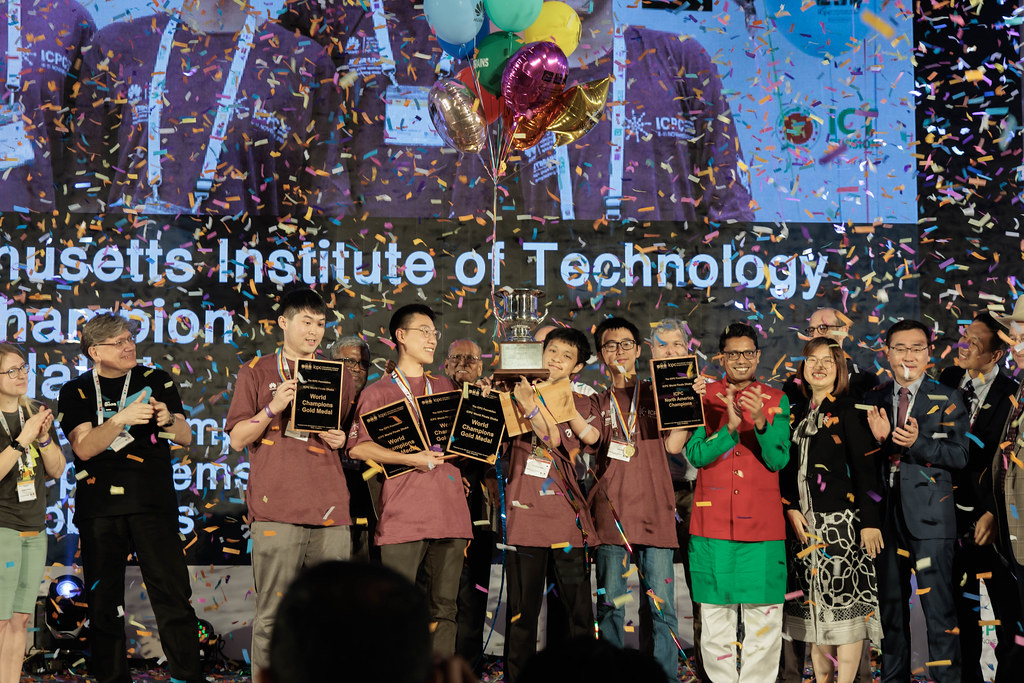
In a hail of confetti, the members of the MIT programming team stand on a large stage clutching trophies and plaques. Behind them, a huge screen displays the MIT team name.

On November 10th, MIT’s team of crack coders made history by winning the globe’s oldest, largest, and most prestigious programming contest—the World Finals of the International Collegiate Programming Contest (ICPC). Held in Dhaka, Bangladesh, the 45th World Finals drew a live audience of over 1600 viewers to the tense 12-problem competition, which featured 420 contestants, representing 140 universities across 45 nations.

The first ICPC World Finals contest was held in 1977, and the second (in 1978) was won by MIT—followed by many, many years of close misses for the team from Cambridge. “We have recently come close with very strong teams, and at times it felt like we might never make it,” said faculty coordinator Martin Rinard, Professor of CS and Engineering within MIT’s Department of Electrical Engineering and Computer Science. “Since I took over the team in 1997, we have won 5 gold medals, 5 silver medals, and 3 bronze medals. We have come in second three times. Overall, it’s a very good record, but it also feels great to finally win!”

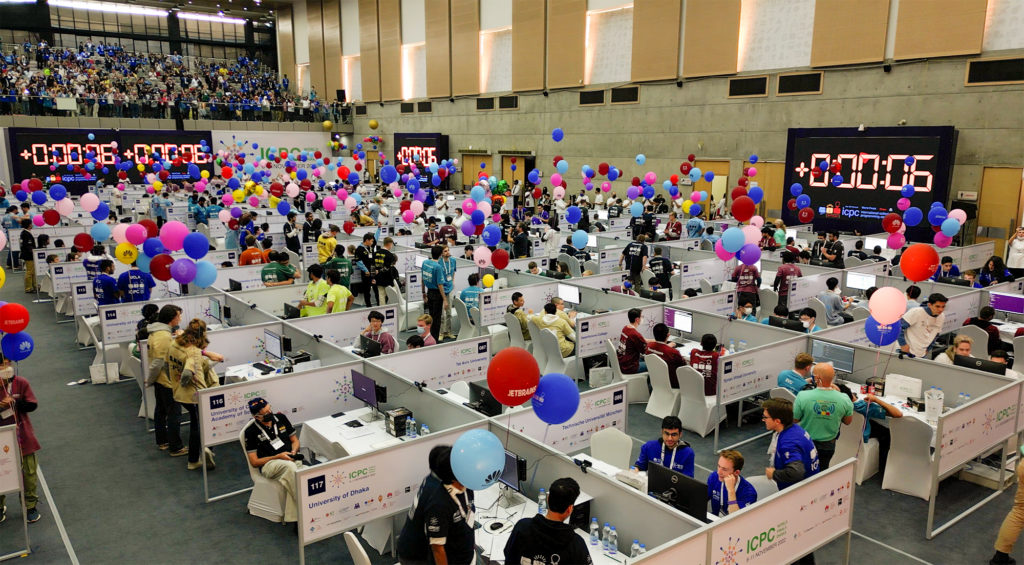
A crowded hall full of low cubicles is livened up with hundreds of colorful balloons and several huge timekeeping clocks. Inside each cubicle, a team of 3 computer programmers sit, wearing colorful t-shirts that identify their university.
140 universities and 45 countries were represented by the teams packed into the colorful ICPC hall. Photo credit: Michael Roytek for ICPC.

That win was the work of many, including admin Mary McDavitt, who dealt with the daunting logistics involved in sending a team of undergraduates halfway around the world, and student coaches Ce Jin and Yinzhan Xu, both PhD students in EECS, who help select the best team to represent MIT. “In addition to the official regional contests held by ICPC, we also organize two selection contests every year especially for MIT students,” says student coach Ce Jin. “MIT students are usually extremely talented, and most of them are already experienced competitive programmers even before joining MIT. For example, the three members on this team all won medals at IOI (International Olympiad in Informatics) during high school!” That team is composed of Xiao Mao ’21 MEng ’22, who has degrees in both computer science and engineering and in mathematics; Jerry Mao, a senior in computer science and engineering; and Mingyang Deng, a junior in computer science and engineering. (Deng also recently competed in and won the 2022 North American Championships of the ICPC, clinching eligibility to attend the 46th annual ICPC World Finals next year.)

In this interview, conducted via email during and immediately after the flight back from Bangladesh, the trio reflected on their historical victory.

First off, congratulations on this incredible win. Tell me a little about how you got in the mental space to compete. What kinds of practices, rituals, and preparation habits do you recommend for this kind of intense, competitive brain work? 

Jerry: The ICPC is certainly intense—and unlike some other programming competitions, in the ICPC there is no such thing as partial credit! As a team, we did many test runs over the months leading to the competition, to iron out those nerves and develop a routine for the real thing.

Xiao: We ran several weekly practice sessions, but they were not optimal, since I already graduated and was in another city. We had to communicate via Zoom and emulate the “one keyboard” environment via communication. However, these difficulties were somewhat of a blessing in disguise, since they forced us to sharpen our communication skills and improve our strategies. 

A colorful market in Dhaka features a stacked array of sandwiches and a spinning cone of meat. In the background, vendor umbrellas and packages of clothing are visible.
Contestants toured some of the city of Dhaka, sampling the sights, sounds, and tastes. Photo credit: Randy Piland for ICPC.

Dhaka is a long way from Cambridge! Tell us about your experience of the city.

Jerry Mao: It’s a bustling city: there are people and cars and rickshaws everywhere. We didn’t go too far from where we were staying, because we knew we’d get stuck in the gridlock. ICPC signs were also everywhere around the city, including in the airport, on the roads, and even on the public transport—the world finals were definitely a major event for the city.

Xiao Mao: I did not experience the best traffic situation during our stay, but I still liked the city for many of its offerings and its hospitality! The food was also amazing and so were the people that prepared it. 

Jerry: I certainly enjoyed sampling the tastes, such as a mutton bhuna or a vegetable bhaji.

Mingyang Deng: I didn’t have time to visit many of the sights, but I wandered around the city a bit and had lots of conversations with local teenagers. Dhaka has a vast, visible wealth gap. The young people are aware of this, and hopefully, they can make a better future with their knowledge. 


Many folks may never have seen a programming competition before. Just from a logistical perspective, how do you divide up the work of programming? Is the fastest typist the person who gets the keyboard? Do all three work on separate possible solutions and compare? 

Jerry: All three of us are very experienced competitive programmers, so thankfully typing speed is not something we have to worry about. For most problems, the most challenging part is coming up with the idea of the solution, while programming is just a way to write it down. That’s why our teamwork is built on collaborating to find ideas; there are times when we’d each have partial ideas on a problem, and when we discuss them, we discover that they combine to a full solution.

Xiao: As there was only one keyboard, we had to alternate between coders. When one person was coding, the other two could cross-check each other’s solution. We actually started with some strategy where one person did all the coding and the other did all the thinking, but we quickly abandoned it since we realized we could easily get tired if we kept doing one thing without a break.

Jerry: We each have our own individual strengths, whether that be math, geometry, data structures, or something else. Some of the most challenging problems may pull together a combination of these, and that’s when our teamwork is able to shine the most.

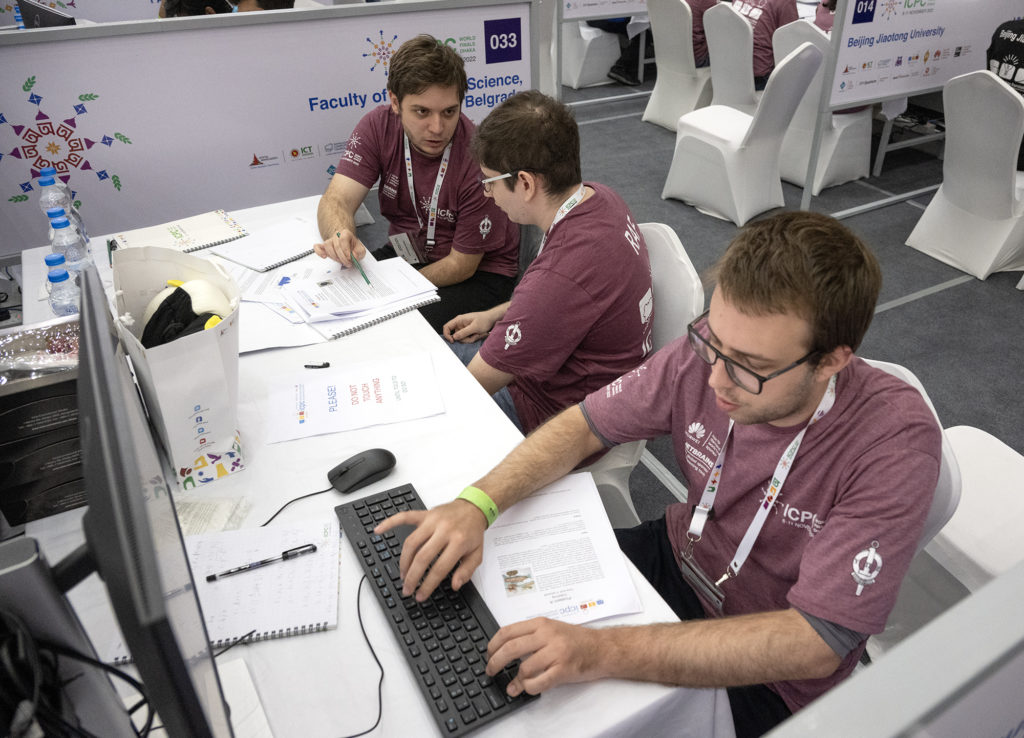
Three male competitors, wearing the plum-colored tee shirts that identify them as students from the Faculty of Computer Science in Belgrade, confer over papers detailing a coding problem in the ICPC World Finals.
Two team members from Faculty of Computer Science, Belgrade, confer while the third codes. Photo credit: Michael Roytek for ICPC.

You got four first-solves out of twelve problems! Was speed a deliberate part of your strategy? 

Mingyang: We didn’t aim for speed. However, while most teams follow the leaderboard, our team prefers to explore new problems. As a result, we were the first to solve many unexplored problems. 


Jerry: While we weren’t specifically aiming for first-solves, there are 12 problems to work on, but only 5 hours. And on the leaderboard, teams that solve more problems faster are ranked higher, so speed is of utmost importance.

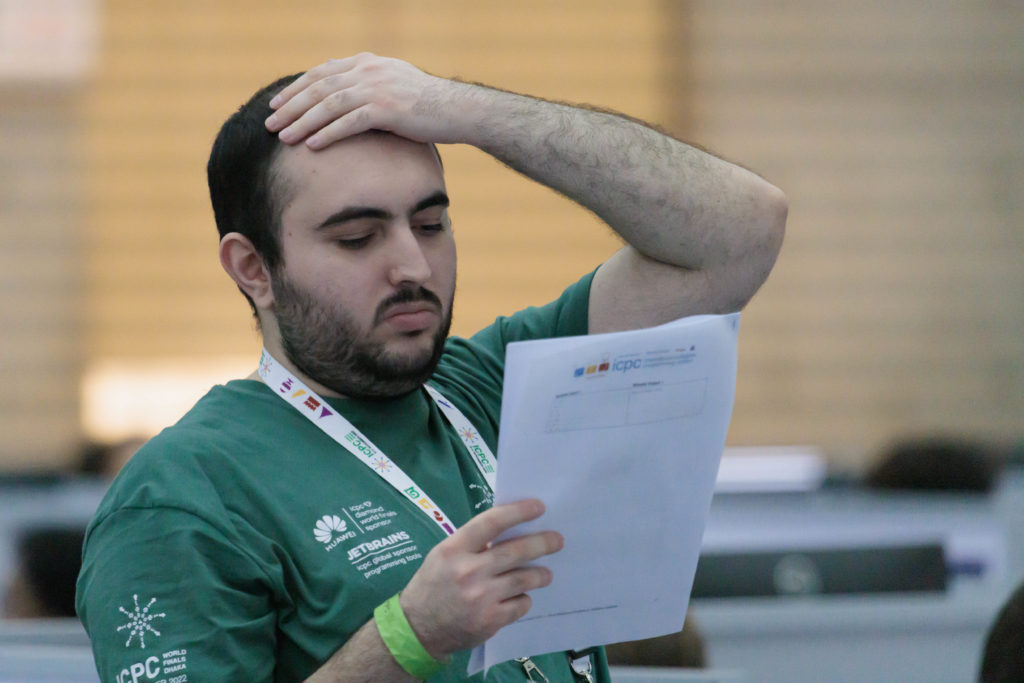
A bearded coder wearing a green t-shirt stares at a problem with a look of intense concentration. He is wiping his forehead.
An intense moment for a coder at the ICPC World Finals. Photo credit: Bob Smith for ICPC.

Xiao: We started on two unpopular problems instead of the one most of the teams were solving, and that was what contributed to two of our first-solves. Moreover, we focused more on correctness than speed, since an incorrect solution could waste a lot of time. Our strategy of alternating between coders and cross-checking solutions made sure that there was no “idle time” on the machine (i.e. time when no one was coding) and that we also never had incorrect solutions. Despite the expectations other people have put on us, we came into the competition with a “just for fun” mindset, and were not aiming for anything. Being first was certainly a surprise for us. 

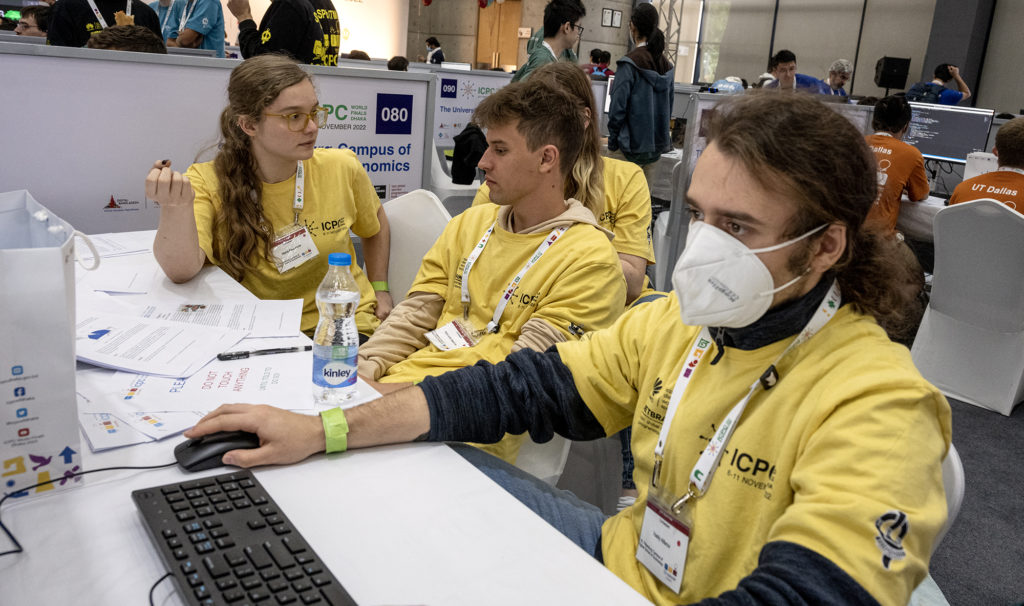
A team composed of one woman and two men are captured in intense discussion about a potential solution. One of the men is staring at the computer screen.
A team from St. Petersburg Campus of Higher School of Economics discusses a possible solution. Photo credit: Randy Piland for ICPC.

Looking at the final scoreboard, it’s evident that Problem D, called “Guardians of the Gallery”, was the most challenging problem. While many teams attempted it, and you gave it a valiant 19 tries, no one solved it correctly. What was it about Problem D that gave everyone such trouble? 

Jerry: Problem D was a deceptively simple but exceptionally tricky geometry problem — and to make it harder, imprecision was everywhere. The concept of the problem was simple: there’s a guard in an art gallery, and an alarm goes off for a treasured sculpture. Art galleries are oddly-shaped, so the sculpture might not be in the guard’s line of sight–can you calculate how quickly they can run somewhere to see it?

What made this problem tricky was that some galleries would have walls with the tiniest sliver of a gap between them, and depending on the shape, the guard would sometimes be able to see through that gap. Figuring out what to do with these tiny slivers is what caused most teams who tried this problem to stumble.

Xiao: The challenging part of it was all the tricky edge cases and precision issues. Think about all the glitches in any physics engine in video games! Although we did fix a lot of bugs, most of the 19 attempts were “Hail Mary” attempts where we simply tried different parameters in hope that one of them would pass.

Jerry: I solved problem D this afternoon after getting off the plane back to Boston — unfortunately a bit late, but a satisfying solve nonetheless! While we had a clear path to solving the problem during the contest, we didn’t have enough time to reach the full and complete solution.

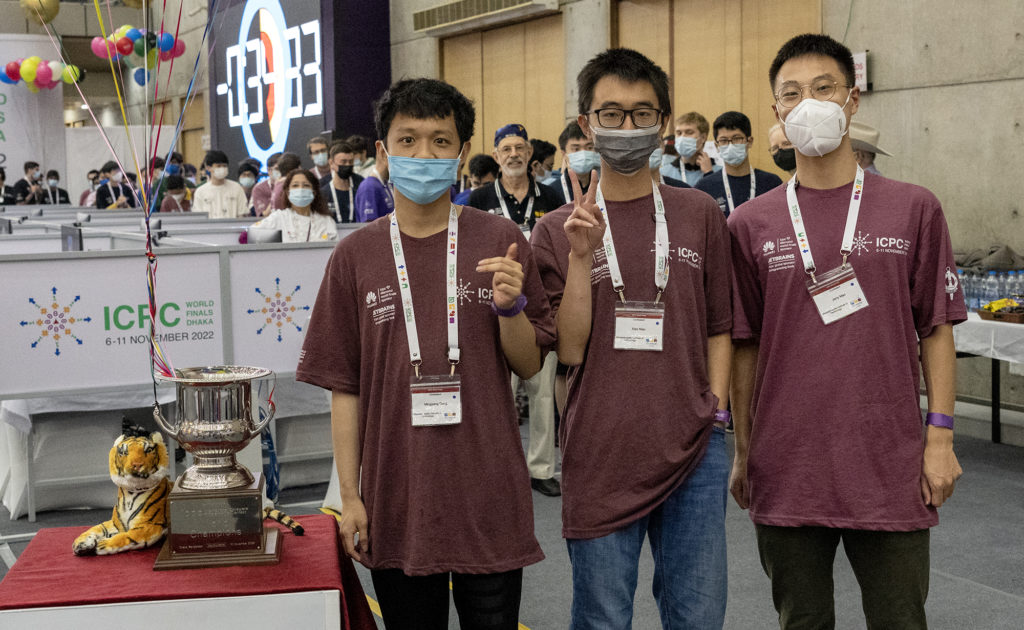
The MIT team, wearing ICPC badges, face masks, and matching burgundy t-shirts, pose next to a large trophy cup and a small plush tiger toy.
The MIT team (from left to right, Mingyang Deng, Xiao Mao, and Jerry Mao) pose next to their trophy. Photo credit: Michael Roytek for ICPC.

Individually, did you have a “favorite” problem?

Xiao: Problem I was a particularly fun experience for us. It uses one of the most common data structures called “segment tree.” Our solution borrowed a technique called “lazy propagation” in a very unconventional way.

Mingyang: I especially liked problem E. It’s a problem related to a magic trick in which a servant helps the magician guess a hidden card. The topic is interesting on its own; moreover, clever mathematical intuition is involved in modeling the trick precisely. I found the modeling part challenging and exciting.

Jerry: My favorite problems are about geometry. Geometry problems are often considered the bane of all programming contests due to the unique obstacles they bring: just like how a picture gets blurry the more you zoom in, this “blurriness” or “imprecision” can make a lot of correct ideas hard to express in code. However, there is a certain beauty to discovering how a computer program, which works with just numbers, can connect with a picture, such as a geometric diagram. In fact, it is in this connection that the most elegant results in mathematics become related.

Caption for video: Front row, from left to right: Ce Jin, Jerry Mao, Mingyang Deng, Xiao Mao, and Mr. Zunaid Ahmed Palak MP, the Bangladesh State Minister for the ICT Division (wearing red and green).

In this YouTube clip, shared by Prof. Rinard, you’re being announced as the World Champion Gold Medalists and called up to the stage to receive your trophies. Can you tell us a little about what you were thinking about and feeling at this particular moment? 

Mingyang: It was awesome. I felt unreal when this happened. Many strong teams participated, but our excellent performance placed us at the top. Xiao and Jerry are amazing teammates, and I enjoyed the time spent with them.

Xiao: This competition was my swan song performance concluding my more-than-a-decade-long competitive programming career starting from the 5th grade. On the stage, I was very happy that it ended on a high note, and I was able to avenge my disastrous performance at International Olympiad in Informatics (IOI) 2017. I was also grateful for all the people who made this possible, especially my two teammates, Mingyang and Jerry.

Jerry: We’ve all been medalists on the world stage before at international contests, but this was an entirely different feeling. The ICPC is the oldest, largest, and most prestigious programming contest in the world. To have the opportunity to compete in the World Finals is already a great honor; to become a medalist is extraordinary; and to be the world champion team, representing MIT and bringing the trophy home, is a dream come true.

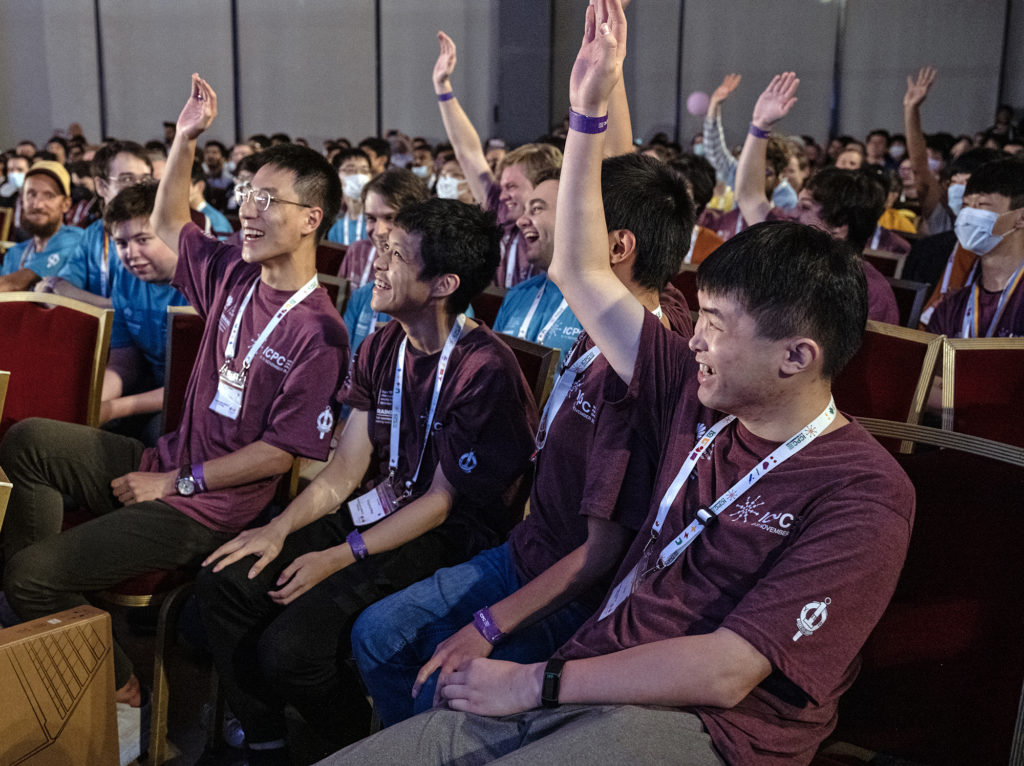
The team of three MIT programmers, and their student coach Ce Jin, smile broadly and raise their hands in celebration.
The team raises their hands as they are named champions. Photo credit: Randy Piland for ICPC.

Three from MIT named 2023 Rhodes Scholars

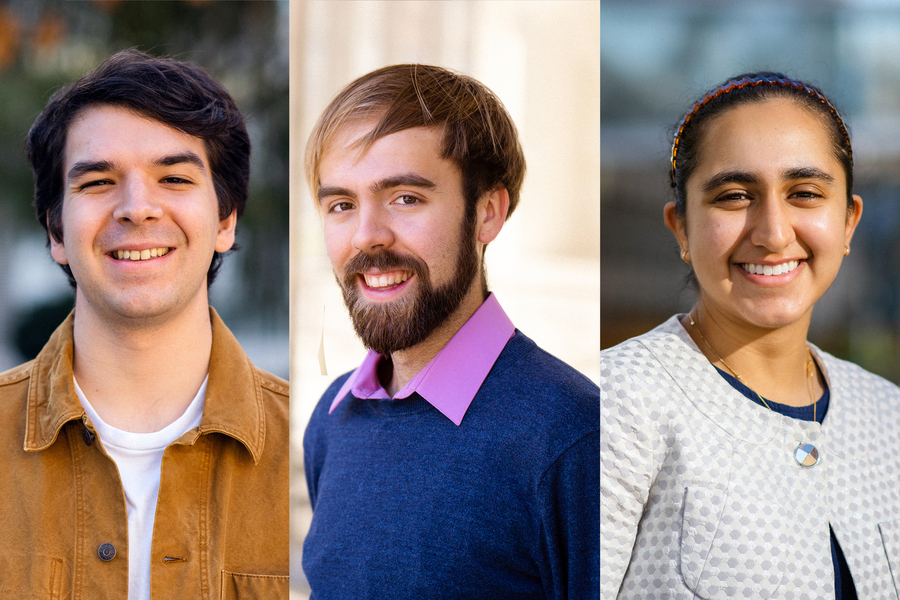
Jack Cook, Matthew Kearney, and Jupneet Singh have been selected for the 2023 cohort of the prestigious Rhodes Scholarship program. They will begin fully funded postgraduate studies at Oxford University in the U.K. next fall. Each year, Rhodes awards 32 scholarships to U.S. citizens plus additional scholarships for citizens from non-U.S. constituencies.

The students were supported by Associate Dean Kim Benard and the Distinguished Fellowships team in Career Advising and Professional Development, and received additional mentorship from the Presidential Committee on Distinguished Fellowships.

“Our students have worked incredibly hard throughout this process,” says Professor Tamar Schapiro, who co-chairs the committee along with Professor Will Broadhead. “They have been challenged to think deeply about what they want to do and about who they want to be. They have learned to communicate their values and goals in powerful ways. And they have developed confidence presenting themselves to others. We are thrilled that so many of them were recognized this year, as finalists and as winners.” 

Jack Cook ’22

Jack Cook is a MEng student from New York City who recently graduated with a major in computer science and a minor in brain and cognitive sciences. At Oxford, he plans to pursue an MSc in the social science of the internet and an MSc in evidence-based social intervention and policy evaluation. In the future, he plans to apply his technical skills toward solving problems involving misinformation.

As an undergraduate at MIT, Cook was lead author on “There’s Always a Bigger Fish,” a research paper from Mengjia Yan’s lab that demonstrates how machine learning can be weaponized to extract sensitive information from applications such as a web browser. His work on this project won him MIT’s 2022 Robert M. Fano UROP Award. For his master’s thesis, in partnership with Lahey Hospital, Jack is building a digital cognitive assessment for diagnosing patients with neurodegenerative diseases.

Cook also leads natural language processing initiatives at The New York Times R&D, where he built a system that answers questions from readers about breaking news in real time. As a high school student, he was on the founding team of Mixer, a startup focusing on low-latency live-streaming that was acquired by Microsoft in 2016.

Cook was also director of HackMIT, MIT’s premier annual 1,000-person hackathon, for two years. For HackMIT’s first virtual event in September 2020, he led the development of a 3D virtual platform on which hackers could “walk around” and interact with each other while participating remotely.

Matthew Kearney

Matt Kearney from Austin, Texas, is a senior majoring in both electrical engineering and computer science and philosophy. At Oxford, he will pursue an MSc in research in statistics. His goal is to redesign AI technologies and practices to both address their harms and reimagine them as tools for solutions to pressing societal issues such as climate change and economic inequality.

At MIT, Kearney has researched theoretical quantum computing with the Quanta Research Group, computer vision for 3D scene understanding with the Computer Science and Artificial Intelligence Laboratory (CSAIL), probabilistic climate downscaling with the Human Systems Lab, and explainability methods for natural language models with CSAIL. He also interned with Argo AI, an autonomous vehicle company, and Google X, the moonshot factory of Google.

Kearney ran on the MIT Cross Country and Track and Field teams and served as a captain for three years. He also co-founded a project in 2020 with the goal of focusing individual efforts on the most effective solutions to climate change. He and his co-founder were awarded the PKG Fellowship and the IDEAS Fellowship to support this work. Additionally, as part of his studies in the humanities, he was selected as an MIT Burchard Scholar.

In his spare time, Kearney loves spontaneously singing, cooking elaborate meals, and absolutely anything in the outdoors.

Jupneet Singh

Jupneet Singh is a senior from Somis, California, majoring in chemistry with a flex in biomedical engineering and minoring in history. As a Rhodes Scholar at Oxford, she intends to study for an MSc in evidence-based social intervention and policy evaluation. Following Rhodes, she plans to attend medical school and then complete residency as an active-duty Air Force Captain.

Singh’s career goals include serving as a trauma surgeon in the Air Force, and then entering the United States Public Health Commissioned Corps to advocate for the representation of minorities and culturally adaptive practices in health care. She currently holds leadership positions in Air Force ROTC, MIT Mock Trial, and Project Sunshine MIT, and is also involved with the PKG Center. She conducts research in the Shalek Lab studying fatty liver disease, and she has also worked in the Nolan Lab on natural products research.  

This past summer, Singh worked in de-addiction centers in India and had an abstract accepted to the American College of Surgeons Southern California Conference. She has worked in California at the Ventura County Family Justice Center and Ventura County Medical Center Trauma Center and published a paper as first author in The American Surgeon. Singh founded a program, Pathways to Promise, to support the health of children in Ventura affected by domestic violence, and has received four fellowships to support it.

In machine learning, synthetic data can offer real performance improvements

Teaching a machine to recognize human actions has many potential applications, such as automatically detecting workers who fall at a construction site or enabling a smart home robot to interpret a user’s gestures.

To do this, researchers train machine-learning models using vast datasets of video clips that show humans performing actions. However, not only is it expensive and laborious to gather and label millions or billions of videos, but the clips often contain sensitive information, like people’s faces or license plate numbers. Using these videos might also violate copyright or data protection laws. And this assumes the video data are publicly available in the first place — many datasets are owned by companies and aren’t free to use.

So, researchers are turning to synthetic datasets. These are made by a computer that uses 3D models of scenes, objects, and humans to quickly produce many varying clips of specific actions — without the potential copyright issues or ethical concerns that come with real data.

But are synthetic data as “good” as real data? How well does a model trained with these data perform when it’s asked to classify real human actions? A team of researchers at MIT, the MIT-IBM Watson AI Lab, and Boston University sought to answer this question. They built a synthetic dataset of 150,000 video clips that captured a wide range of human actions, which they used to train machine-learning models. Then they showed these models six datasets of real-world videos to see how well they could learn to recognize actions in those clips.

The researchers found that the synthetically trained models performed even better than models trained on real data for videos that have fewer background objects.

This work could help researchers use synthetic datasets in such a way that models achieve higher accuracy on real-world tasks. It could also help scientists identify which machine-learning applications could be best-suited for training with synthetic data, in an effort to mitigate some of the ethical, privacy, and copyright concerns of using real datasets.

“The ultimate goal of our research is to replace real data pretraining with synthetic data pretraining. There is a cost in creating an action in synthetic data, but once that is done, then you can generate an unlimited number of images or videos by changing the pose, the lighting, etc. That is the beauty of synthetic data,” says Rogerio Feris, principal scientist and manager at the MIT-IBM Watson AI Lab, and co-author of a paper detailing this research.

The paper is authored by lead author Yo-whan “John” Kim ’22; Aude Oliva, director of strategic industry engagement at the MIT Schwarzman College of Computing, MIT director of the MIT-IBM Watson AI Lab, and a senior research scientist in the Computer Science and Artificial Intelligence Laboratory (CSAIL); and seven others. The research will be presented at the Conference on Neural Information Processing Systems.   

Building a synthetic dataset

The researchers began by compiling a new dataset using three publicly available datasets of synthetic video clips that captured human actions. Their dataset, called Synthetic Action Pre-training and Transfer (SynAPT), contained 150 action categories, with 1,000 video clips per category.

They selected as many action categories as possible, such as people waving or falling on the floor, depending on the availability of clips that contained clean video data.

Once the dataset was prepared, they used it to pretrain three machine-learning models to recognize the actions. Pretraining involves training a model for one task to give it a head-start for learning other tasks. Inspired by the way people learn — we reuse old knowledge when we learn something new — the pretrained model can use the parameters it has already learned to help it learn a new task with a new dataset faster and more effectively.

They tested the pretrained models using six datasets of real video clips, each capturing classes of actions that were different from those in the training data.

The researchers were surprised to see that all three synthetic models outperformed models trained with real video clips on four of the six datasets. Their accuracy was highest for datasets that contained video clips with “low scene-object bias.”

Low scene-object bias means that the model cannot recognize the action by looking at the background or other objects in the scene — it must focus on the action itself. For example, if the model is tasked with classifying diving poses in video clips of people diving into a swimming pool, it cannot identify a pose by looking at the water or the tiles on the wall. It must focus on the person’s motion and position to classify the action.

“In videos with low scene-object bias, the temporal dynamics of the actions is more important than the appearance of the objects or the background, and that seems to be well-captured with synthetic data,” Feris says.

“High scene-object bias can actually act as an obstacle. The model might misclassify an action by looking at an object, not the action itself. It can confuse the model,” Kim explains.

Boosting performance

Building off these results, the researchers want to include more action classes and additional synthetic video platforms in future work, eventually creating a catalog of models that have been pretrained using synthetic data, says co-author Rameswar Panda, a research staff member at the MIT-IBM Watson AI Lab.

“We want to build models which have very similar performance or even better performance than the existing models in the literature, but without being bound by any of those biases or security concerns,” he adds.

They also want to combine their work with research that seeks to generate more accurate and realistic synthetic videos, which could boost the performance of the models, says SouYoung Jin, a co-author and CSAIL postdoc. She is also interested in exploring how models might learn differently when they are trained with synthetic data.

“We use synthetic datasets to prevent privacy issues or contextual or social bias, but what does the model actually learn? Does it learn something that is unbiased?” she says.

Now that they have demonstrated this use potential for synthetic videos, they hope other researchers will build upon their work.

“Despite there being a lower cost to obtaining well-annotated synthetic data, currently we do not have a dataset with the scale to rival the biggest annotated datasets with real videos. By discussing the different costs and concerns with real videos, and showing the efficacy of synthetic data, we hope to motivate efforts in this direction,” adds co-author Samarth Mishra, a graduate student at Boston University (BU).

Additional co-authors include Hilde Kuehne, professor of computer science at Goethe University in Germany and an affiliated professor at the MIT-IBM Watson AI Lab; Leonid Karlinsky, research staff member at the MIT-IBM Watson AI Lab; Venkatesh Saligrama, professor in the Department of Electrical and Computer Engineering at BU; and Kate Saenko, associate professor in the Department of Computer Science at BU and a consulting professor at the MIT-IBM Watson AI Lab.

This research was supported by the Defense Advanced Research Projects Agency LwLL, as well as the MIT-IBM Watson AI Lab and its member companies, Nexplore and Woodside.

Louis Braida, hearing aid innovator and mentor, dies at 79

Lou Braida passed on September 2, 2022.

Louis Braida, the Henry Ellis Warren (1894) Professor (Emeritus) in the Department of Electrical Engineering and Computer Science (EECS), died Sept. 2nd. He was 79. Braida was a principal researcher in the Research Laboratory of Electronics (RLE), and a faculty member in the Harvard-MIT Health Sciences and Technology (HST) program. The Institute for Medical Engineering and Science (IMES) is HST’s home at MIT.

Born in the Bronx to Louis Braida and Elvina Tonelli Braida, Braida received the B.E.E from The Cooper Union in 1964, and the S.M. and PhD in electrical engineering from MIT in 1965 and 1969, respectively. During the course of his career at MIT, he was for many years the director of the Speech and Hearing Sciences training program within HST.

Braida was internationally known for his research in the areas of intensity perception, the characterization of hearing impairments, and aids for the deaf. Using modern communication theory and computational techniques, he worked to develop improved hearing aids for people suffering from sensorineural hearing impairments, and cochlear implants for the deaf, addressing many of the field’s knottiest problems in the pursuit of improved performance.

His work strongly enhanced the research community’s analytical understanding of both the benefits, and limitations of, compression amplification in hearing aids. Additionally, Braida sought to develop tactile aids for people who are profoundly deaf or deaf-blind, serving as a substitute for hearing in the reception of speech and environmental sounds.

“Lou Braida was, in many respects, the father of speech and hearing sciences within HST,” said Collin Stultz, Nina T. and Robert H. Rubin Professor in Medical Engineering and Science, Associate Director of IMES, and Co-Director of HST. “His contributions to the field will endure in perpetuity. He was a scholar, a cherished mentor, and a dedicated educator.” Charlotte Reed, a principal investigator and Senior Research Scientist in RLE and longtime friend and colleague of Braida’s, noted that “Lou applied a rigorous quantitative approach to the study of a wide range of topics in speech and hearing science.  Among his lasting contributions to the field are his comprehensive modeling work on the auditory perception of intensity and loudness and on the multimodal perception of speech.”

Beyond Braida’s contributions to the world of auditory science, he was known throughout EECS for his community-minded and collegial approach to work. Taking time from his intense research schedule, he volunteered to mentor new faculty members and orient them to MIT’s largest department. Elazer R. Edelman, Edward J. Poitras Professor in Medical Engineering and Science, MIT, and the Director of the Institute for Medical Engineering and Science (IMES) was one of the many influenced by Braida: “Lou was the consummate educator and mentor, a citizen of MIT and a dedicated member of HST whose engineering and programmatic innovations made life better for all in our community and the world at large.” And Jae Lim, Professor Post-Tenure of Electrical Engineering, remembered his friend as a kindly influence on all who entered his sphere. “Lou influenced the lives of many students at MIT. He supervised my bachelor’s and master’s theses.  I learnt from him what research is and how exciting and satisfying research can be. As a floor tutor of Burton-Conner House, he helped many students including me not only with academic issues but personal matters. He will be remembered and missed by many whose lives he touched.”

Braida’s remarkable devotion to his community was recognized in 2001, when he was awarded the Thomas A. McMahon Mentoring Award by HST. His friend Charlotte Reed aptly summed up his legacy of care, saying, “Lou will be remembered by his many students and colleagues as an intellectual force who had an enormous impact on our personal and professional growth, and he will be greatly missed.”

They’re going the distance: for MIT’s competitive programmers, North America is just the beginning.

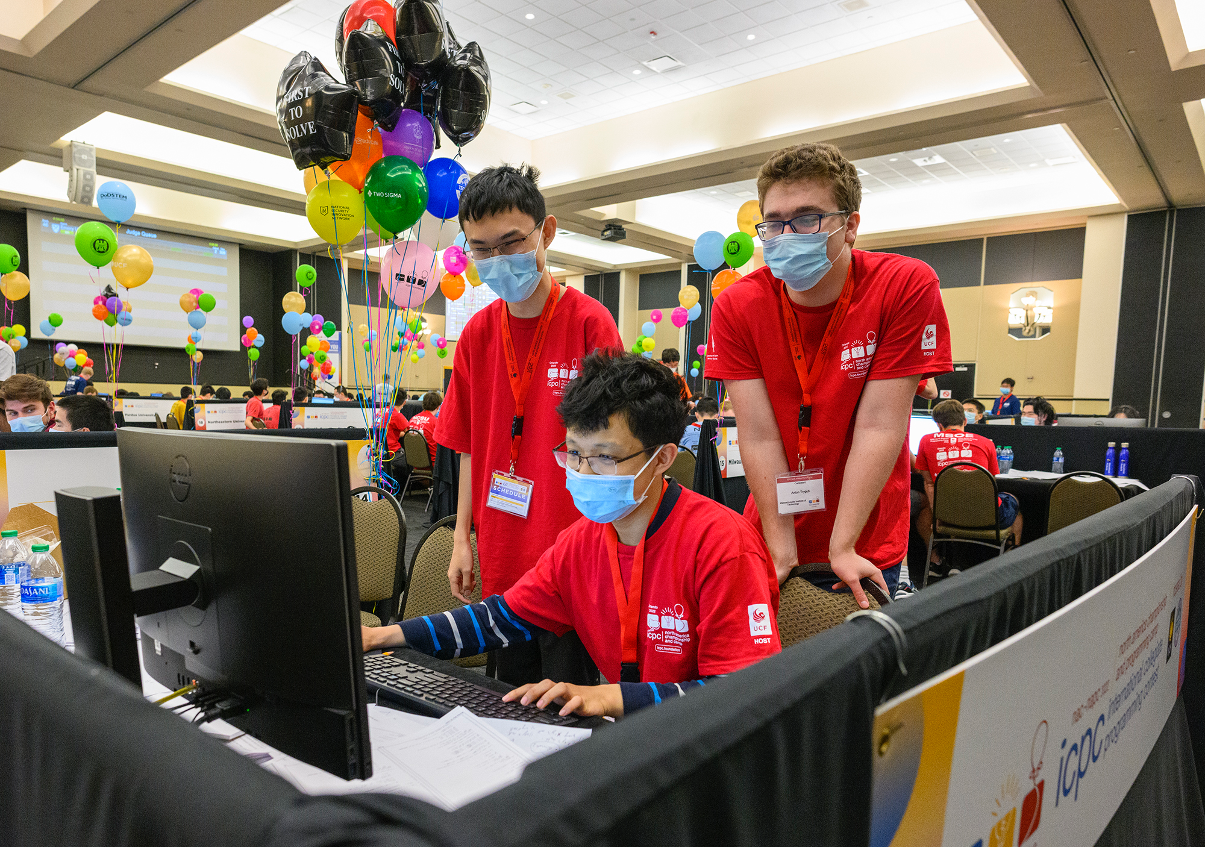
Sharing a single computer, Ziqian Zhong, MingYang Deng, and Anton Trygub work on their coding solution.

When you think of computer programmers, you might picture a lone coder, sitting in a cubicle, bathed in flickering light. But you should picture a team: in MIT’s case, a joyous, triumphant team of competitive programmers, bent on solving incredibly thorny problems faster and more accurately than their competition. With a #1 placement in the North American Championships of the International Collegiate Programming Contest (ICPC), MIT’s programming team is now eligible to attend the 46th Annual ICPC World Finals next year. This year, the world finals are being held in Bangladesh; next year’s finals will be held in Egypt.

We sat down with three of the team’s members, Ziqian Zhong (Computer Science and Engineering ’24), MingYang Deng (Computer Science and Engineering ’24), and Anton Trygub (Mathematics and Computer Science and Engineering ’23), to learn what it’s like to compete at the very top tiers of computing.

Many of our readers might have never seen a programming contest before. Tell us a little about the basic rules: what kinds of problems you are faced with, how much time you have to prepare or solve them, and the tools you’re allowed to use!

Ziqian Zhong: We’re typically faced with 10 to 15 problems and five hours. You can code with Java, Kotlin, Python and C/C++. Most teams, including us, prefer to use C++, since it is very concise and usually runs faster.

MingYang Deng: In ACM-ICPC contests, a team consists of three members while only one computer is available, so on average, a member has only a third of the access to the computer. Besides, problems in a programming contest usually require implementing efficient algorithms and data structures, so we typically spend much of our time thinking about solutions before coding.

Do you typically know anything about your competitors, or have friends on opposing teams? Is there trash talking in programming competitions? In other words, what’s the social atmosphere like?

Ziqian Zhong: I personally knew some of my competitors before, and the overall social atmosphere is pretty chill and friendly. We played poker and all kinds of other card games together; I ended up learning two new card games! I guess trash talking is not so popular here.

MingYang Deng: I agree. I made friends with many of my competitors, who are all very nice. People here share the same interests and similar backgrounds. It feels like a community. So there’s no need to be competitive outside the contest.

Anton Trygub: Competitive Programming is different from other competitive activities in the sense that you don’t compete directly against someone, as in football, chess, etc. You just need to do as well as you can yourself, so there is no tension between teams. And on the higher level, competitors know each other, as we participate in the same competitions on a regular basis. We are here to make friends and to help the ICPC community develop!

MIT’s team topped the rankings of the North American Championships, which were held at the University of Central Florida (UCF) in Orlando, FL, from May 26-31.

What makes a problem particularly hard to solve, and which problem was the most difficult in the North American Championships, from your perspective?

Ziqian Zhong: To solve a question, we think and code. Some problems are hard to code, with lots of messy details and casework that is hard to get right. For some other problems it’s hard to figure out the correct solution. Personally, I hate the former kinds of problems (it’s not a typing contest!) and the latter kinds of problems are more popular. Problem H was probably the hardest one and we were the only team that solved it.

Anton Trygub: The problem may be difficult because of different reasons: it might be just heavy implementation with small to no thinking, or requiring some knowledge without which you might just give up, or have a lot of messy details. I prefer problems in which the difficulty lies in the thinking part, in something creative. It’s great to read the problem statement and feel “How can this even be solvable?”

Tell me about a solution you felt was particularly creative, or that you were really proud of!

MingYang Deng: I think Anton’s solution to Problem H and Ziqian’s solution to Problem D are pretty creative.

Anton Trygub: I don’t think that any of my solutions were particularly creative, but Problem H was quite interesting to solve. The setup is, again, “How can this even be solvable”, and then you start looking at some cases and notice some observations, which suddenly add up to the full solution.

Ziqian Zhong: I don’t remember the details about Problem D but I remember it’s a pretty straightforward problem and requires some counting tricks!

How will you be preparing for the world finals next year—what’s involved in that?

Ziqian Zhong: I guess we’ll just do more training contests together. There is no secret ingredient. Mainly just practice more.

MingYang Deng: We will practice more, during which we will refine our strategies.

Anton Trygub: We will have to listen more to our coach on that one 😛 But yeah, mostly practice.

Over the last few years, teams from China, Russia, and Poland have been particularly dominant in the world finals. Why is that, from your perspective—do different countries have different styles of preparation or competition?

Ziqian Zhong: I think many teams in Russia and Poland practiced really hard and they have good strategies. I heard that the Red Panda Team from Moscow State University likes to start with the hard problems and leave some easy problems to the final hour. This is not optimal penalty-wise (the longer you take to solve every problem in total, the larger the penalty) but it probably utilizes the last hour better (the last hour is usually really stressful and it’s hard to get things right). This is pretty different from what we usually pursue.

Anton Trygub: I don’t really think that we should talk about some kind of a trend here, the participants from those countries just happened to be really strong and went to the world finals several times. I hope we can bring a little bit of North America dominance to the finals!

Tell me a little about what competitions like this one have taught you, as a programmer.

Ziqian Zhong: I think it helps me to code faster and more accurately. In a contest, you don’t have much time to debug once things go south.

Anton Trygub: It helps me to go for the most efficient way to implement something, while keeping it clean, as otherwise I would die debugging.

MingYang Deng: It also improves my collaboration skills. In contests like this, you must communicate with your teammates, express your thoughts clearly, work as a team, and believe in each other.