
Undergraduate Programs

SHARE:

World-renowned for both rigor and innovation, EECS is the largest undergraduate program at MIT. Our flexible curriculum and intensive, hands-on coursework gives students a holistic view of the field, an understanding of how to solve problems, and a focus on modeling and abstraction that prepares them for success in a wide range of industries, from software to bioengineering.

Taught by world class faculty, EECS students explore subjects critical to advancement in today’s high-tech society — from mathematical computer theory to circuit design and electronics, control and communication theory, artificial intelligence, and robotics. Starting salaries for students with bachelor’s degrees average above $90,000.

Check out the four undergraduate degree programs offered (6-1, 6-2,  6-3, and 6-7) and the master of engineering degree (6-P) available to EECS undergraduates with the option to complete the MEng thesis at a company through the 6-A program. All degree programs are highlighted in the cards on this page and link to further coverage.  

Students may also engage in independent study or research for academic credit, with faculty supervision. 

Current MIT undergraduate students wanting more information to enter Course VI, please visit the Course VI Undergraduate Office, 38-476. You may also contact Anne Hunter directly by email: anneh@mit.edu.

Prospective undergraduate students -- all applicants must apply directly to MIT.  See the orange box below!

Prospective Undergraduate students must apply directly to MIT!

Masterworks 2013 - Come for refreshments, raffles, great presentations!
            Tuesday, April 30 Student Street, first floor of the Stata Center 4:00 PM to 5:30 PM Masterworks is a great opportunity for EECS students completing their Master's (SM or MEng) theses to show their work in a public setting. For the faculty, staff and other students it is an excellent occasion to see some of the amazing things going on in our Department. There will be refreshments, ice cream and, for the best presentations, prizes.  
APPLY NOW for MENG -- Online application due May 1
Course VI Juniors! Apply NOW for the Master of Engineering! The deadline is May 1st.  You'll hear back in early June. The MEng is open to MIT Course VI undergraduates, and gives them the opportunity to stay at MIT for an extra year to complete a Master's thesis and extra classes including a three-subject concentration in a specific technical area. Learn more from some of our MEng students on the MEng homepage.
UG and MEng. Degree CHECKLIST
You can access the Undergraduate and MEng degree programs checklist here!
How to Find a UROP in Course 6
Three basic steps to help you find a UROP or other research project in Course 6. A quick read for some useful tips!
Ashwini Gokhale, Course 6-2 senior wins Google's Anita Borg Scholarship, 2012-13
"Hello! I'm a senior at MIT, love meeting new people, traveling to unexplored locales, and trying out different foods. My undergraduate research revolves around statistical modeling of an agent in an eCommerce environment."
6-P The Masters of Engineering Program
The MEng or Masters of Engineering Program (6-P) enables students to earn Course 6 bachelor's and master's degrees simultaneously over a period of five or five and a half years. Research for the master's thesis is completed on campus.
Interview with MEng. student Katie Szeto
"My time at MIT in course VI has given me great confidence that I will be able to handle whatever problems my future career throws at me. This is because course VI taught me how to think - how to model things, how to approach problems, how to be critical and open minded at the same time, how to prioritize various competing entities, how to work with people, and the value of hard work."
Interview with MEng student Kanjun Qiu
"I found out that I greatly preferred algorithms and software design to circuits and signal processing, so the choice was fairly obvious. That being said, one great thing about Course 6 is that you can graduate with a deep understanding of how computer systems work in their entirety - from the plug in the wall outlet to the CPU, the operating system, the programs, even the wireless routing and communication." — Kanjun Qiu
Interview with MEng student Ye Wang
Since I couldn’t decide at that moment whether I should do a PhD or work in industry, and I really liked the research project I was working on and my team members, I made the decision of doing MEng. I could give myself more time to learn about computer graphics and 3D printing, while thinking about what is my next step after graduation.
Meet MEng student Owen Derby
Senior year, I've been able to take graduate classes in machine learning and distributed systems. Not only has this varied curriculum met all the requirements of the 6-3 program, but it has allowed me to really explore all my interests, and now I'll be starting my MEng working on genetic programming in the cloud.
Course 6-1: Electrical Science and Engineering
EECS undergraduate degree program 6-1: Electrical Science and Engineering
6-1 Interview with Kelly Ran
Interview with 6-1 student Kelly Ran.
6-1 Interview with Thilani D. Bogoda
EECS Course 6-1 (Electrical Science and Engineering) and current VI-A MEng Thesis student Thilani D. Bogoda discusses her career path.
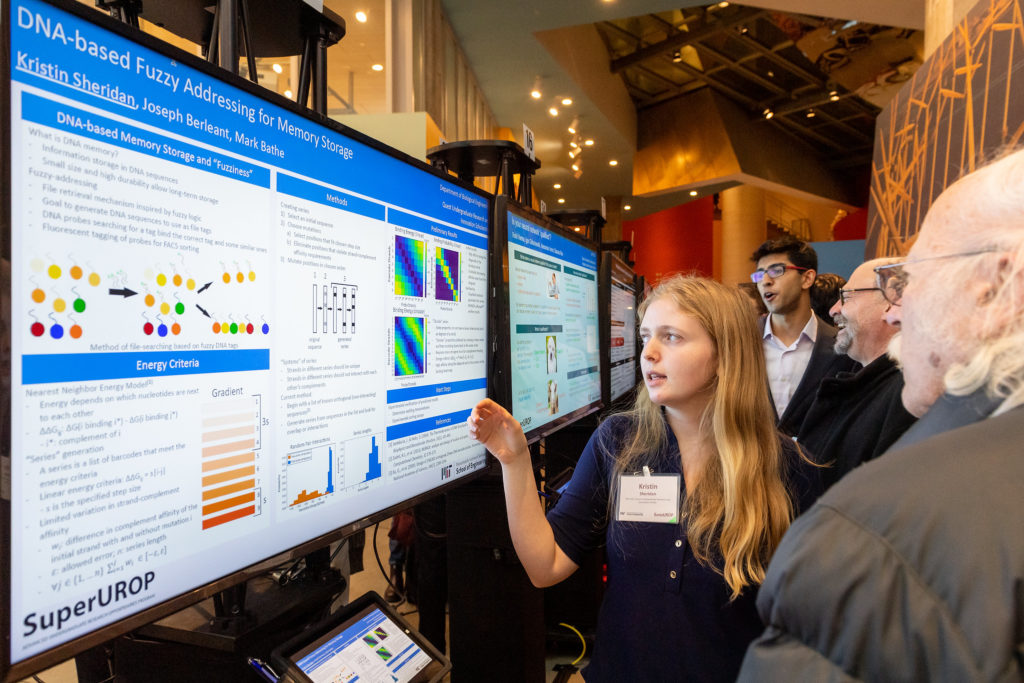
Super-UROP: A development environment for entrepreneurship and mobile apps
A development environment for entrepreneurship and mobile apps Faculty Advisor: Prof. Hal Abelson Contact e-mail: hal@mit.edu Research Area(s): Computer Systems The goal of this project is to build and test an integrated development environment where undergraduates can generate ideas for mobile applications...
Super-UROP: Printable Robots
Printable Robots Faculty Advisor: Daniela Rus Contact e-mail: rus@csail.mit.edu Research Area(s): Artificial Intelligence, Circuits, Communications, Computer Systems, Control, Materials and Devices The goal of this project is to build a variety of flexible robotic systems from scratch... 
Super-UROP: Bullet time smartphone app
Bullet time smartphone app Faculty Advisor: Fredo Durand Contact e-mail: fredo@mit.edu Research Area(s): Graphics and Human-Computer Interfaces Bullet time effects, made popular by movies such as the Matrix, freeze an action...
Super-UROP: Energy-efficient Architectures for Next Generation Video
Energy-efficient Architectures for Next Generation Video Faculty Advisor: Anantha Chandrakasan Mentor(s): Mehul Tikekar Contact e-mail: anantha@mtl.mit.edu, mtikekar@MIT.EDU Research Area(s): Circuits, Computer Systems Most video codecs, such as the ones in Adobe Flash, Apple QuickTime and YouTube...
Super-UROP: Crowd-Powered Audio Tuner
Crowd-Powered Audio Tuner Faculty Advisor: Prof. Rob Miller Contact e-mail: rcm@mit.edu Research Area(s): Graphics and Human-Computer Interfaces The CarSinch project is exploring the possibilities of crowd computing in the car, helping a driver manage information technology...
Super-UROP: Paper-based-Graphene Glucose Sensors
Development of Paper-based Graphene Glucose Sensors Faculty Advisor: Prof. Tomas Palacios Contact e-mail: tpalacios@mit.edu Research Area(s): BioEECS, Materials and Devices In this project, we will fabricate graphene sensor devices on paper to provide a low cost solution to glucose monitoring in diabetic patients.
Super-UROP: Non-destructive breakdown voltage evaluation of High-voltage GaN FETs
Non-destructive breakdown voltage evaluation of High-voltage GaN FETs Faculty Advisor: Jesus del Alamo Contact e-mail: alamo@mit.edu Research Area(s): Materials and Devices This project is about developing non-destructive and non-degrading techniques to evaluate the breakdown voltage of high-voltage GaN FETs. 
VI-A MEng Thesis Program - Interview with Cyril Lan
Meet VI-A (6-A) student Cyril Lan to learn more about the options you have as a VI-A student.
Course 6-2: Electrical Eng. & Computer Science
EECS Course 6-2: Electrical Engineering and Computer Science
6-2 Interview with Ashwini Gokhale
EECS Course 6-2 student Ashwini Gokhale shares her student and career path choices as she decided to be Course 6 and then to be a 6-2 major.
6-2 interview with Kevin Zheng
EECS Course 6-2 student Kevin Zheng shares his student and career path choices as he decided to be Course 6 and then to be a 6-2 major.
Course 6-3: Computer Science and Engineering
6-3 Interview with Carine Abi-Akar
6-3 interview with Carine Abi-Akar
6-3 interview with Ryan Ko
EECS Course 6-3 (Computer Science and Engineering) undergraduate student Ryan Ko gives some feedback about his career course and choosing 6-3.
6-7: Computer Science and Molecular Biology
Course 6-7 is a degree program offered by EECS and Biology for Computer Science and Molecular Biology.
6-7 Interview with Kristjan Eerik Kaseniit
EECS undergraduate student Kristjan Kaseniit talks about his path to MIT EECS and his choice for the new 6-7 degree program in computer science and molecular biology.