New software enables blind and low-vision users to create interactive, accessible charts

A growing number of tools enable users to make online data representations, like charts, that are accessible for people who are blind or have low vision. However, most tools require an existing visual chart that can then be converted into an accessible format.

This creates barriers that prevent blind and low-vision users from building their own custom data representations, and it can limit their ability to explore and analyze important information.

A team of researchers from MIT and University College London (UCL) wants to change the way people think about accessible data representations.

They created a software system called Umwelt (which means “environment” in German) that can enable blind and low-vision users to build customized, multimodal data representations without needing an initial visual chart.

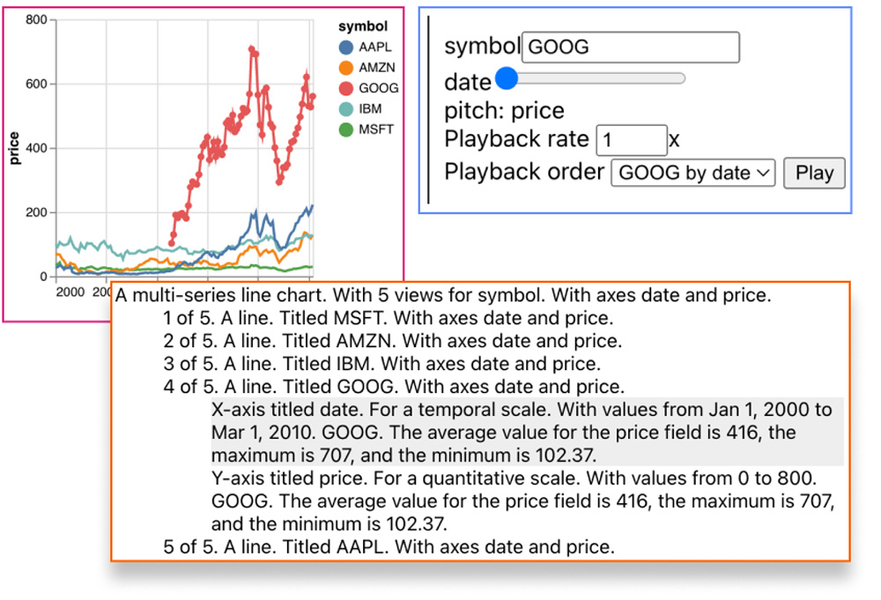
Umwelt, an authoring environment designed for screen-reader users, incorporates an editor that allows someone to upload a dataset and create a customized representation, such as a scatterplot, that can include three modalities: visualization, textual description, and sonification. Sonification involves converting data into nonspeech audio.

Pictured is an example multi-modal representation of stock data created with Umwelt. It includes a line chart, a sonification (top right), and a multi-level textual description describing various fields. In this example, the user has highlighted “GOOG” for Google and Umwelt will allow them to “hear” the data about Google. Image courtesy of Umwelt.

The system, which can represent a variety of data types, includes a viewer that enables a blind or low-vision user to interactively explore a data representation, seamlessly switching between each modality to interact with data in a different way.

The researchers conducted a study with five expert screen-reader users who found Umwelt to be useful and easy to learn. In addition to offering an interface that empowered them to create data representations — something they said was sorely lacking — the users said Umwelt could facilitate communication between people who rely on different senses.

“We have to remember that blind and low-vision people aren’t isolated. They exist in these contexts where they want to talk to other people about data,” says Jonathan Zong, an electrical engineering and computer science (EECS) graduate student and lead author of a paper introducing Umwelt. “I am hopeful that Umwelt helps shift the way that researchers think about accessible data analysis. Enabling the full participation of blind and low-vision people in data analysis involves seeing visualization as just one piece of this bigger, multisensory puzzle.”

Joining Zong on the paper are fellow EECS graduate students Isabella Pedraza Pineros and Mengzhu “Katie” Chen; Daniel Hajas, a UCL researcher who works with the Global Disability Innovation Hub; and senior author Arvind Satyanarayan, associate professor of computer science at MIT who leads the Visualization Group in the Computer Science and Artificial Intelligence Laboratory. The paper will be presented at the ACM Conference on Human Factors in Computing.

De-centering visualization

The researchers previously developed interactive interfaces that provide a richer experience for screen reader users as they explore accessible data representations. Through that work, they realized most tools for creating such representations involve converting existing visual charts.

Aiming to decenter visual representations in data analysis, Zong and Hajas, who lost his sight at age 16, began co-designing Umwelt more than a year ago.

At the outset, they realized they would need to rethink how to represent the same data using visual, auditory, and textual forms.

“We had to put a common denominator behind the three modalities. By creating this new language for representations, and making the output and input accessible, the whole is greater than the sum of its parts,” says Hajas.

To build Umwelt, they first considered what is unique about the way people use each sense.

For instance, a sighted user can see the overall pattern of a scatterplot and, at the same time, move their eyes to focus on different data points. But for someone listening to a sonification, the experience is linear since data are converted into tones that must be played back one at a time.

“If you are only thinking about directly translating visual features into nonvisual features, then you miss out on the unique strengths and weaknesses of each modality,” Zong adds.

They designed Umwelt to offer flexibility, enabling a user to switch between modalities easily when one would better suit their task at a given time.

To use the editor, one uploads a dataset to Umwelt, which employs heuristics to automatically creates default representations in each modality.

If the dataset contains stock prices for companies, Umwelt might generate a multiseries line chart, a textual structure that groups data by ticker symbol and date, and a sonification that uses tone length to represent the price for each date, arranged by ticker symbol.

The default heuristics are intended to help the user get started.

“In any kind of creative tool, you have a blank-slate effect where it is hard to know how to begin. That is compounded in a multimodal tool because you have to specify things in three different representations,” Zong says.

The editor links interactions across modalities, so if a user changes the textual description, that information is adjusted in the corresponding sonification. Someone could utilize the editor to build a multimodal representation, switch to the viewer for an initial exploration, then return to the editor to make adjustments.

Helping users communicate about data

To test Umwelt, they created a diverse set of multimodal representations, from scatterplots to multiview charts, to ensure the system could effectively represent different data types. Then they put the tool in the hands of five expert screen reader users.

Study participants mostly found Umwelt to be useful for creating, exploring, and discussing data representations. One user said Umwelt was like an “enabler” that decreased the time it took them to analyze data. The users agreed that Umwelt could help them communicate about data more easily with sighted colleagues.

“What stands out about Umwelt is its core philosophy of de-emphasizing the visual in favor of a balanced, multisensory data experience. Often, nonvisual data representations are relegated to the status of secondary considerations, mere add-ons to their visual counterparts. However, visualization is merely one aspect of data representation. I appreciate their efforts in shifting this perception and embracing a more inclusive approach to data science,” says JooYoung Seo, an assistant professor in the School of Information Sciences at the University of Illinois at Urbana-Champagne, who was not involved with this work.

Moving forward, the researchers plan to create an open-source version of Umwelt that others can build upon. They also want to integrate tactile sensing into the software system as an additional modality, enabling the use of tools like refreshable tactile graphics displays.

“In addition to its impact on end users, I am hoping that Umwelt can be a platform for asking scientific questions around how people use and perceive multimodal representations, and how we can improve the design beyond this initial step,” says Zong.

This work was supported, in part, by the National Science Foundation and the MIT Morningside Academy for Design Fellowship.

AI generates high-quality images 30 times faster in a single step

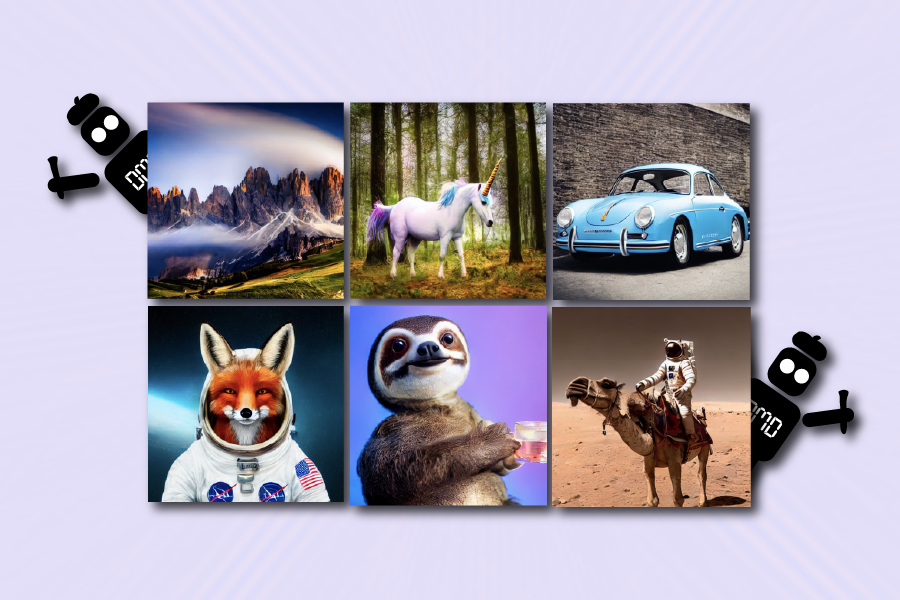
In our current age of artificial intelligence, computers can generate their own “art” by way of diffusion models, iteratively adding structure to a noisy initial state until a clear image or video emerges. Diffusion models have suddenly grabbed a seat at everyone’s table: Enter a few words and experience instantaneous, dopamine-spiking dreamscapes at the intersection of reality and fantasy. Behind the scenes, it involves a complex, time-intensive process requiring numerous iterations for the algorithm to perfect the image.

MIT Computer Science and Artificial Intelligence Laboratory (CSAIL) researchers have introduced a new framework that simplifies the multi-step process of traditional diffusion models into a single step, addressing previous limitations. This is done through a type of teacher-student model: teaching a new computer model to mimic the behavior of more complicated, original models that generate images. The approach, known as distribution matching distillation (DMD), retains the quality of the generated images and allows for much faster generation. 

“Our work is a novel method that accelerates current diffusion models such as Stable Diffusion and DALLE-3 by 30 times,” says Tianwei Yin, an MIT PhD student in electrical engineering and computer science, CSAIL affiliate, and the lead researcher on the DMD framework. “This advancement not only significantly reduces computational time but also retains, if not surpasses, the quality of the generated visual content. Theoretically, the approach marries the principles of generative adversarial networks (GANs) with those of diffusion models, achieving visual content generation in a single step — a stark contrast to the hundred steps of iterative refinement required by current diffusion models. It could potentially be a new generative modeling method that excels in speed and quality.”

This single-step diffusion model could enhance design tools, enabling quicker content creation and potentially supporting advancements in drug discovery and 3D modeling, where promptness and efficacy are key.

Distribution dreams

DMD cleverly has two components. First, it uses a regression loss, which anchors the mapping to ensure a coarse organization of the space of images to make training more stable. Next, it uses a distribution matching loss, which ensures that the probability to generate a given image with the student model corresponds to its real-world occurrence frequency. To do this, it leverages two diffusion models that act as guides, helping the system understand the difference between real and generated images and making training the speedy one-step generator possible.

The system achieves faster generation by training a new network to minimize the distribution divergence between its generated images and those from the training dataset used by traditional diffusion models. “Our key insight is to approximate gradients that guide the improvement of the new model using two diffusion models,” says Yin. “In this way, we distill the knowledge of the original, more complex model into the simpler, faster one, while bypassing the notorious instability and mode collapse issues in GANs.” 

Yin and colleagues used pre-trained networks for the new student model, simplifying the process. By copying and fine-tuning parameters from the original models, the team achieved fast training convergence of the new model, which is capable of producing high-quality images with the same architectural foundation. “This enables combining with other system optimizations based on the original architecture to further accelerate the creation process,” adds Yin. 

When put to the test against the usual methods, using a wide range of benchmarks, DMD showed consistent performance. On the popular benchmark of generating images based on specific classes on ImageNet, DMD is the first one-step diffusion technique that churns out pictures pretty much on par with those from the original, more complex models, rocking a super-close Fréchet inception distance (FID) score of just 0.3, which is impressive, since FID is all about judging the quality and diversity of generated images. Furthermore, DMD excels in industrial-scale text-to-image generation and achieves state-of-the-art one-step generation performance. There’s still a slight quality gap when tackling trickier text-to-image applications, suggesting there’s a bit of room for improvement down the line. 

Additionally, the performance of the DMD-generated images is intrinsically linked to the capabilities of the teacher model used during the distillation process. In the current form, which uses Stable Diffusion v1.5 as the teacher model, the student inherits limitations such as rendering detailed depictions of text and small faces, suggesting that DMD-generated images could be further enhanced by more advanced teacher models. 

“Decreasing the number of iterations has been the Holy Grail in diffusion models since their inception,” says Fredo Durand, MIT professor of electrical engineering and computer science, CSAIL principal investigator, and a lead author on the paper. “We are very excited to finally enable single-step image generation, which will dramatically reduce compute costs and accelerate the process.” 

“Finally, a paper that successfully combines the versatility and high visual quality of diffusion models with the real-time performance of GANs,” says Alexei Efros, a professor of electrical engineering and computer science at the University of California at Berkeley who was not involved in this study. “I expect this work to open up fantastic possibilities for high-quality real-time visual editing.” 

Yin and Durand’s fellow authors are MIT electrical engineering and computer science professor and CSAIL principal investigator William T. Freeman, as well as Adobe research scientists Michaël Gharbi SM ’15, PhD ’18; Richard Zhang; Eli Shechtman; and Taesung Park. Their work was supported, in part, by U.S. National Science Foundation grants (including one for the Institute for Artificial Intelligence and Fundamental Interactions), the Singapore Defense Science and Technology Agency, and by funding from Gwangju Institute of Science and Technology and Amazon. Their work will be presented at the Conference on Computer Vision and Pattern Recognition in June.

Optimizing nuclear fuels for next-generation reactors

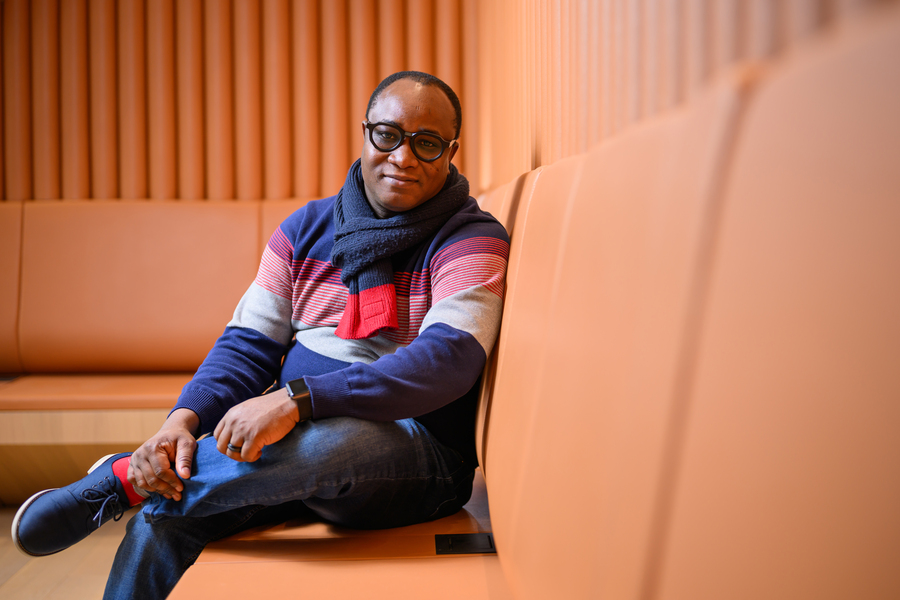
In 2010, when Ericmoore Jossou was attending college in northern Nigeria, the lights would flicker in and out all day, sometimes lasting only for a couple of hours at a time. The frustrating experience reaffirmed Jossou’s realization that the country’s sporadic energy supply was a problem. It was the beginning of his path toward nuclear engineering.

Because of the energy crisis, “I told myself I was going to find myself in a career that allows me to develop energy technologies that can easily be scaled to meet the energy needs of the world, including my own country,” says Jossou, an assistant professor in a shared position between the departments of Nuclear Science and Engineering (NSE), where is the John Clark Hardwick (1986) Professor, and of Electrical Engineering and Computer Science.

Today, Jossou uses computer simulations for rational materials design, AI-aided purposeful development of cladding materials and fuels for next-generation nuclear reactors. As one of the shared faculty hires between the MIT Schwarzman College of Computing and departments across MIT, his appointment recognizes his commitment to computing for climate and the environment.

A well-rounded education in Nigeria

Growing up in Lagos, Jossou knew education was about more than just bookish knowledge, so he was eager to travel and experience other cultures. He would start in his own backyard by traveling across the Niger river and enrolling in Ahmadu Bello University in northern Nigeria. Moving from the south was a cultural education with a different language and different foods. It was here that Jossou got to try and love tuwo shinkafa, a northern Nigerian rice-based specialty, for the first time.

After his undergraduate studies, armed with a bachelor’s degree in chemistry, Jossou was among a small cohort selected for a specialty master’s training program funded by the World Bank Institute and African Development Bank. The program at the African University of Science and Technology in Abuja, Nigeria, is a pan-African venture dedicated to nurturing homegrown science talent on the continent. Visiting professors from around the world taught intensive three-week courses, an experience which felt like drinking from a fire hose. The program widened Jossou’s views and he set his sights on a doctoral program with an emphasis on clean energy systems.

A pivot to nuclear science

While in Nigeria, Jossou learned of Professor Jerzy Szpunar at the University of Saskatchewan in Canada, who was looking for a student researcher to explore fuels and alloys for nuclear reactors. Before then, Jossou was lukewarm on nuclear energy, but the research sounded fascinating. The Fukushima, Japan, incident was recently in the rearview mirror and Jossou remembered his early determination to address his own country’s energy crisis. He was sold on the idea and graduated with a doctoral degree from the University of Saskatchewan on an international dean’s scholarship.

Jossou’s postdoctoral work registered a brief stint at Brookhaven National Laboratory as staff scientist. He leaped at the opportunity to join MIT NSE as a way of realizing his research interest and teaching future engineers. “I would really like to conduct cutting-edge research in nuclear materials design and to pass on my knowledge to the next generation of scientists and engineers and there’s no better place to do that than at MIT,” Jossou says.

Merging material science and computational modeling

Jossou’s doctoral work on designing nuclear fuels for next-generation reactors forms the basis of research his lab is pursuing at MIT NSE. Nuclear reactors that were built in the 1950s and ’60s are getting a makeover in terms of improved accident tolerance. Reactors are not confined to one kind, either: We have micro reactors and are now considering ones using metallic nuclear fuels, Jossou points out. The diversity of options is enough to keep researchers busy testing materials fit for cladding, the lining that prevents corrosion of the fuel and release of radioactive fission products into the surrounding reactor coolant.

The team is also investigating fuels that improve burn-up efficiencies, so they can last longer in the reactor. An intriguing approach has been to immobilize the gas bubbles that arise from the fission process, so they don’t grow and degrade the fuel.

Since joining MIT in July 2023, Jossou is setting up a lab that optimizes the composition of accident-tolerant nuclear fuels. He is leaning on his materials science background and looping computer simulations and artificial intelligence in the mix.

Computer simulations allow the researchers to narrow down the potential field of candidates, optimized for specific parameters, so they can synthesize only the most promising candidates in the lab. And AI’s predictive capabilities guide researchers on which materials composition to consider next. “We no longer depend on serendipity to choose our materials, our lab is based on rational materials design,” Jossou says, “we can rapidly design advanced nuclear fuels.”

Advancing energy causes in Africa

Now that he is at MIT, Jossou admits the view from the outside is different. He now harbors a different perspective on what Africa needs to address some of its challenges. “The starting point to solve our problems is not money; it needs to start with ideas,” he says, “we need to find highly skilled people who can actually solve problems.” That job involves adding economic value to the rich arrays of raw materials that the continent is blessed with. It frustrates Jossou that Niger, a country rich in raw material for uranium, has no nuclear reactors of its own. It ships most of its ore to France. “The path forward is to find a way to refine these materials in Africa and to be able to power the industries on that continent as well,” Jossou says.

Jossou is determined to do his part to eliminate these roadblocks.

Anchored in mentorship, Jossou’s solution aims to train talent from Africa in his own lab. He has applied for a MIT Global Experiences MISTI grant to facilitate travel and research studies for Ghanaian scientists. “The goal is to conduct research in our facility and perhaps add value to indigenous materials,” Jossou says.

Adding value has been a consistent theme of Jossou’s career. He remembers wanting to become a neurosurgeon after reading “Gifted Hands,” moved by the personal story of the author, Ben Carson. As Jossou grew older, however, he realized that becoming a doctor wasn’t necessarily what he wanted. Instead, he was looking to add value. “What I wanted was really to take on a career that allows me to solve a societal problem.” The societal problem of clean and safe energy for all is precisely what Jossou is working on today.

2024 MacVicar Faculty Fellows named

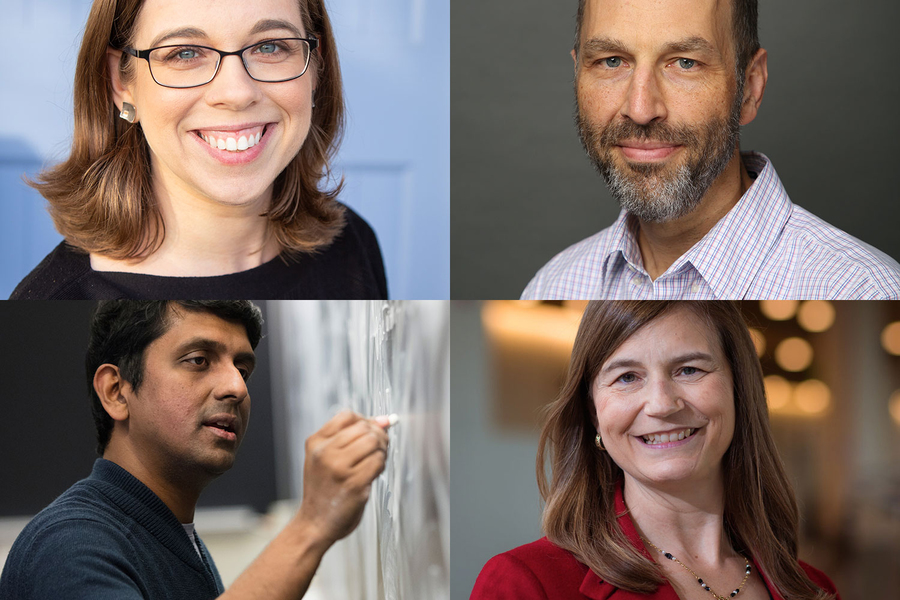
Four outstanding undergraduate teachers and mentors have been named MacVicar Faculty Fellows: professor of electrical engineering and computer science (EECS) Karl Berggren, professor of political science Andrea Campbell, associate professor of music Emily Richmond Pollock, and professor of EECS Vinod Vaikuntanathan.

For more than 30 years, the MacVicar Faculty Fellows Program has recognized exemplary and sustained contributions to undergraduate education at MIT. The program is named in honor of Margaret MacVicar, MIT’s first dean for undergraduate education and founder of the Undergraduate Research Opportunities Program (UROP).

New fellows are chosen each year through a highly competitive nomination process. They receive an annual stipend and are appointed to a 10-year term. Nominations, including letters of support from colleagues, students, and alumni, are reviewed by an advisory committee led by vice chancellor Ian Waitz with final selections made by provost Cynthia Barnhart.

Role models both in and out of the classroom, Berggren, Campbell, Pollock, and Vaikuntanathan join an elite academy of scholars from across the Institute who are committed to curricular innovation; exceptional teaching; collaboration with colleagues; and supporting students through mentorship, leadership, and advising.

Karl Berggren

“It is a great honor to have been selected for this fellowship. It has particularly made me remember the years of dedicated mentoring and support that I’ve received from my colleagues,” says Karl Berggren. “I’ve also learned a great deal over this period from our students by way of their efforts and thoughtful feedback. MIT continuously strives for excellence in undergraduate education, and I feel very lucky to have been part of that effort.”

Karl Berggren is the Joseph F. and Nancy P. Keithley Professor in the Department of EECS. He received his PhD from Harvard University and his BA in physics from Harvard College. Berggren joined MIT in 1996 as a staff member at Lincoln Laboratory before becoming an assistant professor in 2003. He regularly teaches undergraduate EECS offerings including 6.2000, formerly 6.002 (Electrical Circuits), and 6.3400, formerly 6.02 (Introduction to EECS via Communication Networks).

Sahil Pontula ’23 writes“Professor Berggren turned 6.002 from a mere course requirement into a truly memorable experience that shaped my current research interests and provided a unique perspective … He is devoted not just to educating the next generation of engineers, but also to imbuing in them interdisciplinary problem-solving perspectives that push the frontiers of science forward.”

MacVicar Fellow and professor of EECS Jeffrey Lang notes, “His lectures are polished, presented with humor, and well-appreciated by his students.” Senior Tiffany Louieadds: “He connects with us, inspires us, and welcomes us to ask questions in class and in the greater electrical engineering field.”

Berggren is also deeply invested in the art and science of teaching. Tomás Palacios, professor of EECS, says, “Professor Berggren is genuinely interested in continuously improving the educational experience of our students. He approaches this in the same methodological and quantitative way we typically approach research. He is well-versed in the most modern theories about learning and he is always happy to share … relevant books and papers on the subject.”

Lang agrees, noting that Berggren “reads articles and books that examine and discuss how learning occurs so that he can become a more effective teacher.” He goes on to recall a conversation in which Berggren explained a new form of homework grading. Instead of reducing grades for errors that did not render an obviously flawed result, he helps students extract key takeaways from their assignments and come to correct solutions on their own. Lang notes that a key benefit of this approach is that it allows graders to “work much more quickly yet carefully” and “provides them more time to spend on giving helpful feedback.”

Adding to his long list of contributions, Berggren also oversees the EECS teaching labs. Since assuming this role, he has pursued changes to ensure that students feel comfortable and confident using the space for both coursework and outside projects, developing their critical thinking and hands-on skills.

Faculty head and professor of electrical engineering Joel Voldman applauds Berggren’s efforts: “Since [he] has taken over, the labs are now a place for projects of all sorts, with students being trained on various processes, parts being easy to obtain, equipment readily available … His fundamental mantra has been to make a space that serves students, meets them where they’re at, and helps them get to where they want to go.”

Andrea Campbell

Andrea Campbell received her BA in social studies from Harvard University and her MA and PhD in political science from the University of California at Berkeley. She joined MIT’s Department of Political Science in 2005 and is currently the Arthur and Ruth Sloan Professor of Political Science and director of undergraduate studies.

Professor Campbell regularly teaches classes 17.30 (Making Public Policy), 17.315 (Health Policy), and 17.317 (U.S. Social Policy). Her research examines the relationships between public policies, public opinion, and political behavior.

A unique aspect of Campbell’s teaching style is the personal approach she brings. In 17.315, Campbell shared her own experiences following a tragic accident in her family, which highlighted the real-life challenges that many face navigating America’s health care system.

According to David Singer, department head and the Raphael Dorman-Helen Starbuck Professor of Political Science, Campbell “weaves personal experience into her teaching in powerful ways … Her openness about her experience permits students to share their own … thereby strengthening their own engagement with the material.”

Singer goes on to say, “In all of her classes, [she] encourages students to examine policymaking not as a technocratic exercise, or an exercise of optimization, but rather as a process infused with politics. In steering her pedagogy in this way, she shows her students how to understand the identity and interests of different groups in society, where their relative power emanates from, and how the rules and institutions of the U.S. political system shape policy outcomes on critical issues like LGBTQ rights, gun control, military intervention, and health care.”

Students say her classes are incredibly impactful, lingering with them for years to come. Her former teaching assistant, now Harvard professor, Justin de Benedictis-Kessner wrote, “Andrea’s talents have been an enormous asset … I have seen how many of her former undergraduate students have gone on to successful careers adjacent to her field of public policy in large part because of her inspiration.” Echoing this sentiment, Julia H. Ginder ’19 writes, “her lessons and mentorship have impacted my day-to-day life and career trajectory even five years after graduation.”

Campbell’s work set the stage for wide-ranging improvements to the Course 17 curriculum and under her leadership, public policy has become the most popular minor in the department. Singer writes, “She ensures that required classes in political institutions, economics, and substantive policy areas are regularly taught, and she proselytizes … to students about the importance of understanding policymaking, especially to [those] in engineering and sciences who might otherwise overlook this critically important domain.”

Campbell is heavily involved with undergraduate advising at the department, school, and Institute levels. She is a popular sponsor of UROPs and attracts many undergraduate researchers each year. Campbell is also co-chair of the Gender Equity Committee in the School of Humanities, Arts, and Social Sciences (SHASS) and the Subcommittee on the Communication Requirement (SOCR).

“It is clear that Andrea takes undergraduate teaching extraordinarily seriously, not just when designing her own classes, but when leading the undergraduate program in our department,” says Adam Berinsky, the Mitsui Professor of Political Science.

Beyond her many pedagogical and curricular accomplishments, Singer notes: “Andrea’s students consistently tout her extraordinary degree of personal engagement. She takes the time to get to know students, to mentor them outside the classroom, and to keep them energized in the classroom. Many express gratitude for Andrea’s willingness to go the extra mile — by staying late after class, holding extra office hours, and even inviting students to her home for Thanksgiving dinner.”

On receiving this award Campbell writes, “I am so grateful to my colleagues and students for taking the time to nominate me and so honored to be selected. Teaching and mentoring MIT students is such a joy. I am well aware that some students come through my door just to fulfill a requirement. Others come with genuine enthusiasm and interest. Either way, I love watching them discover how fascinating political science is and how relevant politics and policymaking are for their lives and their futures.”

Emily Richmond Pollock

“I am truly thrilled to become a MacVicar Faculty Fellow. Working with the undergraduates at MIT is such a gift in itself. When I teach, I can only strive to match the students’ creativity and commitment with my own,” says Emily Richmond Pollock.

Pollock joined MIT’s faculty in 2012. She received her BA in music from Harvard University in 2006 and her MA and PhD in music history and literature from the University of California at Berkeley in 2008 and 2012. She was awarded MIT’s Arthur C. Smith Award for meaningful contributions and devotion to undergraduate student life and learning in 2019 and the James A. and Ruth Levitan Teaching Award from the SHASS in 2020. She currently serves on the SOCR, the Subcommittee on the HASS requirements, and is the inaugural undergraduate chair in the SHASS.

Pollock is a dedicated mentor and advisor and testimonials highlight her commitment to student well-being and intellectual development. “Professor Emily Richmond Pollock is a kind, intentional, and dedicated teacher and advisor,” says senior Katherine Reisig. “By fostering such a welcoming community, she helps the MIT music department be a better place. It is clear … [she] cares deeply about her students, not only that we are doing well academically, but also that we are succeeding in life and doing well mentally.”

MacVicar Faculty Fellow and associate professor of literature Marah Gubar agrees: “Emily has long served as a role model for how to support the ‘whole student’ in ways that build community, right wrongs, and infuse more humanity and beauty into our campus.”

MIT colleagues and students praise Pollock’s extensive contributions to curriculum development at the introductory and advanced levels. She regularly teaches class 21M.011 (Introduction to Western Music) and courses on opera, symphonic repertoire, and the advanced seminar for music majors. Her lectures provide lively learning experiences in which her students are encouraged to think critically about music and culture, dive into unfamiliar operas with curiosity, and compare dramatic elements across time periods.

“I came away from 21M.011 not only with a better understanding of Western music, but with new curiosities and questions about music’s role in the world. Professor Pollock’s teaching made me want to learn more  it encouraged lifelong discovery, curiosity, and education,” Reisig says.

Associate professor of music and MacVicar Faculty Fellow Patricia Tang writes, “Professor Pollock continues to grow as a leader in pedagogical innovation, transforming the music history curriculum and being a true inspiration to her colleagues in her devotion to her students. Though these subjects existed in the course catalog before Pollock’s arrival, in all cases she has radically transformed them, infusing new energy and excitement into the curriculum.”

Pollock also champions issues of diversity, equity, and inclusion in the arts and is dedicated to making classical music and opera more accessible while maintaining the intellectual prestige applauded by students. She encourages students to embrace lesser-known works and step outside their comfort zone, even taking students to the opera herself. She has a “strong interest in anti-racist pedagogies and decolonizing music curriculum … [her] pedagogical innovations are numerous,” Tang observes.

About her impact as an advisor, Tang notes: “Professor Pollock genuinely loves getting to know her students … it is really her ‘superpower.’ It is her mission to make sure [they] are not just surviving but thriving in their first year.”

Senior Hana Ro agrees: “Under her guidance, my academic journey has been transformed, and I have gained not only a profound understanding of [this] subject matter but also a sense of belonging and encouragement that has been invaluable during my time at MIT.”

Furthermore, Pollock ensures that students never feel isolated or alone. Graduate student Frederick Ajisafe says, “If she knew that a cohort was taking a demanding class, she would check in with us … In all cases, Emily emphasized her belief in our ability to succeed and her willingness to help us get there.”

Vinod Vaikuntanathan

Vinod Vaikuntanathan is a professor in the Department of EECS. He received his bachelor’s degree in computer science from the Indian Institute of Technology Madras in 2003 and his SM and PhD degrees in computer science from MIT in 2005 and 2009. Vaikuntanathan joined the faculty in 2013 and in recognition of his contributions to teaching and service to students, he received the Harold E. Edgerton Faculty Achievement Award in 2017 and the Ruth and Joel Spira Award for Distinguished Teaching in 2016.

Vaikuntanathan has taught all three EECS undergraduate theoretical computer science subjects including 6.1210, formerly 6.006 (Introduction to Algorithms); 6.1200, formerly 6.042 (Mathematics for Computer Science); and 6.1220, formerly 6.046 (Design and Analysis of Algorithms).

Students say his classes are challenging, yet approachable and inclusive. Helen Propson ’24 writes,“He excels at makingcomplex subjects like cryptography accessible and captivating for all students, creating anatmosphere where every student’s input is highly regarded. He embraces questions and leaves students feeling inspired and motivated to tackle challenging problems, fostering a sense of confidence and a belief in their own abilities.” She goes on to say, “He often describes intricate concepts as ‘magical,’ and his enthusiasm is contagious, making the material come alive in the classroom.”

MIT alumna Anne Kim concurs: “His teaching style is characterized by its clarity, enthusiasm, and a genuine passion for the subject matter. In his classes, he managed to distill complex algorithms into digestible concepts, making the material accessible to students with varying levels of expertise.”

Vaikuntanathan has also made significant contributions to the EECS curriculum. In spring 2022, he, along with fellow professors in the department, led an effort to improve 6.046. According to professor of EECS and MacVicar Fellow Srini Devadas, “designing a new lecture for 6.046 is not easy. Each new lecture is, typically, days of prep work, including preparing to … give the lecture itself and writing and testing problem set questions, quiz questions, and quiz practice questions. Vinod did all this with skill, aplomb, and enthusiasm. His contributions have had a permanent and beneficial effect on 6.046.”

Widely known for his work in cryptography, including homomorphic encryption and computational complexity, Vaikuntanathan became the lecturer-in-charge of the department’s first theoretical cryptography offering, 6.875. In addition, as the fields of quantum and post-quantum cryptography have grown, “Vinod has added relevant modules to the syllabus, taking the place of topics which had grown obsolete,” Devadas remarks. “Some professors might see teaching the same class multiple times as a chance to save themselves work by reusing the same materials. Vinod sees teaching 6.875 every fall as an opportunity to keep improving the class.”

Vinod Vaikuntanathan is also a devoted mentor and advisor, assisting with first-year UROPs and encouraging students to take advantage of his “open-door” policy. Kim writes that Professor Vaikuntanathan is benefiting her career still as “his mentorship … extends beyond the classroom through his research” and that he “has mentored and advised dozens of [her] friends in the cryptography space.”

“His encouraging demeanor sets a remarkable example of the kind of teacher every student hopes to encounter during their academic career,” says Propson.

On becoming a MacVicar Faculty Fellow Vaikuntanathan writes, “It is humbling to be in the company of such amazing teachers and mentors, many of whom I have come to think of as my role models. Many thanks to my colleagues and my students for considering me worthy of this honor.”


Priya Donti named AI2050 Early Career Fellow

Photo courtesy the subject.

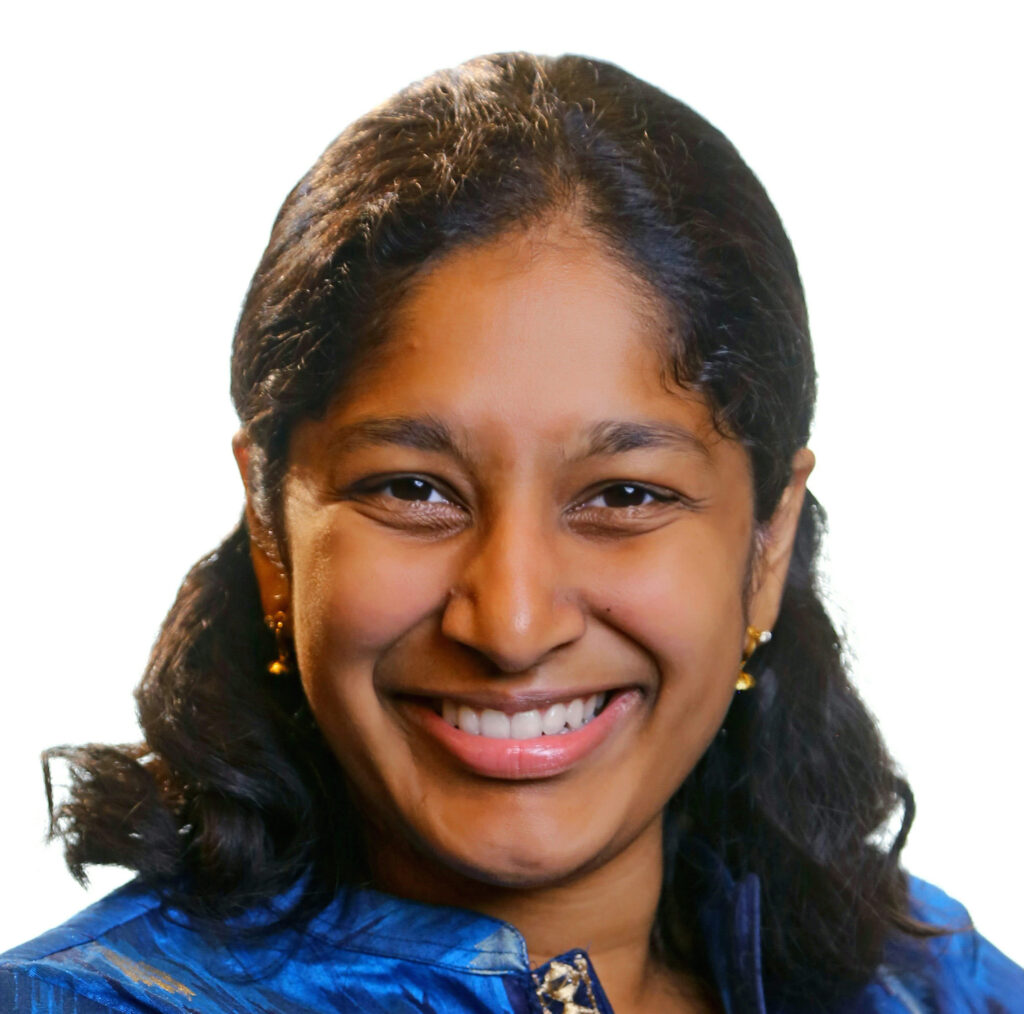
Assistant Professor Priya Donti has been named an AI2050 Early Career Fellow by Schmidt Sciences, a philanthropic initiative from Eric and Wendy Schmidt aimed at helping to solve hard problems in AI

Priya Donti joined the Department of EECS as an assistant professor in September of 2023. Her work focuses on physics-informed deep learning for forecasting, optimization, and control in high-renewables power grids; additionally, she is the co-founder of Climate Change AI, global nonprofit initiative to catalyze impactful work at the intersection of climate change and machine learning. Donti earned her bachelor’s degree in computer science and mathematics from Harvey Mudd College and her PhD in computer science and public policy from Carnegie Mellon University. She was honored with the MIT Technology Review Innovators Under 35 Award and the ACM SIGEnergy Doctoral Dissertation Award. She has also been honored as a U.S. Department of Energy Computational Science Graduate Fellow, Siebel Scholar, NSF Graduate Research Fellow, and Thomas J. Watson Fellow.


Conceived and co-chaired by Eric Schmidt and James Manyika, AI2050 stems in part from issues raised in the bestselling book, The Age of AI: And our Human Future, co-authored by Schmidt, Henry Kissinger, and Schwarzman College of Computing Dean Dan Huttenlocher. The initiative is grounded in the following motivating question: It’s 2050. AI has turned out to be hugely beneficial to society. What happened? What are the most important problems we solved and the opportunities and possibilities we realized to ensure this outcome? AI2050 aims to support exceptional people working on key opportunities and hard problems that are critical to get right for society to benefit from AI.

Using generative AI to improve software testing

Generative AI is getting plenty of attention for its ability to create text and images. But those media represent only a fraction of the data that proliferate in our society today. Data are generated every time a patient goes through a medical system, a storm impacts a flight, or a person interacts with a software application.

Using generative AI to create realistic synthetic data around those scenarios can help organizations more effectively treat patients, reroute planes, or improve software platforms — especially in scenarios where real-world data are limited or sensitive.

For the last three years, the MIT spinout DataCebo has offered a generative software system called the Synthetic Data Vault to help organizations create synthetic data to do things like test software applications and train machine learning models.

The Synthetic Data Vault, or SDV, has been downloaded more than 1 million times, with more than 10,000 data scientists using the open-source library for generating synthetic tabular data. The founders — Principal Research Scientist Kalyan Veeramachaneni and alumna Neha Patki ’15, SM ’16 — believe the company’s success is due to SDV’s ability to revolutionize software testing.

SDV goes viral

In 2016, Veeramachaneni’s group in the Data to AI Lab unveiled a suite of open-source generative AI tools to help organizations create synthetic data that matched the statistical properties of real data.

Companies can use synthetic data instead of sensitive information in programs while still preserving the statistical relationships between datapoints. Companies can also use synthetic data to run new software through simulations to see how it performs before releasing it to the public.

Veeramachaneni’s group came across the problem because it was working with companies that wanted to share their data for research.

“MIT helps you see all these different use cases,” Patki explains. “You work with finance companies and health care companies, and all those projects are useful to formulate solutions across industries.”

In 2020, the researchers founded DataCebo to build more SDV features for larger organizations. Since then, the use cases have been as impressive as they’ve been varied.

With DataCebo’s new flight simulator, for instance, airlines can plan for rare weather events in a way that would be impossible using only historic data. In another application, SDV users synthesized medical records to predict health outcomes for patients with cystic fibrosis. A team from Norway recently used SDV to create synthetic student data to evaluate whether various admissions policies were meritocratic and free from bias.

In 2021, the data science platform Kaggle hosted a competition for data scientists that used SDV to create synthetic data sets to avoid using proprietary data. Roughly 30,000 data scientists participated, building solutions and predicting outcomes based on the company’s realistic data.

And as DataCebo has grown, it’s stayed true to its MIT roots: All of the company’s current employees are MIT alumni.

Supercharging software testing

Although their open-source tools are being used for a variety of use cases, the company is focused on growing its traction in software testing.

“You need data to test these software applications,” Veeramachaneni says. “Traditionally, developers manually write scripts to create synthetic data. With generative models, created using SDV, you can learn from a sample of data collected and then sample a large volume of synthetic data (which has the same properties as real data), or create specific scenarios and edge cases, and use the data to test your application.”

For example, if a bank wanted to test a program designed to reject transfers from accounts with no money in them, it would have to simulate many accounts simultaneously transacting. Doing that with data created manually would take a lot of time. With DataCebo’s generative models, customers can create any edge case they want to test.

“It’s common for industries to have data that is sensitive in some capacity,” Patki says. “Often when you’re in a domain with sensitive data you’re dealing with regulations, and even if there aren’t legal regulations, it’s in companies’ best interest to be diligent about who gets access to what at which time. So, synthetic data is always better from a privacy perspective.”

Scaling synthetic data

Veeramachaneni believes DataCebo is advancing the field of what it calls synthetic enterprise data, or data generated from user behavior on large companies’ software applications.

“Enterprise data of this kind is complex, and there is no universal availability of it, unlike language data,” Veeramachaneni says. “When folks use our publicly available software and report back if works on a certain pattern, we learn a lot of these unique patterns, and it allows us to improve our algorithms. From one perspective, we are building a corpus of these complex patterns, which for language and images is readily available. “

DataCebo also recently released features to improve SDV’s usefulness, including tools to assess the “realism” of the generated data, called the SDMetrics library as well as a way to compare models’ performances called SDGym.

“It’s about ensuring organizations trust this new data,” Veeramachaneni says. “[Our tools offer] programmable synthetic data, which means we allow enterprises to insert their specific insight and intuition to build more transparent models.”

As companies in every industry rush to adopt AI and other data science tools, DataCebo is ultimately helping them do so in a way that is more transparent and responsible.

“In the next few years, synthetic data from generative models will transform all data work,” Veeramachaneni says. “We believe 90 percent of enterprise operations can be done with synthetic data.”

Student Spotlight: Victory Yinka-Banjo

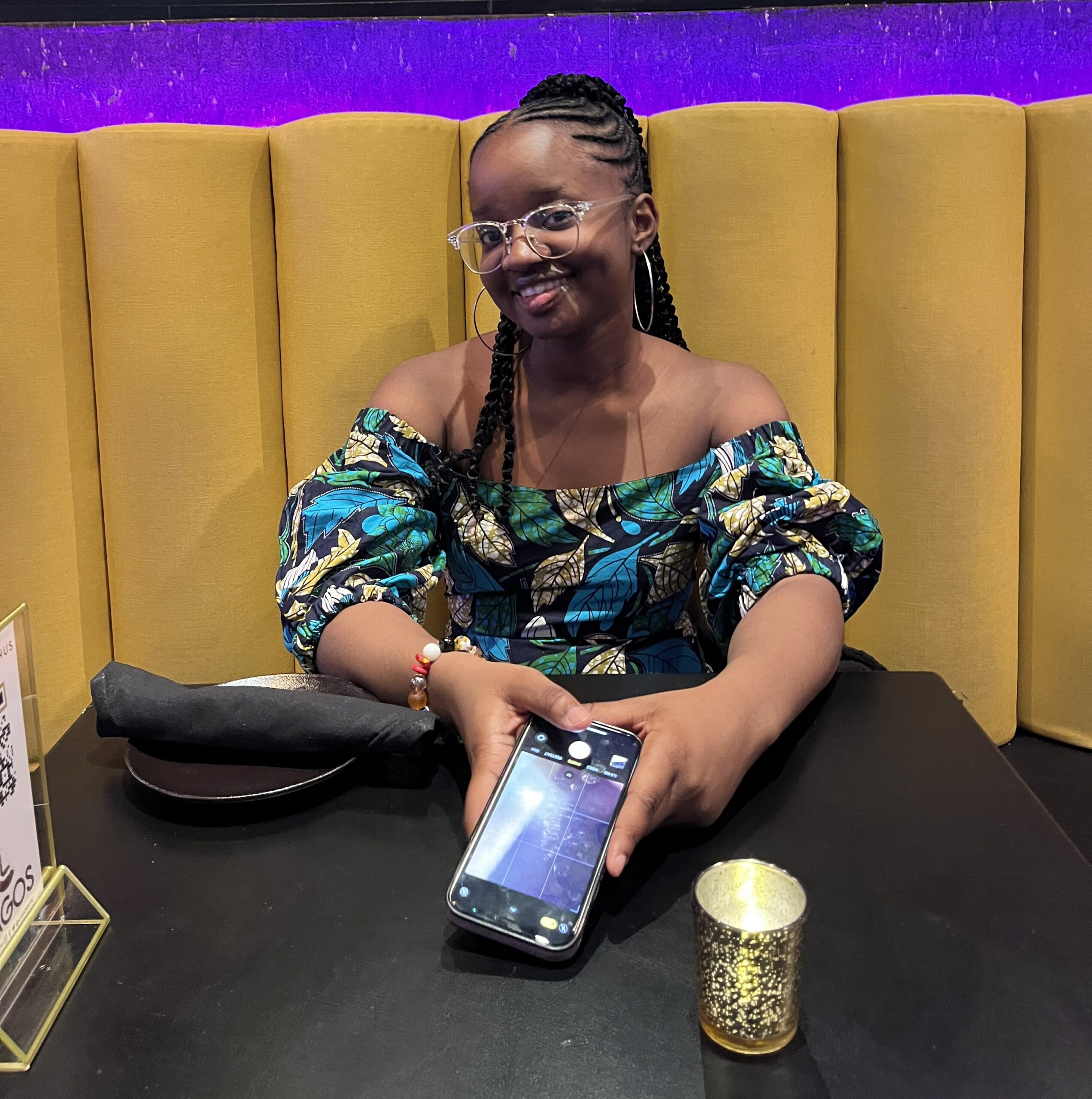
This interview is part of a series of short interviews from the Department of EECS, called Student Spotlights. Each Spotlight features a student answering their choice of questions about themselves and life at MIT. Today’s interviewee, Victory Yinka-Banjo, is a junior majoring in 6-7: Computer Science and Molecular Biology. Yinka-Banjo keeps a packed schedule; she is a member of the Office of Minority Education (OME) Laureates & Leaders program; a 2024 fellow in the public service-oriented BCAP program; has previously served as Secretary of the African Students’ Association and is now undergraduate president of the MIT Biotech Group; additionally, she is a SuperUROP Scholar; a member of the Ginkgo Bioworks’ Cultivate Fellowship (a program that supports students interested in synthetic biology/biotech); and an ambassador for Leadership Brainery, which equips juniors/leaders of color with the resources needed to prepare for graduate school. Nevertheless, she found time to share a peek into her MIT experience with readers. 

What’s your favorite building or room within MIT, and what’s special about it to you?

It has to be the Broad Institute of MIT & Harvard on Ames Street in Kendall Square, where I do my SuperUROP research in Caroline Uhler’s lab. Outside of classes, you’re 90% likely to find me on the newest mezzanine floor (between the 11th and 12th floor), in one of the UROP rooms I share with two other undergrads in the lab. We have standing desks, an amazing coffee/hot chocolate machine, external personal monitors, comfortable sofas – everything really! Not only is it my favorite building, it is also my favorite study spot on campus. In fact, I am there so often that when friends recently planned a birthday surprise for me, they told me they were considering having it at the Broad, since they could count on me being there. 

I think the most beautiful thing about this building, apart from the beautiful view of Cambridge we get from being on one of the highest floors, is that when I was applying to MIT from high school, I had fantasized working at the Broad because of the ground-breaking research. To think that it is now a reality makes me appreciate every minute I spend on my floor, whether I am doing actual research or some last-minute studying for a midterm. 

Tell me about one interest or hobby you’ve discovered since you came to MIT. (It doesn’t have to be academic!)

I have become pretty involved in the performing arts since I got to MIT! I have acted in two plays run by the Black Theater Guild, which was revived during my freshman year by one of my friends. I played a supporting role in the first play called Nkrumah’s Last Day, which was about Ghana at a time of governance under Kwame Nkrumah (its first president). In the second play, a ghost story/comedy called Shooting the Sheriff, I played one of the lead roles. Both caused me to step way out of my comfort zone and I loved the experiences because of that. I also got to act with some of my close friends who were first-time stage actors as well, so that made it even more fun. 

Outside of acting, I also do spoken word/poetry. I have performed at events like the African Students Association Cultural Night, MIT Africa Innovate Conference and Black Womens’ Alliance Banquet. I try to use my pieces to share my experiences both within and beyond MIT, offering the perspective of an international Nigerian student. My favorite piece was called Code Switch, and I used concepts from CS & Biology (especially genetic code switching), to draw parallels with linguistic code-switching, and emphasize the beauty and originality of authenticity. This semester, I’m also a part of MIT Monologues and will be performing a piece called Inheritance, about the beauty of self-love found in affection transferred from a mother. 

Are you a re-reader or a re-watcher—and if so, what are your comfort books, shows, or movies?

I don’t watch too many movies, although I used to be obsessed with all parts of High School Musical; and the only book I’ve ever reread is Americanah. I would actually say I am a re-podcaster! My go-to comfort-podcast is this episode, “A Breakthrough Unfolds”, by Google DeepMind. It makes me a little emotional every time I listen. It is such an exemplification of the power of science and its ability to break boundaries that humans formerly thought impossible. As a Computer Science & Biology major, I am particularly interested in these two disciplines’ applications to relevant problems, like the protein-folding problem discussed in the episode, which DeepMind’s solution for has caused massive advances in the biotech industry. It makes me so hopeful for the future of biology, and the ways in which computation can advance human health and precision medicine.

Who’s your favorite artist? (Using the term very broadly; any form of art can qualify!)

When I think of the word ‘artist’, I think of music artists first. There are so many who I love; my favorites also evolve over time. I’m Christian, so I listen to a lot of gospel music. I’m also Nigerian so I listen to a lot of afrobeats. Since last summer, I’ve been obsessed with Limoblaze, who fuses both gospel and afrobeats music! KB, a super talented gospel rapper, is also somewhat tied in ranking with Limo for me right now. His songs are probably ~50% of my workout playlist.

It’s time to get on the shuttle to the first Mars colony, and you can only bring one personal item. What are you going to bring along with you?

Oooh, this is a tough one, but it has to be my brass rat. Ever since I got mine at the end of sophomore year, it’s been nearly impossible for me to take it off. If there’s ever a time I forget to wear it, my finger feels off for the entire day. 

Tell me about one conversation that changed the trajectory of your life.

Two specific career-defining moments come to mind. They aren’t quite conversations, but they are talks/lectures that I was deeply inspired by. The first was towards the end of high school when I watched this TEDx Talk about storing data in DNA. At the time, I was getting ready to apply to colleges and I knew that biology and computer science were two things I really liked, but I didn’t really understand the possibilities that could be birthed from them coming together as an interdisciplinary field. The TEDx talk was my eureka moment for computational biology. 

The second moment was in my junior Fall during an introductory lecture to “Lab Fundamentals for Bioengineering” by Professor Jacquin Niles. I started the school year with a lot of confusion about my future post-grad, and the relevance of my planned career path to the communities that I care about. Basically, I was unsure about how Computational Biology fit into the context of Nigeria’s problems, especially because my interest in the field is oriented towards molecular biology/medicine, not necessarily public health. 

In the US, most research focuses on diseases like cancer and Alzheimer’s, which, while important, are not the most pressing health conditions in tropical regions like Nigeria. When Prof Niles told us about his lab’s dedication to malaria research from a molecular biology standpoint, it was yet another eureka moment. Like yes! Computation and molecular biology can indeed mitigate diseases that affect developing nations like Nigeria–diseases that are understudied, and whose research is underfunded. 

Since his talk, I found a renewed sense of purpose. Grad school isn’t the end goal. Using my skills to shine a light on the issues affecting my people that deserve far more attention is the goal. I’m so excited to see how I will use Computational Biology to possibly create the next cure to a commonly neglected tropical disease, or accelerate the diagnosis of one. Whatever it may be, I know that it will be close to home, eventually 🙂

What are you looking forward to about life after graduation? What do you think you’ll miss about MIT?

Thinking about graduating actually makes me sad. I’ve grown to love MIT. The biggest thing I’ll miss, though, is Independent Activities Period (IAP). It is such a unique part of the MIT experience. I’ve done a web development class/competition, research, a data science challenge, a molecular bio crash course, and a deep learning crash course over the past 3 IAPs. It is SUCH an amazing time to try something low stakes, forget about grades, explore Boston, build a robot, travel abroad, do less, go slower, really rejuvenate before the Spring, and embrace MIT’s motto of “mind and hand” by just being creative and explorative. It is such an exemplification of what it means to go here, and I can’t imagine it being the same anywhere else. 

That said, I look forward to graduating so I can do more research. My hours spent at the Broad thinking about my UROP are always the quickest hours of my week. I love the rabbit holes my research allows me to explore, and I hope that I find those over and over again as I apply and hopefully get into PhD programs. I look forward to exploring a new city after I graduate too. I wouldn’t mind staying in Cambridge/Boston. I love it here. But I would welcome a chance to be somewhere new and embrace all the people and unique experiences it has to offer. I also hope to work on more passion projects post-grad. I feel like I have this idea in my head that once I graduate from MIT, I’ll have so much more time on my hands (we’ll see how that goes). I hope that I can use that time to work on education projects in Nigeria, which is a space I care a lot about. Generally, I want to make service more integrated in my lifestyle. I hope that post-graduation, I can prioritize doing that even more: making it a norm to lift others as I continue to climb.

Dealing with the limitations of our noisy world

Tamara Broderick first set foot on MIT’s campus when she was a high school student, as a participant in the inaugural Women’s Technology Program. The monthlong summer academic experience gives young women a hands-on introduction to engineering and computer science.

What is the probability that she would return to MIT years later, this time as a faculty member?

That’s a question Broderick could probably answer quantitatively using Bayesian inference, a statistical approach to probability that tries to quantify uncertainty by continuously updating one’s assumptions as new data are obtained.

In her lab at MIT, the newly tenured associate professor in the Department of Electrical Engineering and Computer Science (EECS) uses Bayesian inference to quantify uncertainty and measure the robustness of data analysis techniques.

“I’ve always been really interested in understanding not just ‘What do we know from data analysis,’ but ‘How well do we know it?’” says Broderick, who is also a member of the Laboratory for Information and Decision Systems and the Institute for Data, Systems, and Society. “The reality is that we live in a noisy world, and we can’t always get exactly the data that we want. How do we learn from data but at the same time recognize that there are limitations and deal appropriately with them?”

Broadly, her focus is on helping people understand the confines of the statistical tools available to them and, sometimes, working with them to craft better tools for a particular situation.

For instance, her group recently collaborated with oceanographers to develop a machine-learning model that can make more accurate predictions about ocean currents. In another project, she and others worked with degenerative disease specialists on a tool that helps severely motor-impaired individuals utilize a computer’s graphical user interface by manipulating a single switch.

A common thread woven through her work is an emphasis on collaboration.

“Working in data analysis, you get to hang out in everybody’s backyard, so to speak. You really can’t get bored because you can always be learning about some other field and thinking about how we can apply machine learning there,” she says.

Hanging out in many academic “backyards” is especially appealing to Broderick, who struggled even from a young age to narrow down her interests.

A math mindset

Growing up in a suburb of Cleveland, Ohio, Broderick had an interest in math for as long as she can remember. She recalls being fascinated by the idea of what would happen if you kept adding a number to itself, starting with 1+1=2 and then 2+2=4.

“I was maybe 5 years old, so I didn’t know what ‘powers of two’ were or anything like that. I was just really into math,” she says.

Her father recognized her interest in the subject and enrolled her in a Johns Hopkins program called the Center for Talented Youth, which gave Broderick the opportunity to take three-week summer classes on a range of subjects, from astronomy to number theory to computer science.

Later, in high school, she conducted astrophysics research with a postdoc at Case Western University. In the summer of 2002, she spent four weeks at MIT as a member of the first class of the Women’s Technology Program.

She especially enjoyed the freedom offered by the program, and its focus on using intuition and ingenuity to achieve high-level goals. For instance, the cohort was tasked with building a device with LEGOs that they could use to biopsy a grape suspended in Jell-O.

The program showed her how much creativity is involved in engineering and computer science, and piqued her interest in pursuing an academic career.

“But when I got into college at Princeton, I could not decide — math, physics, computer science — they all seemed super-cool. I wanted to do all of it,” she says.

She settled on pursuing an undergraduate math degree but took all the physics and computer science courses she could cram into her schedule.

Digging into data analysis

After receiving a Marshall Scholarship, Broderick spent two years at Cambridge University in the United Kingdom, earning a master of advanced study in mathematics and a master of philosophy in physics.

In the UK, she took a number of statistics and data analysis classes, including her first class on Bayesian data analysis in the field of machine learning.

It was a transformative experience, she recalls.

“During my time in the U.K., I realized that I really like solving real-world problems that matter to people, and Bayesian inference was being used in some of the most important problems out there,” she says.

Back in the U.S., Broderick headed to the University of California at Berkeley, where she joined the lab of Professor Michael I. Jordan as a grad student. She earned a PhD in statistics with a focus on Bayesian data analysis. 

She decided to pursue a career in academia and was drawn to MIT by the collaborative nature of the EECS department and by how passionate and friendly her would-be colleagues were.

Her first impressions panned out, and Broderick says she has found a community at MIT that helps her be creative and explore hard, impactful problems with wide-ranging applications.

“I’ve been lucky to work with a really amazing set of students and postdocs in my lab — brilliant and hard-working people whose hearts are in the right place,” she says.

One of her team’s recent projects involves a collaboration with an economist who studies the use of microcredit, or the lending of small amounts of money at very low interest rates, in impoverished areas.

The goal of microcredit programs is to raise people out of poverty. Economists run randomized control trials of villages in a region that receive or don’t receive microcredit. They want to generalize the study results, predicting the expected outcome if one applies microcredit to other villages outside of their study.

But Broderick and her collaborators have found that results of some microcredit studies can be very brittle. Removing one or a few data points from the dataset can completely change the results. One issue is that researchers often use empirical averages, where a few very high or low data points can skew the results.

Using machine learning, she and her collaborators developed a method that can determine how many data points must be dropped to change the substantive conclusion of the study. With their tool, a scientist can see how brittle the results are.

“Sometimes dropping a very small fraction of data can change the major results of a data analysis, and then we might worry how far those conclusions generalize to new scenarios. Are there ways we can flag that for people? That is what we are getting at with this work,” she explains.

At the same time, she is continuing to collaborate with researchers in a range of fields, such as genetics, to understand the pros and cons of different machine-learning techniques and other data analysis tools.

Happy trails

Exploration is what drives Broderick as a researcher, and it also fuels one of her passions outside the lab. She and her husband enjoy collecting patches they earn by hiking all the trails in a park or trail system.

“I think my hobby really combines my interests of being outdoors and spreadsheets,” she says. “With these hiking patches, you have to explore everything and then you see areas you wouldn’t normally see. It is adventurous, in that way.”

They’ve discovered some amazing hikes they would never have known about, but also embarked on more than a few “total disaster hikes,” she says. But each hike, whether a hidden gem or an overgrown mess, offers its own rewards.

And just like in her research, curiosity, open-mindedness, and a passion for problem-solving have never led her astray.

Department of EECS Announces 2024 Promotions

The Department of Electrical Engineering and Computer Science (EECS) is proud to announce the following promotions:

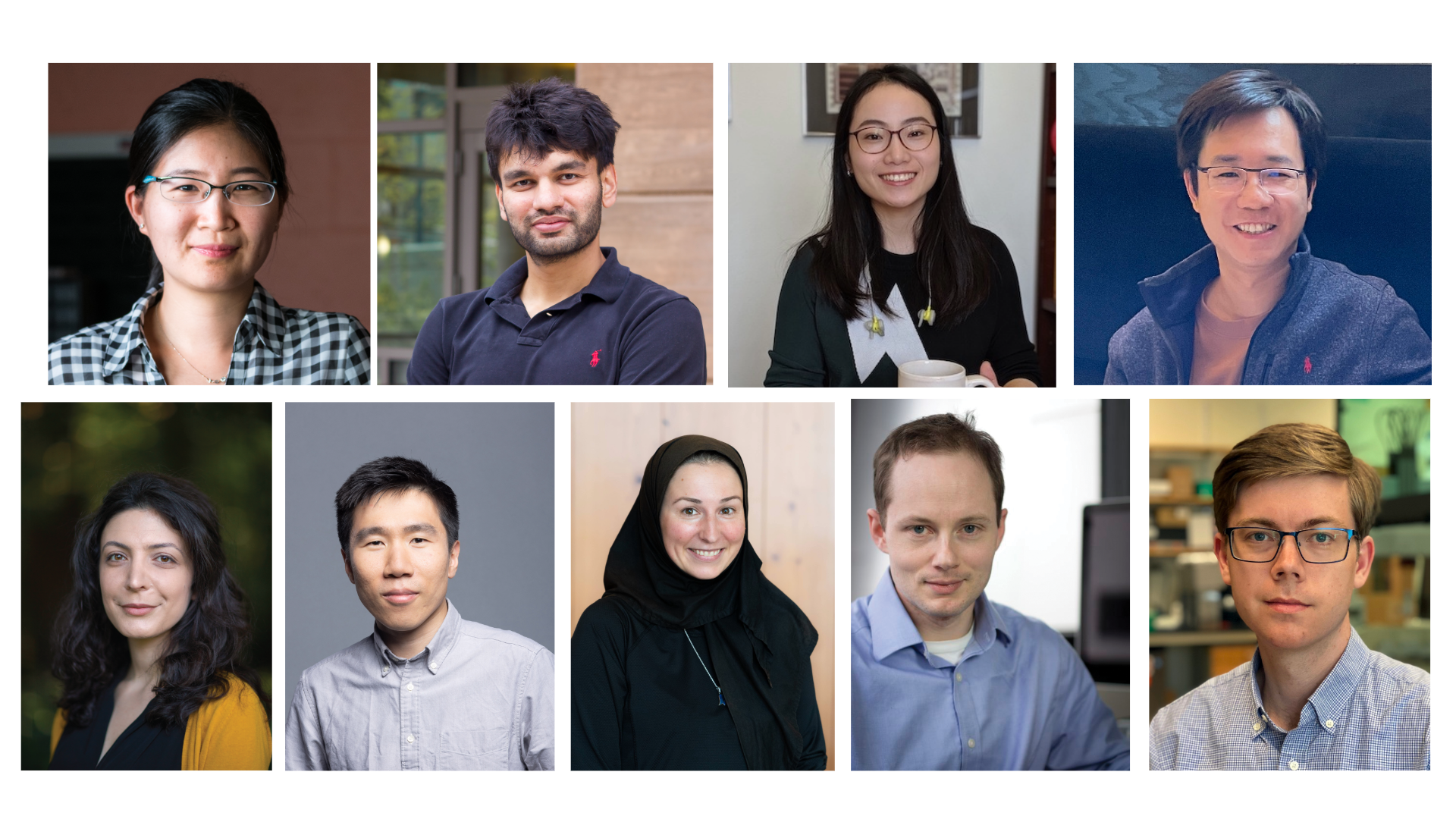
Pulkit Agrawal is being promoted to Associate Professor Without Tenure, effective July 1, 2024. Agrawal earned his undergraduate degree from IIT Kanpur and his M.S. and PhD in computer science from the University of California at Berkeley. He joined the Department of EECS as an assistant professor in July 2019. Agrawal is a principal investigator in the Computer Science and Artificial Intelligence Laboratory (CSAIL) and an affiliate member of the Laboratory for Information and Decision Systems (LIDS); additionally, he is the co-founder of SafelyYou, Inc. Agrawal’s research interests span robotics, deep learning, computer vision and reinforcement learning; he explains, “[my] overarching research interest is to build machines that have similar manipulation and locomotion abilities as humans.” Agrawal is a recipient of multiple best paper awards, the Multidisciplinary University Research Initiative (MURI) award, the Sony Faculty Research Award, the Salesforce Research Award, the Amazon Machine Learning Research Award, the Signatures Fellow Award, the Fulbright Science and Technology Award, the Goldman Sachs Global Leadership Award, the OPJEMS and the Sridhar Memorial Prize, among others. 

Within the Department, Agrawal has developed the classes 6.8200 “Sensorimotor Learning” and 6.S897 “Advanced Sensorimotor Learning” and has served on the EECS-BCS joint faculty search committee; as the chair for reinforcement learning (RL) area in EECS Ph.D. admissions; as organizer for the Computational Sensorimotor Learning seminar; and co-organizer for the MIT Robotics Seminar series.

YuFeng (Kevin) Chen is being promoted to Associate Professor Without Tenure, effective July 1, 2024. Chen earned his bachelor’s degree from Cornell and his PhD from Harvard University; after postdoctoral work at Harvard, he joined the Department of EECS as an assistant professor in 2020. Chen is a principal investigator in the Research Laboratory of Electronics (RLE), where his work focuses on developing multifunctional and multimodal insect-scale robots. He developed the first soft-driven micro-aerial-robots powered by dielectric elastomer actuators, and further demonstrated flights resembling insect agility and resilience. He is a recipient of the NSF CAREER award, the Steven Vogel Young Investigator Award, and several best paper awards at top robotics journals and conferences such as TRO 2021, RAL 2020, and IROS 2015.

Within the Department, Chen has contributed greatly to multiple fundamental undergraduate electrical engineering courses, including 6.2000 “Electrical Circuits: Modeling and Design of Physical Systems”, 6.3100 “Dynamical System Modeling and Control Design”, and 6.2210 “Electromagnetic Fields, Forces and Motion”. He has helped with graduate admissions, and served on the MTL Doctoral Dissertation Seminar Series Committee. His gift for teaching and mentorship has been honored with the 2023 Ruth and Joel Spira Award for Excellence in Teaching.

Connor Coley is being promoted to Associate Professor Without Tenure in the Department of Chemical Engineering and the Department of Electrical Engineering and Computer Science, effective July 1, 2024. Coley received his B.S. and Ph.D. in Chemical Engineering from Caltech and MIT, respectively, and did his postdoctoral training at the Broad Institute. His research group at MIT develops computational strategies for small molecule drug discovery, molecular optimization, and synthesis planning. He explains, “A long-term goal of our work is to enable autonomous molecular discovery, where hypotheses are proposed algorithmically and tested via experiments with minimal human intervention.” Key research areas in the group include the design of new neural models for representation learning on molecules, data-driven synthesis planning, in silico strategies for predicting the outcomes of organic reactions, model-guided Bayesian optimization, de novo molecular generation, and structure elucidation. 

Among other honors, Coley has received the AI2050 Early Career Fellowship; is a recipient of C&EN’s “Talented Twelve” award; was named to Forbes Magazine’s “30 Under 30” for Healthcare; and has received the NSF CAREER award and the Bayer Early Excellence in Science Award. Additionally, Coley has distinguished himself as a thoughtful curriculum developer, creating 3.C01[J] “Machine Learning for Molecular Engineering” alongside Rafael Gomez-Bombarelli (Materials Science and Engineering) and Ernest Fraenkel (Biological Engineering), a course for which all three were recognized with the Schwarzman College of Computing’s 2023 Common Ground Award for Excellence in Teaching.

Marzyeh Ghassemi is being promoted to Associate Professor Without Tenure, effective July 1, 2024. Ghassemi earned two bachelor’s degrees from New Mexico State University as a Goldwater Scholar; her MS from Oxford University as a Marshall Scholar; and her PhD from MIT. She joined MIT from the University of Toronto, joining the Department of EECS and the Institute for Medical Engineering & Science (IMES) – the home of the Harvard-MIT Program in Health Sciences and Technology – as an assistant professor in July 2021. She is also affiliated with the Jameel Clinic and CSAIL, and is a Vector Institute faculty member holding a Canadian CIFAR AI Chair and Canada Research Chair. She also founded the non-profit Association for Health Learning and Inference. 

Ghassemi’s research in “Healthy” Machine Learning in the Healthy ML Group creates a rigorous quantitative framework in which to place ML models in a way that is robust and fair in health settings. Her contributions range from socially-aware model construction, to improving subgroup- and shift-robust learning methods, to identifying important insights in model deployment scenarios that have implications in policy, health practice and equity. Among other awards, Ghassemi has been named one of MIT Tech Review’s 35 Innovators Under 35; and has been awarded the 2018 Seth J. Teller Award, the 2023 MIT Prize for Open Data, and a 2024 NSF CAREER Award. Within the department, Ghassemi has revised HST 953 to include more modern machine learning issues; created EECS 6.882 “Ethical Machine Learning in Human Deployments”; and developed a reputation as an excellent mentor while serving on several committees, including the School of Engineering’s Faculty Gender Equity Committee, the IMES Graduate Admissions Committee, and the institutional Presidential Committee for Distinguished Fellowships. 

Kaiming He is appointed to Associate Professor Without Tenure, effective Feb 27, 2024. He earned his bachelor’s degree from Tsinghua University, and his PhD from the Chinese University of Hong Kong before joining Microsoft Research Asia (MSRA) as a Researcher and then Facebook AI Research (FAIR) as a Research Scientist. His research areas include deep learning and computer vision. He is best-known for his work on Deep Residual Networks (ResNets), which have made significant impact on computer vision and broader artificial intelligence; on visual object detection and segmentation, including Faster R-CNN and Mask R-CNN; and on visual self-supervised learning. He explains, “My research currently focuses on building computer models that can learn representations and develop intelligence from and for the complex world. The long-term goal of my research is to augment human intelligence with more capable artificial intelligence.”

He has had multiple prominent positions within the research community, including acting as program chair of ICCV 2023, and as editor of the International Journal of Computer Vision. His awards include the PAMI Young Researcher Award in 2018; three best paper awards, at CVPR 2009, CVPR 2016, and ICCV 2017; two best paper honorable mentions (at ECCV 2018 and CVPR 2021); and an Everingham Prize for selfless contributions to computer vision. 

Farnaz Niroui is being promoted to Associate Professor Without Tenure, effective July 1, 2024. Niroui earned her bachelor’s degree at the University of Waterloo, and her PhD from MIT before taking a postdoctoral position at University of California Berkeley. She returned to MIT as an Assistant Professor in EECS in November 2018, and is a principal investigator in the Research Laboratory of Electronics (RLE). Niroui’s research focuses on pushing the limits of nanoscale engineering towards the atomic scale, where by developing new fabrication and materials integration platforms, she enables new active nanoscale devices and systems for emerging applications in electronics and optoelectronics. For her research contributions, Niroui has been the recipient of awards including the DARPA Young Faculty Award and the NSF CAREER Award. 

Within the Department, she has co-chaired the EECS Rising Stars program, served as a member of the EECS DEI committee, and has been the coordinator for the new EE Nano track curriculum while serving as an often-invited speaker or panelist at events ranging from the MIT Path of Professorship, Graduate Women in Course 6 Research Summit, and MIT Women’s Technology Program, among others. Niroui has taught multiple core classes and co-developed 6.2540 “Nanotechnology: From Atoms to Systems”, a new class with an interactive curriculum where lectures are closely integrated with design-oriented labs and projects to teach the fundamentals of applied quantum mechanics in relation to the design and fabrication of diverse nanotechnologies. For her efforts in creating this unique and groundbreaking class, Niroui has received the EECS Outstanding Educator Award (2022). Beyond teaching in class, Niroui has also supported nanotechnology research and education across MIT by organizing the MIT.nano seminar series and co-chairing the Dresselhaus lectures.  

Mengjia Yan is being promoted to Associate Professor Without Tenure, effective July 1, 2024. Yan earned her bachelor’s degree from Zhejiang University, and her PhD from the University of Illinois at Urbana-Champaign before joining MIT as an Assistant Professor in November 2019. She is a principal investigator within the Computer Science and Artificial Intelligence Laboratory (CSAIL), where her research focuses on computer architecture and security, with a specific focus on hardware security in processor design, side channel attacks and defenses. Her group works on exploiting new micro-architectural vulnerabilities and designing comprehensive and efficient defense mechanisms.

Among other honors, Yan has received the NSF CAREER Award, Intel Rising Star Faculty Award, ACM SIGARCH/IEEE CS TCCA Outstanding Dissertation Award Honorable Mention, multiple MICRO TopPicks in Computer Architecture and a MICRO best paper award. Within the Department, Yan has designed a new class on secure hardware design, 6.5950, “Secure Hardware Design”, with in-depth lab assignments. The course’s material has already been adapted by other universities, including UC San Diego, CMU, and University of Toronto. Additionally, Yan has taught graduate and undergraduate architecture subjects,  6.823 and 6.004, respectively; co-chaired the EECS Rising Stars Workshop in 2021; served on the Grad Admissions committee, chairing the architecture section in 2020-2023; and served on the 2020 Sprowls + ACM Award Committees.

Dirk Englund is being promoted to Full Professor, effective July 1, 2024. Englund received his BS in Physics from Caltech; following a Fulbright year at TU Eindhoven, he earned his MS and PhD from Stanford University. He was a postdoctoral fellow at Harvard University until 2010, when he started his group as Assistant Professor of Electrical Engineering and of Applied Physics at Columbia University. In 2013, he joined MIT’s Department of Electrical Engineering and Computer Science; he was promoted to Associate Professor without Tenure in 2016, and promoted to Associate Professor with Tenure in 2018. Englund is a principal investigator within the Microsystems Technology Laboratories (MTL) and the Research Laboratory of Electronics (RLE), where his research focuses broadly on the field of photonics applied to quantum information science and engineering and to machine learning; quantum computing; quantum networking & sensing; and photonic integrated circuits for machine learning. His awards include the NSF CAREER award, Sloan fellowship, DARPA YFA, the PECASE, the Optical Society of America Adolph Lomb Medal (the top award for a young researcher in optics), Fellow of Optica (formerly the Optical Society of America), fellow of IEEE, a Web of Science “Highly Cited Researcher” since 2021, awardee of a Alexander von Humboldt Foundation Professorship, and he has co-founded and serves as scientific advisor to several technology companies.

Within the Department, Englund has co-chaired one of the graduate admissions subcommittees in the department, co-organized the Masterworks event, and served on the Lincoln Laboratory-Campus Interaction Committee, among other service contributions. He has taught a number of service and specialty classes (including 6.UAT Oral Communication 6.602 Fundamental of Photonics), and, most notably, led the development of what is one of the first undergraduate quantum engineering lab classes in the nation–a class for which all the abstractions, equipment, and pedagogy needed to be developed from scratch.

Vivienne Sze is being promoted to Full Professor, effective July 1, 2024. Sze earned her bachelor’s degree from the University of Toronto and her master’s degree and PhD from MIT. She was a member of the technical staff in the R&D Center at Texas Instruments (TI), where she designed low-power algorithms and architectures for video coding, before returning to MIT in 2013 as an assistant professor of electrical engineering and computer science. She was promoted to associate professor without tenure in July 2017, and is a principal investigator within the Research Laboratory of Electronics (RLE), Microsystems Technology Laboratories (MTL), and the Computer Science and Artificial Intelligence Laboratory (CSAIL). Sze’s research involves the co-design of energy-aware signal processing algorithms and low-power circuits, architectures, and systems for a broad set of applications, including machine learning, computer vision, robotics, image processing, and video coding. She is currently working on projects focusing on autonomous navigation and embedded artificial intelligence (AI) for health-monitoring applications. Her honors include MIT’s Edgerton Faculty Achievement Award, the Young Investigator Research Program Award from the Air Force Office of Scientific Research, the Young Faculty Award from the Defense Advanced Research Projects Agency,  the Symposium on VLSI Circuits Best Student Paper Award, the CICC Outstanding Invited Paper Award, the IEEE Micro Top Picks Award, and several faculty awards from Google, Facebook, and Qualcomm. As a member of the Joint Collaborative Team on Video Coding, she received the Primetime Engineering Emmy Award for the development of the High-Efficiency Video Coding video compression standard.

Sze, alongside Joel Emer, has codeveloped a considerable body of instructional material surrounding hardware accelerators for deep neural networks, including tutorials at ISCA, MICRO, ISSCC and NeurIPS, an MIT Professional Education short course, a tutorial paper in Proceedings of the IEEE, and finally a residential class on hardware accelerators for neural networks (6.5930, “Hardware Architecture for Deep Learning”) that now counts as part of the graduate qualifying exam. In addition, Sze, Emer, Y.-H. Chen and T.-J. Yang have co-authored a textbook on the subject, entitled “Efficient Processing of Deep Neural Networks”.

At the MIT Quantum Hackathon, a community tackles quantum computing challenges

Quantum computing is the next frontier for faster and more powerful computing technologies. It has the potential to better optimize routes for shipping and delivery, speed up battery development for electric vehicles, and more accurately predict trends in financial markets. But to unlock the quantum future, scientists and engineers need to solve outstanding technical challenges while continuing to explore new applications.

One place where they’re working towards this future is the MIT Interdisciplinary Quantum Hackathon, or iQuHACK for short (pronounced “i-quack” like a duck). Each year, a community of quhackers (quantum hackers) gathers at iQuHACK to work on quantum computing projects using real quantum computers and simulators. This year, the hackathon was held both in-person at MIT and online over three days, from Friday, February 2 to Sunday, February 4. Quhackers worked in teams to advance the capability of quantum computers and to investigate promising applications. Collectively, they tackled a wide range of projects, such as running a quantum-powered dating service, building an organ donor matching app, and breaking into quantum vaults. While working, quhackers could consult with scientists and engineers in attendance from sponsoring companies. Many sponsors also received feedback and ideas from quhackers to help improve their quantum platforms. “The goal of iQuHACK is to connect our beautiful hackers to our fabulous sponsors” so that they can work together to help solve the “puzzle” of quantum computing, said Alessandro Buzzi, one of iQuHACK’s two co-chairs.

Each team of quhackers tackled one of ten challenges posed by the hackathon’s eight major sponsoring companies. Some challenges asked quhackers to improve computing performance, such as by making quantum algorithms faster and more accurate. Other challenges asked quhackers to explore applying quantum computing to other fields, such as finance and machine learning. The sponsors worked with the iQuHACK committee to craft creative challenges with industry relevance and societal impact. “We wanted people to be able to address an interesting challenge [that has] applications in the real world,” said Daniela Zaidenberg, iQuHACK’s other co-chair. 

One team of quhackers looked for potential quantum applications and found one close to home: dating. A team member, Liam Kronman, had previously built dating apps but disliked that matching algorithms for normal classical computers “require [an overly] strict setup.” With these classical algorithms, people must be split into two groups – for example, men and women – and matches can only be made between these groups. But with quantum computers, matching algorithms are more flexible and can consider all possible combinations, enabling the inclusion of multiple genders and gender preferences. 

Kronman and his team members leveraged these quantum algorithms to build a quantum-powered dating platform called MITqute (pronounced “meet cute”). To date, the platform has matched at least 240 people from the iQuHACK and MIT undergrad communities. In a follow-up survey, 13 out of 41 respondents reported having talked with their match, with at least two pairs setting up dates. “I really lucked out with this one,” one respondent wrote. 

Another team of quhackers also based their project on quantum matching algorithms but instead leveraged the algorithms’ power for medical care. The team built a mobile app that matches organ donors to patients, earning them the hackathon’s top social impact award. 

But they almost didn’t go through with their project. “At one point, we were considering scrapping the whole thing because we thought we couldn’t implement the algorithm,” said Alma Alex, one of the developers. After talking with their hackathon mentor for advice, though, the team learned that another group was working on a similar type of project – incidentally, the MITqute team. Knowing that others were tackling the same problem inspired them to persevere.

Photo credit: Qiushi Gu

A sense of community also helped to motivate other quhackers. For one of the challenges, quhackers were tasked with hacking into thirteen virtual quantum vaults. Teams could see each other’s progress on each vault in real-time on a leaderboard, and this knowledge informed their strategies. When the first vault was successfully hacked by a team, progress from many other teams spiked on that vault and slowed down on others, said Dr. Daiwei Zhu, a quantum applications scientist at IonQ and one of the challenge’s two architects.

The vault challenge may appear to be just a fun series of puzzles, but the solutions can be used in quantum computers to improve their efficiency and accuracy. To hack into a vault, quhackers had to first figure out its secret key – an unknown quantum state – using a maximum of twenty probing tests. Then, they had to change the key’s state to a target state. These types of characterizations and modifications of quantum states are “fundamental” for quantum computers to work, said Dr. Jason Iaconis, a quantum applications engineer at IonQ and the challenge’s other architect. 

But the best way to characterize and modify states is not yet clear. “Some of the [vaults] we [didn’t] even know how to solve ourselves,” Zhu said. At the end of the hackathon, six vaults had at least one team mostly hack into them. (In the quantum world where grey areas exist, it’s possible to partly hack into a vault.)

The community of scientists and engineers formed at iQuHACK persists beyond the weekend, and many members continue to grow the community outside the hackathon. Inspired quhackers have gone on to start their own quantum computing clubs at their universities. A few years ago, a group of undergraduate quhackers from different universities formed a Quantum Coalition that now hosts their own quantum hackathons. “It’s crazy to see how the hackathon itself spreads and how many people start their own initiatives,” co-chair Zaidenberg said. 

The three-day hackathon opened with a keynote from MIT Professor Will Oliver, which included an overview of basic quantum computing concepts, current challenges, and computing technologies. Following that were industry talks and a panel of six industry and academic quantum experts, which included MIT Professor Peter Shor, known for developing one of the most famous quantum algorithms. The panelists discussed current challenges, future applications, the importance of collaboration, and the need for ample testing. Later, sponsors held technical workshops where quhackers could learn the nitty-gritty details of programming on specific quantum platforms. Day one closed out with a talk by research scientist Dr. Xinghui Yin on the role of quantum technology at LIGO, the Laser Interferometer Gravitational-Wave Observatory that was the first to detect gravitational waves. The next day, the hackathon’s challenges were announced at 10 am, and hacking kicked off at the MIT InnovationHQ. In the afternoon, attendees could also tour MIT quantum computing labs. Hacking continued overnight at the MIT Museum and ended back at MIT iHQ at 10 am on the final day. Quhackers then presented their projects to panels of judges. Afterwards, industry speakers gave lightning talks about each of their company’s latest quantum technologies and future directions. The hackathon ended with a closing ceremony, where sponsors announced the awards for each of the ten challenges. 

The hackathon was captured in a three-part video by Albert Figurt, a resident artist at MIT. Figurt shot and edited the footage in parallel with the hackathon. Each part represented one day of the hackathon and was released on the subsequent day.

Throughout the weekend, quhackers and sponsors consistently praised the hackathon’s execution and atmosphere. “That was amazing…never felt so much better, one of the best hackathons I did from over 30 hackathons I attended,” Abdullah Kazi, a quhacker, wrote on the iQuHACK Slack.

But organizing iQuHACK 2024 was no easy feat. Co-chairs Buzzi and Zaidenberg led a committee of nine members to hold the largest iQuHACK yet. “It wouldn’t have been possible without them,” Buzzi said. The hackathon hosted 260 in-person quhackers and 1000 remote quhackers, representing 77 countries in total. More than 20 scientists and engineers from sponsoring companies also attended in person as mentors for quhackers.

Ultimately, “[we wanted to] help people to meet each other,” co-chair Buzzi said. “The impact [of iQuHACK] is scientific in some way, but it’s very human at the most important level.”