Research
Labs
Areas
-
How much does your smartphone know about you — even when it's turned off? Under the guidance of CSAIL Principal Investigator Hal Abelson, the Class of 1922 Professor in the Department of Electrical Engineering and Computer Science, CSAIL graduate students Fuming Shih and Frances Zhang are investigating how much certain smartphone applications know about users.
-
As reported by the Champalimaud Foundation, the 2012 António Champalimaud Vision Award was given to several researchers including Professor James G. Fujimoto, Research Laboratory of Electronics affiliate Eric A. Swanson for the creation and development of optical coherence tomography (OCT). Fujimoto, the Elihu Thomson Professor of Electrical Engineering, Swanson, and their collaborators were recognized for the major role that OCT now plays in the diagnosis and treatment of the most important blinding diseases of the industrialized world: macular degeneration, diabetic retinopathy and glaucoma. Currently, it is estimated that more than 40 million OCT diagnostic procedures are performed worldwide annually. -
Jesus del Alamo, Donner Professor, MacVicar Faculty Fellow and Professor of Electrical Engineering in the EECS Department at MIT received the Semiconductor Research Corporation 2012 Technical Excellence Award in recognition for the fabrication of nanometer-scale transistors with world-record high frequency operation, as well as the investigation of the use of III-V compound semiconductors to enable a new generation of deeply scaled transistors for future digital applications. -
David Gifford, EECS professor and director of the Computational Genomics Group in the Computer Science and Artificial Intelligence Lab (CSAIL), working with members of his group, has developed a new algorithm for analyzing millions of experimentally identified DNA fragments and allowing the inference -- with 55% accuracy in the most difficult cases -- of the precise locations at which transcription factors bind to them. Read more! -
EECS professor and MTL core faculty member Dana Weinstein is the recipient of an Intel Early Career Faculty Honor from the Intel Corporation. The announcement was made official this week. -
This fall, the faculty and students in the Electrical Engineering and Computer Science (EECS) Department at MIT are coming together for a new program that has created a buzz since its announcement last spring. The Advanced Undergraduate Research Program — now officially called the SuperUROP — for EECS department juniors and seniors has already enticed over 200 students with more than 100 exciting research projects proposed by the department's faculty. Read more! -
Manolis Kellis, an associate professor of computer science at MIT and an associate member of the Broad Institute, is one of the lead computational scientists and authors of a paper that describes the functionality of the non-gene regions (about 80 percent) of the human genome, the so-called 'junk DNA'. -
Polina Golland, associate professor in the MIT EECS department and principal investigator in the Computer Science and Artificial Intelligence Lab (CSAIL), working with EECS graduate student Archana Venkataraman has developed an algorithm which can aid in deciphering what regions of the brain are involved in certain diseases ultimately enabling drug companies to develop more effective treatments for the disease that specifically target these regions. -
Members of the MIT Database Group including Sam Madden, an associate professor in the Department of Electrical Engineering and Computer Science at MIT and co-leader of the 'bigdata@CSAIL' initiative, EECS graduate student Alvin Cheung, and researchers from Cornell University are presenting work this week at the 38th International Conference on Very Large Databases on Pyxis - a new system that automatically streamlines websites’ database access patterns, making the sites up to three times as fast while allowing the types of languages already favored by Web developers. -
The MIT News Office has featured Russ Tedrake, the X Consortium Associate Professor of Electrical Engineering and Computer Science and Aeronautics and Astronautics at MIT. From his beginnings -- not in computer science -- to his discovery, as an undergraduate, of computer programming as a means to achieve his passion to build things, Russ Tedrake has carved a path as a unique roboticist. -
CSAIL/EECS researchers including EECS graduate students Adam Marcus and Eugene Wu and EECS professors Sam Madden, Rob Miller and David Karger, have developed a way for users of crowdsourcing database operations to avoid computational details in the process while cost effectiveness is significantly improved. The new system called Qurk will automatically crowdsource tasks that are difficult or impossible to perform computationally. -
Molybdenum-Disulfide (MoS2), like Graphene, is a one-molecule-thick material. But, MIT researchers including EECS Professors Tomas Palacios and Jing Kong have been able to produce complex electronic circuits from MoS2, a material that could have many more applications than graphene. This work is now reported in the journal Nano Letters. -
Professor Srini Devadas has been selected as an Edwin Sibley Webster Professor of Electrical Engineering and Computer Science, joining Prof. Alan Willsky as the second Edwin Sibley Webster chaired professor at MIT. Professor Devadas succeeds nearly sixty years of many prominent faculty members holding this professorship, including Ernst Guillemin in 1960, Lan Jen Chu in 1963, Peter Elias in 1974, and Ronald Rivest in 1992. -
Anantha P. Chandrakasan, EECS Department Head and the Joseph F. and Nancy P. Keithley Professor of Electrical Engineering at MIT has been selected as the winner of the 2013 IEEE Donald O. Pederson Award in Solid-State Circuits. The citation for the award reads "For pioneering techniques in low-power digital and analog CMOS design." -
Sangeeta Bhatia, the John and Dorothy Wilson Professor of Health Sciences and Technology and Electrical Engineering and Computer Science and a member of the David H. Koch Institute for Integrative Cancer Research at MIT, has teamed with researchers at the Dana-Farber Cancer Institute and the Broad Institute, to develop an RNA-delivering nanoparticle system that allows clinical targeting to arrive at effective drug treatments. -
A new flexible robot that moves like an earthworm, called "Mesworm," has been devised by researchers from Harvard University, Seoul National University and MIT including EECS professor Daniela Rus, director of the Computer Science and Artificial Intelligence Lab (CSAIL). The robot, designed to stand up to tortuous conditions and still keep on moving in its earthworm-like manner, may prove useful under hazardous conditions that are tight and/or unreachable. -
Qing Hu, professor of electrical engineering and principal investigator in the Research Laboratory of Electronics (RLE), has been awarded the IEEE Photonics Society's 2012 William Streifer Scientific Achievement Award. Qing is cited "for pioneering contribution in the development of high-temperature, high-power, and broadly tunable THz QCLs, and applications in imaging and sensing.” -
Electrical Engineering and Computer Science Department PhD candidate Alec Rivers, working with EECS Associate Professor Fredo Durand and MIT Mechanical Engineering Department PhD candidate Ilan Moyer will be presenting a new digitally driven method for creating precise shapes with minimal human guidance at this week's Siggraph conference in Los Angeles. -
Tim Lu, assistant professor of electrical engineering in the MIT Electrical Engineering and Computer Science Department, principal investigator in the Research Lab of Electronics at MIT, and Associate Member of the Broad Institute of MIT and Harvard, has been working with colleagues at Boston University (BU), Harvard Medical School and Massachusetts General Hospital (MGH) to build genetic circuit components in living cells to ultimately perform novel functions such as manufacturing new drugs, producing fuel, or even programming suicide of cancer cells. -
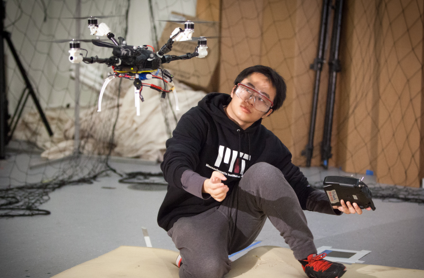
With the goal of developing an aircraft that can fly like a bird, quickly darting around fixed and moving objects, EECS Associate Professor Russ Tedrake as lead of a five-year multi-research initiative, has created a new autonomous flying aircraft that is coming very close to this reality. This work, carried out in Tedrake's lab by his group, the Robot Locomotion Group in the Computer Science and Artificial Intelligence Lab (CSAIL) is featured on the CSAIL website. -
Jonathan Ragan-Kelley, EECS graduate student and Andrew Adams, a CSAIL postdoc, have led the development of Halide, a new programming language for image-processing algorithms. Halide not only yields code that’s much shorter and clearer — but it is much faster and is now available online. At this month’s Siggraph, the premier graphics conference, Ragan-Kelley and Adams will present a paper on Halide, which they co-wrote with EECS faculty members Professors Saman Amarasinghe and Fredo Durand and with colleagues at Adobe and Stanford University. -
Daniel Jackson, professor of computer science and engineering in the EECS department, principal investigator in the Computer Science and Artificial Intelligence Lab, CSAIL, head of the CSAIL Software Design Group, and MacVicar Faculty Fellow is also an avid photographer. His work featuring black and white photos of labs at MIT and titled 'Dark Machines: Inside MIT's Laboratories' is now on exhibit (through Dec. 31, 2012) at the MIT Museum. -
Shafi Goldwasser, the RSA professor of electrical engineering and computer science at MIT and principal investigator with the Computer Science and Artificial Intelligence Lab, is among three at MIT selected as Simons Investigator by the Simons Foundation. -
Timothy K. Lu, EECS assistant professor and principal investigator with the MIT Research Lab of Electronics, RLE, is one of five MIT members selected for the presidential early career award for Scientists and Engineers - and one of 96 selected for this honor nationwide. Lu is cited for his contributions in establishing innovative synthetic biology platforms and for his pioneering applications of synthetic biology to materials science, nanotechnology and infectious diseases. -
Victor Zue, the Delta Electronics Professor of Electrical Engineering and Computer Science at MIT and former Director of the Institute's Computer Science and Artificial Intelligence Laboratory (CSAIL) from 2007 - 2011 (and co-director of CSAIL since its inception in 2004), is the recipient of the 2013 IEEE James L. Flanagan Speech and Audio Processing Award. He is cited "for pioneering contributions to acoustic phonetics and conversational spoken-language systems."