

Results You Can Touch


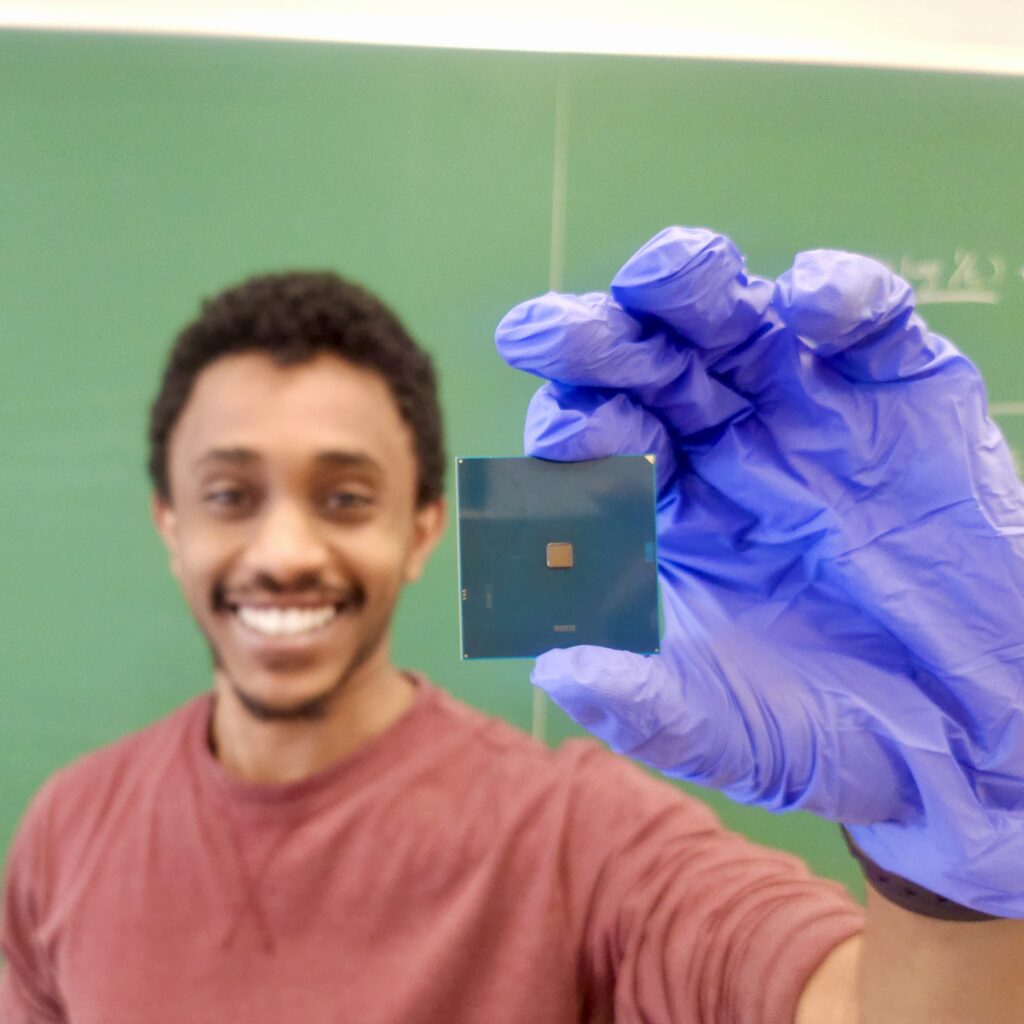 Student Natnael Kahssay holds a chip he designed in 6.208 Semiconductor Electronic Circuits. The circuit design course includes training in industry-standard design tools (Cadence), and tapeout in an Intel process, and is one of the highlights of the popular new major in electrical engineering at MIT. “6.208 has a special and intense focus on semiconductor microelectronics,” says Professor Ruonan Han, who teaches the course along with Associate Professor Negar Reiskarimian. “The students not only learn the basic principles in the context of integrated circuit chips, but also have the exposure to much more practical, engineering-oriented topics, such as reliability, manufacturability and performance tradeoffs.” Photo courtesy of Ruonan Han.
 “It’s a real validation of all the work behind the scenes,” says Karl Berggren, faculty head of electrical engineering within the Department of EECS. He’s looking at the numbers of new enrollees in 6-5, Electrical Engineering With Computing, the flagship electrical engineering degree offered by MIT’s Department of Electrical Engineering and Computer Science, which was launched last fall.
The new major has been embraced by the student community. “The fact that Course 6-5 is now the third most selected major among first-year students shows that the department is clearly meeting a growing need for a curriculum that bridges electrical engineering and computing. This growth is coming from students already interested in pursuing a degree in EECS,” says Anantha Chandrakasan, MIT’s Provost. “The major was thoughtfully designed to offer a strong foundation in core electrical engineering concepts – such as circuits, signals, systems, and architecture – while also providing well-structured specialization tracks that prepare students for the future of the field.”
Those tracks include structured paths to explore not only the traditional domains of electrical engineering (such as hardware design and energy systems) but cutting-edge fields such as nanoelectronics, quantum systems engineering, and photonics. “They are very flexible and essentially allow me to take whatever I want, with the tracks filling up almost automatically,” says 6-5 major Charles Reischer. “For me, it essentially reduces the amount of specific required classes in the major, which has been helpful for choosing the classes I find interesting.” Jelena Notaros, who helped develop the Electromagnetics and Photonics track within the new major, has seen the new wave of student interest from the other side. “It’s been incredibly rewarding… I think students are excited to have the opportunity to take a class where they can learn about a cutting-edge field and test real state-of-the-art chip hardware using industry-standard equipment.” Notaros’s class, 6.2320 Silicon Photonics, includes features not found in a university class anywhere else, such as a sequence in which students can test actual chips at three electronic-photonic probe stations.
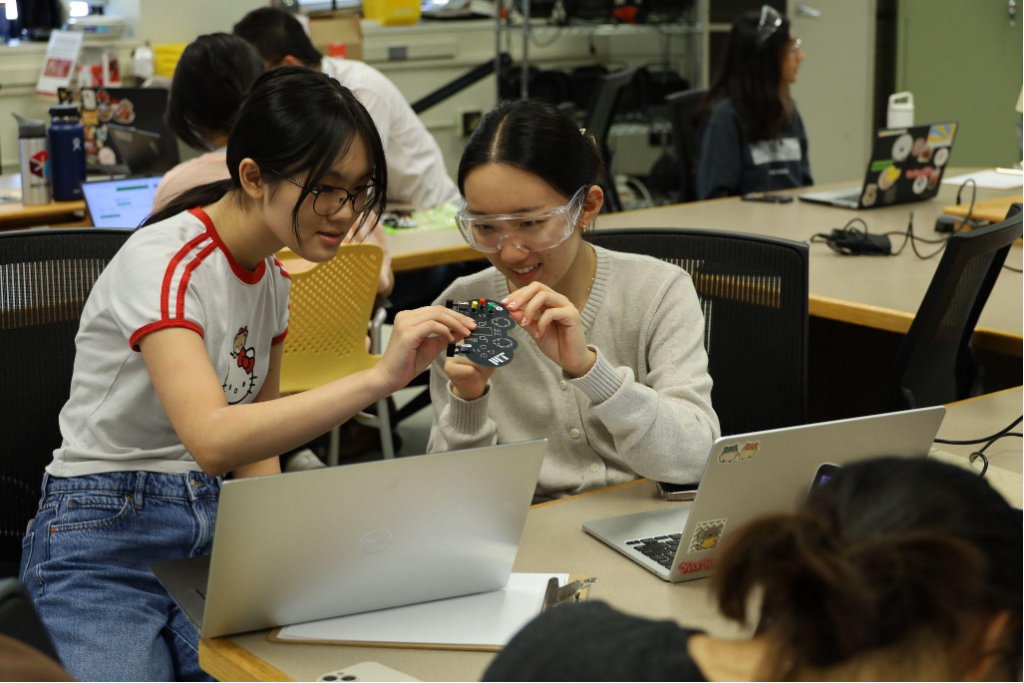
Another 6-5 track, Quantum Systems Engineering, features direct student access to quantum hardware, including electron-nuclear systems and state-of-the-art simulations methods and tools. Prof. Dirk Englund, who teaches multiple courses within the track, explains, “It’s been so successful in part through strong industry support, including from QuTools Inc. Students work with the same tech we use in the Boston-Area Quantum Network Testbed — the metro quantum network linking MIT, Lincoln Lab, and Harvard, and the NSF CQN.” Many of Englund’s students have gone on to pursue a career in quantum information science, either in grad school or in industry. “Students recognize quantum engineering is the future. They see they’re building the foundation for metro-scale quantum networks.”
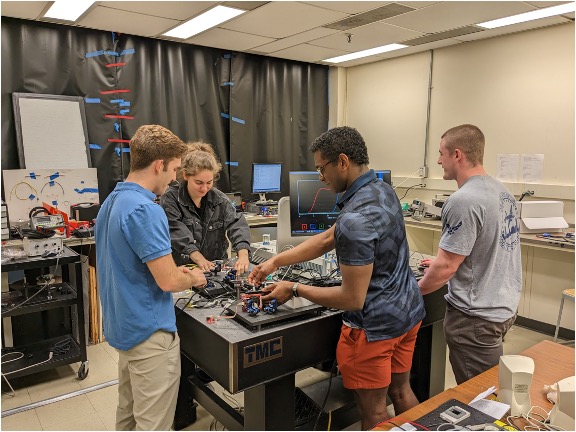
The new curriculum’s emphasis on hands-on learning is deliberate, and ubiquitous throughout 6-5. Within the Circuits track, students who enroll in 6.208, Semiconductor Electronic Circuits, will get an opportunity not only to design a circuit, but to actually see their design made, in a process called “tape-out”. Professor Ruonan Han, who helped design the course, explains: “A tapeout is a perfect training that poses [real-life] constraints and forces the students to solve practical engineering problems. Through circuit simulation using mainstream industry CAD tools, the students better understand how deep-scaled transistors differ from the ideal behaviors taught in textbooks. By drawing the layouts of the silicon and metal patterns, the students learn how a modern chip is made, layer by layer. The complex (and often frustrating) rules of the layout also keep reminding the students of all the technical limitations during the chip manufacturing, and make them better appreciate all the accomplishments in semiconductor manufacturing. Even the firm and non-negotiable tapeout submission deadline forces the students to not only wisely manage their development timeline, but also to experience heart-beating moments when decisions on critical engineering tradeoffs should be made (in order to deliver). To these students, it was such relentless efforts that gave them lots of satisfaction and pride when they finally hold their own chips in hand.”
The sense of completing a full problem-solving cycle is echoed in 6.900 Engineering For Impact, a capstone course designed by former faculty head of electrical engineering Joel Voldman along with senior lecturer Joe Steinmeyer. Over the course of a semester, students team with city governments and non-profits to solve complex local issues. The course is designed not only to introduce students to realistic project management factors (such as budgets, timelines, and stakeholders), but to give them a taste of the satisfaction of engineering a solution that meets a real community’s need.
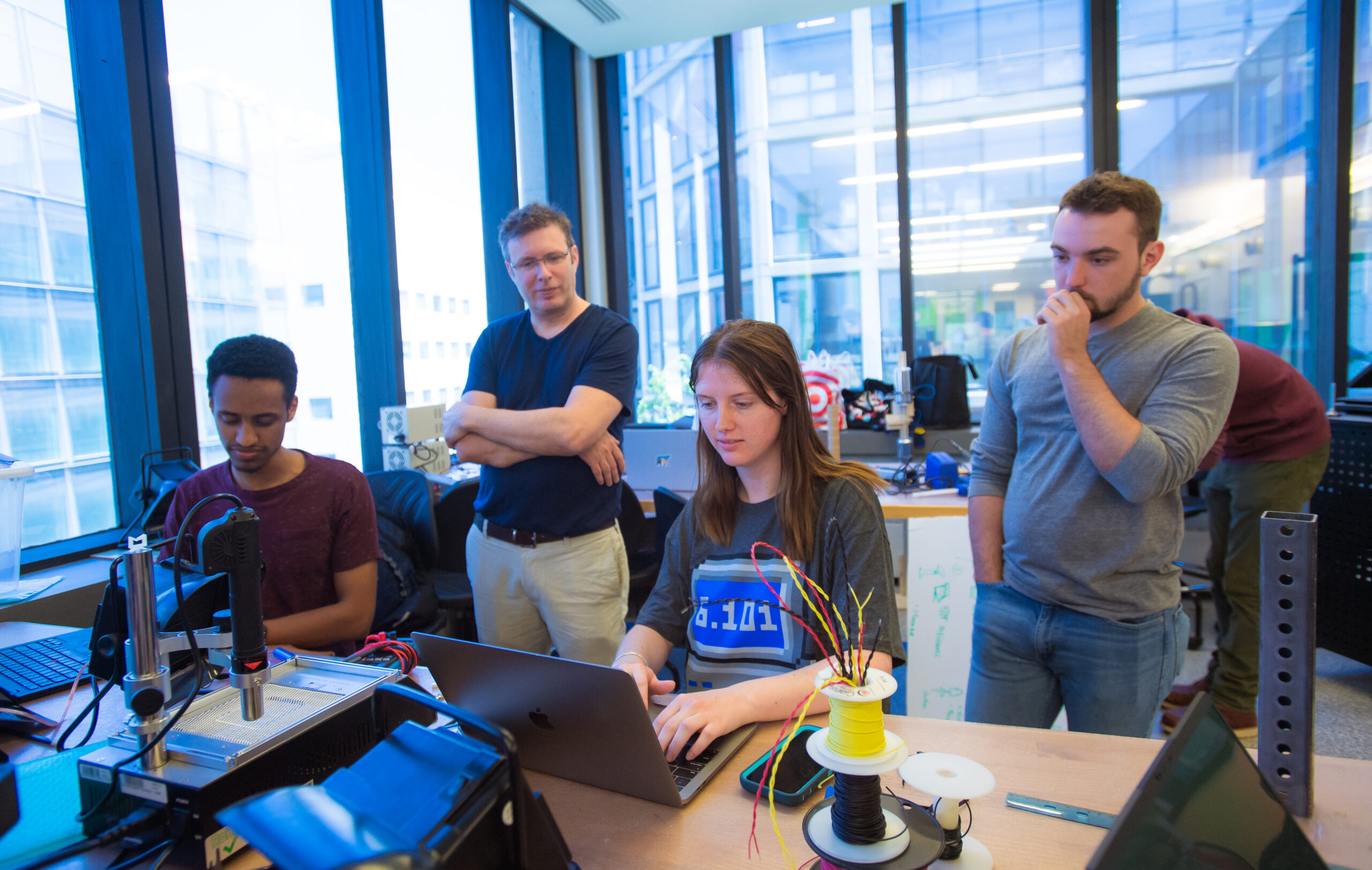
“I’ve taken 6.900 and it’s been eye opening in the collaboration of hardware, firmware, and software to create a cohesive and working product,” says Andrea Leang, a senior majoring in 6-2 who nonetheless decided to try the new course. “In my 6-2 experience, I spent the first 2 years taking more CS classes, but as I went into junior year, I wanted to explore more EE.” That desire led Leang to Voltage, the student group for electrical engineers. “Honestly, it was the first big community of EE I’ve joined. Joining Voltage opened my eyes to what MIT had to offer on EE, and a community who was enthusiastic to share their knowledge.”
Matthew Kim, one of the executives of the Voltage group, echoes Leang’s experience: “It has been great working […] to build a community for EE. We heard faculty say that they wanted to be more engaged with students and communicate more, and it has definitely been felt with the restart and support of Voltage. And I’m hopeful that the community will continue to grow.” That growth has been rapid. The new major’s enrollment is now roughly equivalent to the combined enrollment in the older 6-1 and 6-2 programs, showing the desirability of a major that incorporates fundamentals of both computing and electrical engineering.
Department Head Asu Ozdaglar is thrilled with the energizing effect of the new major: “We are delighted to see the initial success of the 6-5 major which provides our students an exciting and forward-looking curriculum, developed through extensive work and great deal of thought by electrical engineering faculty. The new curriculum reflects the critical role computing plays in electrical engineering, whether in designing new devices and circuits, analyzing data, or in studying complex systems, which almost invariably combine hardware and software.”
“What excites me most about this major is how it empowers students to bring ideas to life — from the invisible signals that connect our world to the complex systems that drive modern technology, “says Dan Huttenlocher, dean of the MIT Schwarzman College of Computing and the Henry Warren Professor of Electrical Engineering and Computer Science. “Students are using computation as a creative and analytical tool to expand the boundaries of engineering. They gain a deep understanding of how hardware and software come together to drive technological progress.” The new degree program’s designers are gratified by the swell of student interest. “The buzz surrounding the classes and the new 6-5 degree program is fantastic,” says Voldman. “It’s great to see the strong student interest in what we’ve put together.”
Media Inquiries
Journalists seeking information about EECS, or interviews with EECS faculty members, should email eecs-communications@mit.edu.
Please note: The EECS Communications Office only handles media inquiries related to MIT’s Department of Electrical Engineering & Computer Science. Please visit other school, department, laboratory, or center websites to locate their dedicated media-relations teams.