
Department of EECS Announces 2026 Promotions


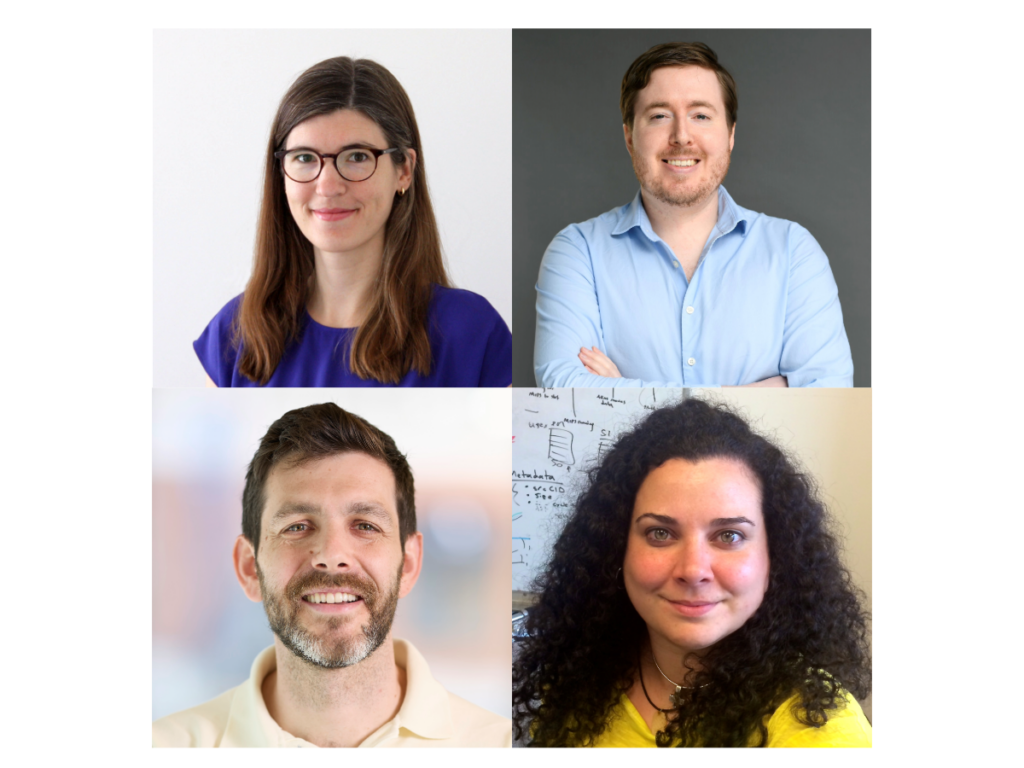 From top left, clockwise: Laura Lewis, Kevin O’Brien, Christina Delimitrou, Jacob Andreas. All photos courtesy of their subjects.
The Department is delighted to announce the following promotions:
Jacob Andreas has been promoted to associate professor with tenure, effective July 1, 2026.
Andreas joined MIT EECS in 2019 and is a principal investigator in the Computer Science and Artificial Intelligence Laboratory (CSAIL). He conducts research in natural language processing (NLP) and more broadly in AI. He aims to understand the computational foundations of language learning, and to build intelligent systems that can learn from human guidance. Much of Andreas’s work develops techniques for “translating” between the implicit behaviors of neural network models and explicit descriptions, specifications, and explanations in the form of language or code.
Among other honors, he has received Samsung’s AI Researcher of the Year award; a Sloan Research Fellow award; the NSF CAREER Award; a Sony faculty innovation award, and paper awards at the North American conference of the Association for Computational Linguistics (NAACL), International Conference on Machine Learning (ICML), and the Association for Computational Linguistics (ACL). He was named a Kavli Fellow of the National Academy of Sciences in 2022.
Andreas received his BS from Columbia; his M.Phil from Cambridge (where he studied as a Churchill scholar), and his Ph.D. degree in natural language processing from Berkeley.
Within the Department, Andreas has developed multiple advanced courses in natural language processing, as well as new exercises designed to get students to grapple with important social and ethical considerations in machine learning deployment. In recognition of his teaching contributions, Jacob was awarded MIT’s Kolokotrones Education Award in 2021 and the School of Engineering’s Junior Bose Award for Teaching in 2023.
Christina Delimitrou has been promoted to associate professor with tenure, effective July 1, 2026.
Delimitrou joined MIT EECS in 2022, following a postdoctoral researcher position at Stanford and five years as an assistant professor at Cornell. She is a principal investigator in CSAIL. Her work applies machine learning techniques to architectural design problems in cloud computing, analyzing the full stack to improve utilization, latency, and reliability in modern datacenters. Her systems, including Paragon, Quasar, and Tarcil, introduced learning-based models to guide scheduling decisions in datacenters. Her Seer and Sage systems focus on reliability and debugging, and her DeathStarBench is used broadly across academia and industry for microservices research.
Among other awards, Delimitrou has received the IEEE TCCA Young Architect Award, the NSF CAREER award, the Sloan Fellowship, the Google Faculty Research Award, the Google Research Award in Recognition of Technical Leadership and Achievements in Systems Research, the Google-Initiated Focused Research Award, two Facebook Research Faculty Awards, the Microsoft Research Faculty Fellowship, the Intel Rising Star Award, two Intel Research Awards, the Presidential Early Career Award for Scientists and Engineers (PECASE), and the Cornell School of Engineering Research Excellence Award, as well as multiple best paper awards and “top conference pick” awards.
Delimitrou obtained her BS from the National Technical University of Athens in 2009 and her PhD from Stanford in 2015. Within the Department, she has taught the largest computer architecture course, as well as a graduate course on datacenter computing, and has served on the graduate admissions committee and as a Rising Stars organizer.
Laura Lewis has been promoted to associate professor with tenure, effective July 1, 2026.
Lewis is the Athinoula A. Martinos Associate Professor in IMES and EECS at MIT. She is also an associate professor at the Athinoula A. Martinos Center for Biomedical Imaging at Massachusetts General Hospital, a principal investigator in the Research Laboratory of Electronics (RLE), and an affiliate member of the Picower Institute for Learning and Memory. Lewis’s research focuses primarily on functional magnetic resonance imaging (fMRI) and other types of noninvasive imaging techniques to measure physiological processes in the brain, most notably the flow of cerebrospinal fluid (CSF). She is particularly interested in understanding the neuroscience of sleep, attention, and aging, and how these three phenomena relate to CSF flow.
Lewis is the recipient of the Society for Neuroscience Peter and Patricia Gruber International Research Award, the One Mind Rising Star Award, the 1907 Trailblazer Award, the Sloan Fellowship, the Searle Scholar Award, the McKnight Scholar Award, and the Pew Biomedical Scholar Award. Additionally, she is a Kavli Fellow of the National Academy of Sciences.
Lewis received her Ph.D. in Neuroscience from MIT, conducted postdoctoral research as a Junior Fellow of the Harvard Society of Fellows, and was previously an instructor at Harvard Medical School and an assistant professor at Boston University before joining MIT EECS in January 2023. Within the Department, she has taught the sophomore-level signal processing course, and taught and contributed curriculum to a unique new hands-on MRI course where students test and operate their own tabletop MRI imaging system. In recognition of her contributions, she has won the MIT Excellence in Post-Doctoral Mentoring Award and the MIT Committed to Caring (C2C) Award.
Kevin O’Brien has been promoted to associate professor with tenure, effective July 1, 2026.
O’Brien joined MIT EECS in July 2018, following a postdoctoral researcher position at UC Berkeley. He is a principal investigator in RLE, where he leads the Quantum Coherent Electronics Group. His research efforts focus on developing tools, techniques, and devices to enhance the measurement of quantum systems, most notably superconducting quantum computers.
O’Brien and his team have made pioneering contributions in the amplification of low-energy quantum signals by developing a new type of amplifier. They then deciphered the noise sources of that approach, enabling them to propose improved amplifiers that could achieve performance within 0.1% of the quantum limit. To improve the readout of quantum information, they developed a purely nonlinear circuit to couple quantum devices, enabling an order of magnitude increase in the coupling, with direct implications for faster readout.
O’Brien received his BS in Physics from Purdue University before going on to earn his PhD from UC Berkeley in Physics in 2016. In 2024, he received the Air Force Office of Scientific Research (AFOSR) Young Investigator Program (YIP) Award. Within the Department, he helped to design and create the flagship quantum engineering class, combining elements of quantum information theory, quantum algorithms, implementation methods, and hands-on coding. He has also helped to revise the undergraduate electromagnetics course, with completely reworked labs, and has served on the Electrical Engineering Curriculum Committee (EECC). In recognition of his contributions, he has won the Ruth and Joel Spira Award for Distinguished Teaching.
Media Inquiries
Journalists seeking information about EECS, or interviews with EECS faculty members, should email eecs-communications@mit.edu.
Please note: The EECS Communications Office only handles media inquiries related to MIT’s Department of Electrical Engineering & Computer Science. Please visit other school, department, laboratory, or center websites to locate their dedicated media-relations teams.