

Two MIT presidential initiatives partner with SuperUROP to expand student opportunities


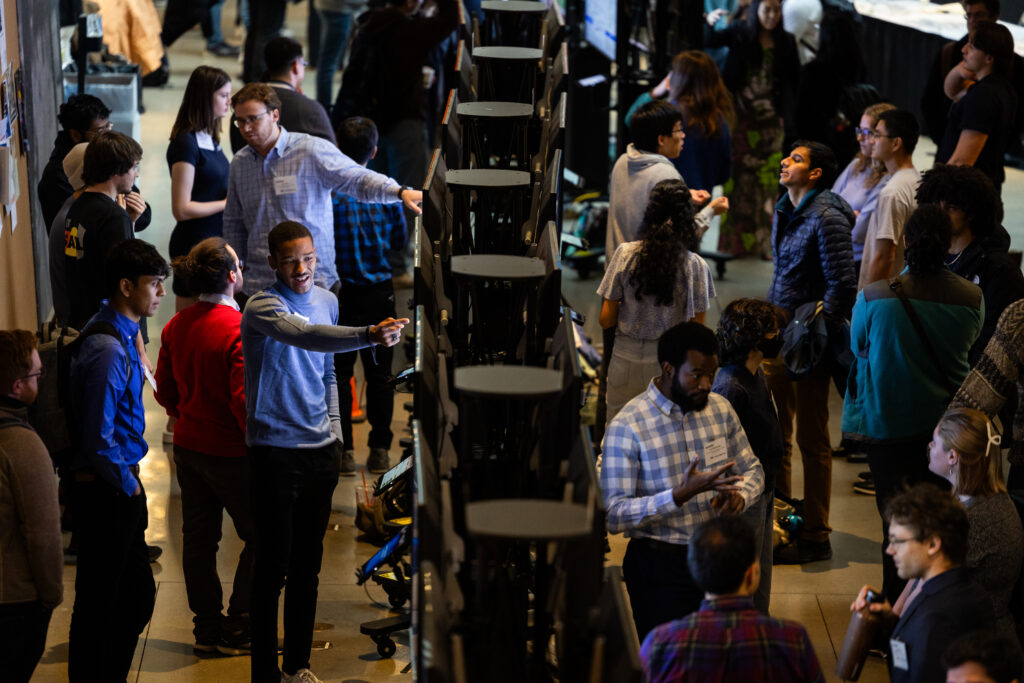 Photo credit: Jack Belcher
 Beginning in the fall of 2025, MIT students will have the opportunity to participate in projects funded directly by two major presidential initiatives: MIT’s Health and Life Sciences Collaborative (MIT HEALS) and MIT’s Generative AI Impact Consortium (MGAIC).
Both MIT HEALS and MGAIC are now collaborating with SuperUROP, a two-semester supervised research experience which takes undergraduates through the complete research cycle, from selecting a topic and designing their experiment to writing a technical paper and presenting their results at conferences. While MGAIC’s funding will focus on research in generative AI, responsible AI, and applications that drive societal benefits, MIT HEALS’s will support research at the intersection of health, well-being, equity, and technology.
“The support from these presidential initiatives reflects an institutional commitment to undergraduate research and innovation, and aligns well with MIT’s broader vision of a hub for interdisciplinary cooperation and cross-disciplinary impact,” says Asu Ozdaglar, head of the Department of EECS.
While the program was initially born in, and continues to be administered by, EECS, participation in the program is open to students across the School of Engineering and the School of Science, with leading faculty from several departments offering mentorship and a wide variety of research projects. That variety now grows even broader with the participation of MGAIC and MIT HEALS, and the program administrators hope the new research projects available will appeal to a broad group of MIT student researchers. The new SuperUROP projects also offer the opportunity for research groups and students alike to advance MIT’s strategic priorities, whether developing open, collaborative AI solutions, or catalyzing discovery, innovation, and impact for human health. A sampling of the projects planned includes: “Animate biosensors for toxic chemical detection,” “Human-AI Collaborative Music Generation,” “Optimization of Natural Fiber Prosthetic Socket Manufacturing Method for Sierra Leone,” and “Enhancing Biodiversity Image Datasets with Generative AI for Improved Species Classification.” “SuperUROP provides a truly unique experience at the undergraduate level,” says Dina Katabi, Thuan (1990) and Nicole Pham Professor in EECS at MIT, who has supervised several SuperUROP scholars since the program’s inception. “With the full experience of a research cycle, students get a real sense of how a research career could suit them, plus experience in meaningfully communicating their results—all before they decide whether to pursue a graduate degree.”
“SuperUROP students in this cohort will be working on socially impactful, high-priority research topics,” says Joanne Luciano, the SuperUROP program administrator. “These opportunities elevate the undergraduate research experience, provide interdisciplinary exposure, and help with career readiness.”
For more information, please visit the SuperUROP website. To learn more about giving to SuperUROP, please visit our supporter page.
Media Inquiries
Journalists seeking information about EECS, or interviews with EECS faculty members, should email eecs-communications@mit.edu.
Please note: The EECS Communications Office only handles media inquiries related to MIT’s Department of Electrical Engineering & Computer Science. Please visit other school, department, laboratory, or center websites to locate their dedicated media-relations teams.