

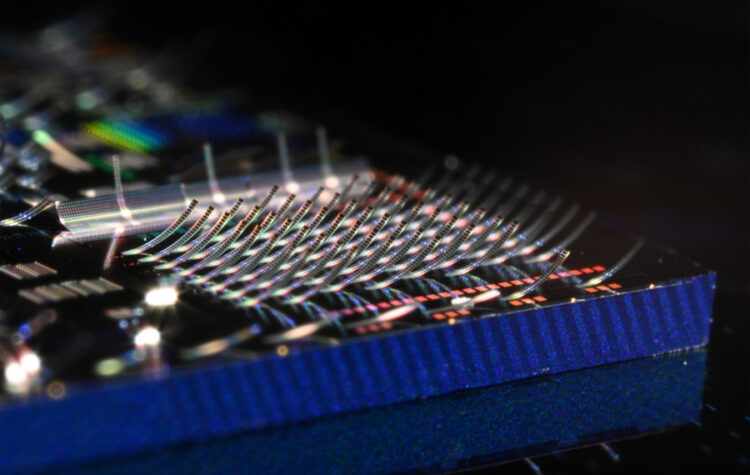
Light-emitting structures that curl off the chip surface could enable advanced displays, high-speed optical communications, and larger-scale quantum computers.

The MIT Quantum Initiative is taking shape, leveraging quantum breakthroughs to drive the future of scientific and technological progress.
Doctoral Thesis Title: Development of Superconducting Quantum Simulators using 2D Lattices of Transmon Qubits Presenter: Sarah Muschinske Presenter’s Affiliation (CSAIL, RLE, LIDS, MTL, etc.): RLE Thesis Supervisor(s): William D.…
Doctoral Thesis Title: Towards a Quantum Network with Waveguide Quantum ElectrodynamicsPresenter: Aziza AlmanaklyPresenter’s Affiliation: RLEThesis Supervisor: William D. Oliver Date: July 22, 2025 Time: 9 am Location: 3-270 Zoom…
Doctoral Thesis Title: Foundational Abstractions for Quantum ProgrammingPresenter: Charles YuanPresenter’s Affiliation: CSAILThesis Supervisor: Michael Carbin Date: July 16, 2025Time: 2 PMLocation: 32-G575 Interested attendees may contact me for…

Researchers achieved a type of coupling between artificial atoms and photons that could enable readout and processing of quantum information in a few nanoseconds.
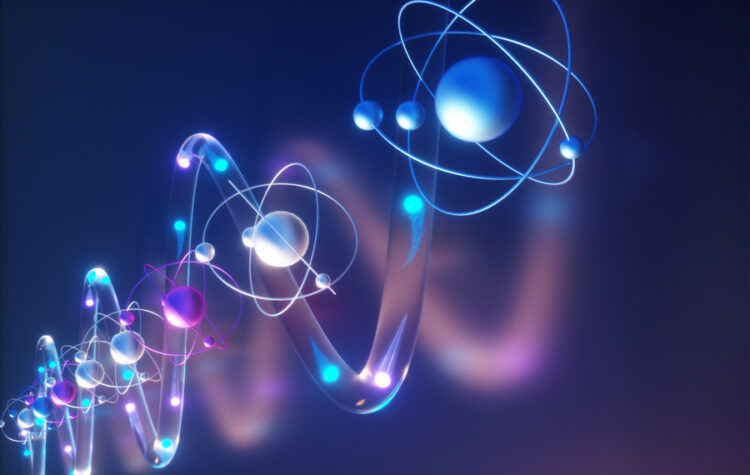
MIT researchers developed a photon-shuttling “interconnect” that can facilitate remote entanglement, a key step toward a practical quantum computer.

All promotions and appointments will take effect July 1, 2025.

By determining how readily electron pairs flow through this material, scientists have taken a big step toward understanding its remarkable properties.