

MIT affiliates named 2026 Schmidt Sciences AI2050 Fellows


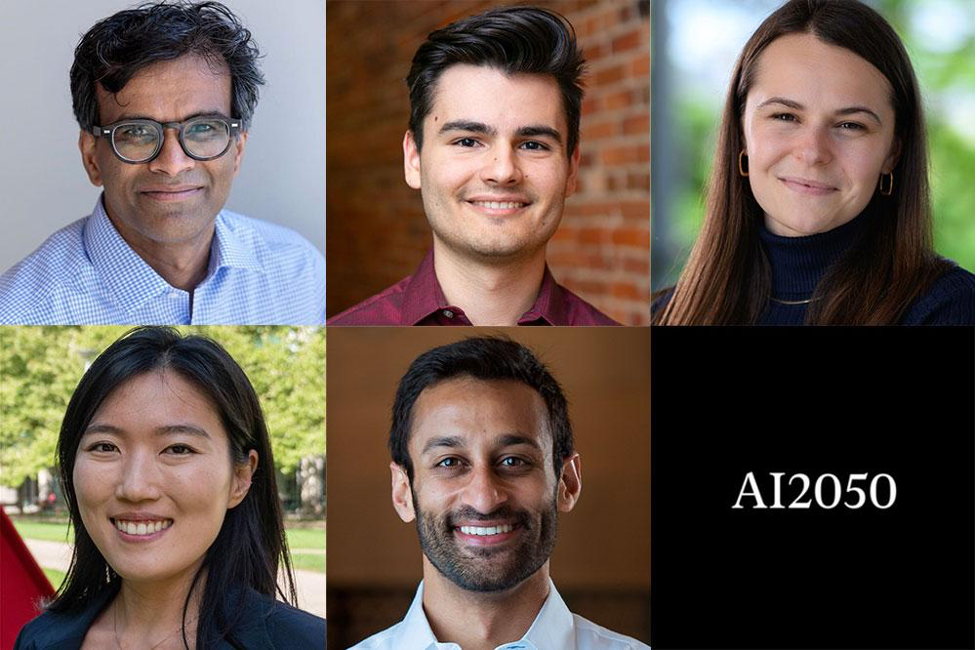 Top, l-r: Sendhil Mullainathan, Alex Damian, Bailey Flanigan. Bottom, l-r: Yunha Hwang and Manish Raghavan.
 Five MIT faculty members and two additional alumni were recently named to the 2026 cohort of AI2050 Fellows. The honor is announced annually by Schmidt Sciences, Eric and Wendy Schmidt’s philanthropic initiative that aims to accelerate scientific innovation.
Conceived and co-chaired by Eric Schmidt and James Manyika, AI2050 is a philanthropic initiative aimed at helping to solve hard problems in AI. Within their research, each fellow will contend with the central motivating question of AI2050: “It’s 2050. AI has turned out to be hugely beneficial to society. What happened? What are the most important problems we solved and the opportunities and possibilities we realized to ensure this outcome?”
The 2026 AI2050 Senior Fellows include:
Sendhil Mullainathan is the Peter de Florez Professor at MIT with dual appointments in the departments of Economics and Electrical Engineering and Computer Science, and a principal investigator at the MIT Laboratory for Information and Decision Systems (LIDS). His current research is at the intersection of algorithms and people, with a central focus on launching The Bike Shop@MIT, a new research center which works towards more human-centered AI through scalable bicycles for the mind, and innovative new gears for machine learning algorithms. Mullainathan is the cofounder of a non-profit to apply behavioral science (ideas42); a center to promote the use of randomized control trials in development (the Abdul Latif Jameel Poverty Action Lab); and Dandelion Health, and is the co-author of Scarcity: Why Having Too Little Means So Much.
Among other awards, he is a recipient of the MacArthur “Genius Grant,” has been designated a “Young Global Leader” by the World Economic Forum, was labeled a “Top 100 Thinker” by Foreign Policy Magazine, and was named to the “Smart List: 50 people who will change the world” by Wired Magazine (UK). He serves on the board of the MacArthur Foundation, is affiliated with the NBER and BREAD, and is a member of the American Academy of Arts and Sciences. His AI2050 project focuses on the translation of patterns detectable by AI into testable theories.
The 2026 AI2050 Early Career Fellows include:
Alex Damian is an Assistant Professor in the Department of Mathematics, holding an MIT Schwarzman College of Computing shared position with the Department of Electrical Engineering and Computer Science (EECS) and a principal investigator at the MIT Laboratory for Information and Decision Systems (LIDS). His research focuses on the mathematical foundations of deep learning, with an emphasis on optimization dynamics and representation learning. He was previously a research fellow at the Kempner Institute at Harvard University. He received his Ph.D. in Applied and Computational Mathematics from Princeton University and his B.S. in Mathematics from Duke University. His AI2050 project focuses on effective AI model training.
Bailey Flanigan is a Theodore T. Miller (1922) Career Development Assistant Professor at MIT, holding an MIT Schwarzman College of Computing shared position with the Departments of EECS and Political Science, and a principal investigator at the MIT Laboratory for Information and Decision Systems (LIDS). She received her PhD in computer science from Carnegie Mellon University in 2024. From 2024-2025, she was a Harvard Data Science Initiative Fellow, hosted at the Harvard Ash Center for Democratic Innovation. Her research combines tools from across disciplines (including social choice theory, game theory, algorithms, statistics, and survey methods) to advance political methodology and strengthen public participation in democracy. She is specifically interested in sampling algorithms, opinion measurement/preference elicitation, and the design of democratic innovations like deliberative minipublics and participatory budgeting. Her AI2050 project focuses on gathering structured public input which lawmakers can use when making complex decisions.
Yunha Hwang is the Samuel A. Goldblitch Career Development Assistant Professor at MIT, holding an MIT Schwarzman College of Computing shared position with the Departments of EECS and Biology. She is also a principal investigator at the MIT Laboratory for Information and Decision Systems (LIDS). Hwang serves as the Co-founder and Chief Scientist at Tatta Bio, a scientific nonprofit dedicated to advancing genomic AI for biological discovery. She received her PhD in Biology from Harvard University and B.S. in Computer Science from Stanford University. Her research interests span machine learning for microbial evolution, biomanufacturing, and open science. Her AI 2050 project focuses on determining biological enzyme functions.
Manish Raghavan is the Drew Houston (2005) Career Development Professor at the Sloan School of Management, holding an MIT Schwarzman College of Computing shared position with the Department of Electrical Engineering and Computer Science, and a principal investigator at the MIT Laboratory for Information and Decision Systems (LIDS). Before that, he was a postdoctoral fellow at the Harvard Center for Research on Computation and Society (CRCS). Raghavan received his bachelor’s degree in electrical engineering and computer science from the University of California, Berkeley, and PhD from Cornell University. His research interests lie in the application of computational techniques to domains of social concern, including algorithmic fairness and behavioral economics, with a particular focus on the use of algorithmic tools in the hiring pipeline. His AI2050 project focuses on mitigating negative effects, and strengthening positive aspects, of widespread AI reliance.
Alumni Irene Chen PhD ’22 and Allison Z. Koenecke ’14 and former postdoc Juan Carlos Perdomo were also named AI2050 Early Career Fellows.
Media Inquiries
Journalists seeking information about EECS, or interviews with EECS faculty members, should email eecs-communications@mit.edu.
Please note: The EECS Communications Office only handles media inquiries related to MIT’s Department of Electrical Engineering & Computer Science. Please visit other school, department, laboratory, or center websites to locate their dedicated media-relations teams.