

Department of EECS Announces 2025 Promotions


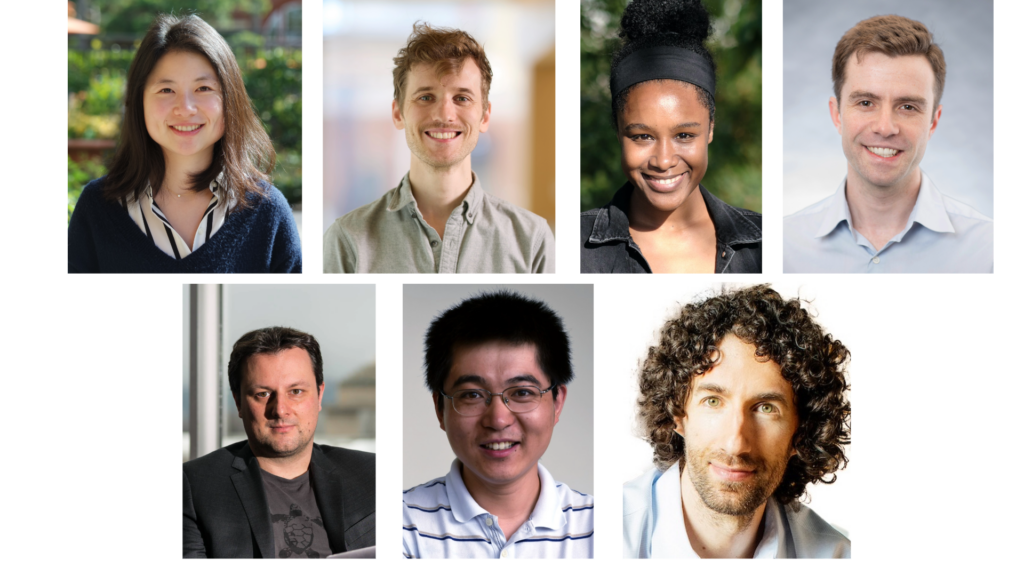 Top row, left to right: Sixian You, Vincent Sitzmann, Ashia Wilson, Sam Hopkins
Bottom row, left to right: Tim Kraska, Luqiao Liu, Guy Bresler. All photos courtesy of the subjects.
Top row, left to right: Sixian You, Vincent Sitzmann, Ashia Wilson, Sam Hopkins
Bottom row, left to right: Tim Kraska, Luqiao Liu, Guy Bresler. All photos courtesy of the subjects.
The Department is proud to announce the following promotions:
To Associate Professor Without Tenure (AWOT)
Sam Hopkins has been promoted to Associate Professor Without Tenure, effective July 1, 2026.
Sam is affiliated with CSAIL, where he works in the Theory of Computation group. His research focuses on algorithms for high-dimensional statistics, with an aim towards developing algorithms with provable guarantees regarding their efficiency, robustness, and privacy. Specifically, he has worked on developing new conceptual approaches to algorithms which recover meaningful information from adversarially corrupted data and found formal connections between robustness and differential privacy, developing in the process an algorithmic toolkit based on Sum of Squares optimization. His most recent works focus on algorithm design for data attribution in machine learning and nonlinear embeddings of high-dimensional data.
Sam completed his Ph.D. at Cornell University, after which he completed a three-year postdoc at UC Berkeley and the Simons Institute before starting as an Assistant Professor at MIT in January 2022. Within the department, Sam has served repeatedly as the lecturer for the “Intro to Algorithms” course, which typically sees over 300 registered students. His teaching was acknowledged with the 2024 MIT EECS Outstanding Educator Award.
Vincent Sitzmann has been promoted to Associate Professor Without Tenure, effective July 1, 2026.
Vincent leads the Scene Representation Group at CSAIL, where he develops algorithms that enable machines to learn from observation and act intelligently within the physical world. Operating at the interface of computer vision and robot learning, his research focuses on discovering scalable, data-driven objectives that train neural networks to construct robust internal models of reality. These models allow artificial agents to simulate the dynamics of their environment and predict the potential impact of their actions before they occur. A central question driving his work is how the latent knowledge embedded in vast amounts of unstructured data can be harnessed to endow robots with the myriad capabilities and intuitive skills that humans naturally acquire, without collecting extensive real-world robot data.
Vincent earned his BSc from the Technical University of Munich in 2015, his MSc from Stanford in 2017, and his PhD from Stanford in 2020, before joining CSAIL as a postdoc. He joined the Department of EECS as an assistant professor in July of 2022. Along with multiple scholarships and fellowships, Vincent has been recognized with the NeurIPS Honorable Mention: Outstanding New Directions in 2019, the Amazon Research Award, and the CVPR Best Paper Runner-Up. Within the Department, he has designed a graduate level computer vision class, 6.8300, Advances in Computer Vision, and a graduate seminar, Machine Learning for Inverse Graphics, and his teaching has been recognized with the Jr. Bose Award.
Ashia Wilson has been promoted to Associate Professor Without Tenure, effective July 1, 2026.
Her research centers upon optimization, algorithmic decision making, dynamical systems, and fairness within large scale machine learning. Some of the recent problems she has addressed include “data unlearning” (the removal from a learned model of data associated with a subset of users), and work on formal structures to measure and increase fairness in the outcomes of algorithms used to allocate concrete social resources, e.g. specialized medical treatment.
Ashia received her BA in Applied Mathematics from Harvard, and her PhD in Statistics from the University of California, Berkeley before joining Microsoft as a postdoc. She joined the Laboratory for Information and Decision Systems (LIDS) as a visiting scholar in December of 2020, and the Department of EECS as an assistant professor in January of 2021. Among other honors, Ashia has received the NeurIPS ’17 Spotlight Paper Award; the 2023 MIT Prize for Open Data; and the 2024 best paper award at the ACM Conference on Fairness, Accountability, and Transparency. Within the Department, Ashia co-designed 6.3950 “AI, Decision-making, and Society” with fellow instructors Aleksander Mądry and Manish Raghavan, and has taught 6.390 “Introduction to Machine Learning” and 6.S964 “Topics in Data Science for Society”. In recognition of her teaching contributions, she received the Louis D. Smullin Teaching Award from MIT EECS in 2024 and the Jr. Bose Award in 2026.
Sixian You has been promoted to Associate Professor Without Tenure, effective July 1, 2026.
Sixian is affiliated with the MIT Research Laboratory of Electronics (RLE), where her research focuses on biophotonics and microscopy, with an emphasis on developing optical hardware and machine learning algorithms to overcome longstanding imaging limitations (depth, resolution, contrast, and speed) for biomedical translation. Specifically, she has developed new methods to allow noninvasive imaging of living intact biological systems at high spatiotemporal resolution deep within intact tissue, without exogenous labels and without perturbing biological function. Sixian’s methods have applications ranging from point-of-procedure surgical imaging, to in vivo cancer imaging, to in vitro organoid monitoring.
Sixian earned her BS from HUST and her PhD from UIUC, and completed a postdoc at UC Berkeley before joining MIT EECS in 2021. She has been the recipient of the NSF CAREER Award, SCIALOG (Advancing Bioimaging) Award, Amazon Research Award, Microscopy Innovation Award, McGinnis Medical Innovation Graduate Inaugural Fellowship, Computational Science and Engineering Fellowship (UIUC), and Nikon Photomicrography Competition Image of Distinction award. Her work has been featured on the Cancer Research Cover, PNAS Cover, and Nature Communications Editors’ Highlight. Within the Department, Sixian has developed and taught a Common Ground course on computational imaging, and taught the department’s primary undergraduate signal-processing course.
To Full Professor
Guy Bresler has been promoted to Full Professor, effective July 1, 2026.
He is a core member of IDSS, a principal investigator in LIDS, and a member of both the Statistics and Data Science Center within IDSS and the Theory of Computation Group. His research lies at the interface of statistics and computation. He seeks to understand how structural properties of statistical and machine learning problems can be leveraged to design computationally efficient algorithms, and conversely, to develop tools for reasoning about computational hardness and how it depends on the amount and quality of available data.
Guy received his BS in Electrical and Computer Engineering and his MS in Mathematics from the University of Illinois, Urbana-Champaign, and his PhD in EECS from the University of California, Berkeley. Before joining MIT EECS in 2015, he was a postdoc in LIDS at MIT. He received an NSF CAREER Award in 2020, and his work has been recognized with several paper awards at COLT (Conference on Learning Theory) and ALT (Algorithmic Learning Theory). Within the department, Guy has led AI+D graduate admissions; regularly serves on the AI+D faculty search committee as well as joint searches; and serves on the fellowship committee. He co-developed 6.7720 Discrete Probability and Stochastic Processes and has revised and updated several courses, including 6.3700 Probabilistic Systems Analysis and Applied Probability, 6.7900 Machine Learning, and 6.7810 Algorithms for Inference.
Tim Kraska has been promoted to Full Professor, effective July 1, 2026.
He is affiliated with CSAIL, serves as Faculty Co-Director of the MIT Generative AI Impact Consortium (MGAIC), and co-leads the Data Systems Group. Tim’s research focuses broadly on the intersection of machine learning/AI and systems. He pioneered the idea of learned indexes, which significantly contributed to the creation of the research area on algorithms with predictions (ML-enhanced algorithms). He was also among the first to propose instance-optimized systems, an idea that has had substantial industry impact, including on Amazon Web Services’ data warehouse systems. Along with his students, Tim co-founded Instancio and Einblick Analytics, both of which were acquired. Following Instancio’s acquisition, he worked at Amazon Web Services, where he helped transition many innovations into production systems.
Tim earned his B.S. in 2004 and his M.S. in 2007 from Westfälische Wilhelms-Universität Münster, an M.S. from the University of Sydney in 2006, and his Ph.D. from ETH Zurich in 2010. He held a postdoctoral appointment at UC Berkeley from 2010 to 2012 before joining Brown University as an Assistant Professor in 2013. Prior to joining MIT in January 2018 as an Associate Professor without tenure, Tim worked at Google Brain. He was promoted to Associate Professor with tenure in 2022. Tim’s honors include the ICDE Best Paper Award, the VLDB Best Paper Award, the SIGMOD Best Paper Award, the AFOSR Young Investigator Award, the NSF CAREER Award, a Google Research Award, the VMware Early Career Faculty Grant, a Sloan Research Fellowship, the Intel Outstanding Researcher Award, and the VLDB Early Career Award. Within the department, he led the development of 6.S080 (Software Systems for Data Science) and has been a regular instructor for 6.033, now 6.1800 (Computer System Engineering).
Luqiao Liu has been promoted to Full Professor, effective July 1, 2026.
Luqiao is affiliated with RLE, where his research is in the field of spin electronics. In particular, he investigates nanoscale materials and devices for spin logic, non-volatile memory, and microwave applications. Within the realm of storage, Luqiao improved the performance of spintronic-based magnetic switches by leveraging novel materials, called tunable ferrimagnets, that allowed him to bypass speed limitations of traditional materials systems. Within logic, Luqiao made the first direct visualization that magnetic domain walls can be used to manipulate magnons, enabling easier all-magnon processing and creating a magnet system much smaller than prior approaches. Recently, he has focused on antiferromagnetic materials with complex internal spin structures, investigating their potential for memory devices and information processing.
Luqiao earned his BS from Peking University, and his PhD from Cornell University. He joined MIT EECS as an Assistant Professor in September 2015 and was promoted to Associate Professor without tenure in July 2019, and to Associate Professor with tenure in 2022. His honors include the McMillan Award, an NSF CAREER Award, an AFOSR Young Investigator Award, an IUPAP Young Scientist Award, and a Sloan Research Fellowship. Within the department, Luqiao has served on the electrical engineering curriculum committee, and has taught 6.200 Circuits and Electronics, 6.300 Signals and Systems, 6.250 Microelectronic Devices and Circuits, 6.221 Electrodynamics, 6.651 Physics for Solid State Applications, 6.310 Dynamical Systems with Feedback Control.
Media Inquiries
Journalists seeking information about EECS, or interviews with EECS faculty members, should email eecs-communications@mit.edu.
Please note: The EECS Communications Office only handles media inquiries related to MIT’s Department of Electrical Engineering & Computer Science. Please visit other school, department, laboratory, or center websites to locate their dedicated media-relations teams.